




H2 Magallanes, the US$16 billion green hydrogen and ammonia project that a TotalEnergies company had filed for environmental review in Chile’s far south, is gone. TEC H2 MAG SpA asked Chile’s Environmental Assessment Service (SEA) on 12 November 2026 to end the review, and the agency declared the procedure terminated. The reasons given by the company are blunt: no long-term purchase contracts, demand for green molecules below expectations, and equipment costs that did not fall as projected.
The withdrawal should surprise nobody who checked the numbers the project published. The filed design paired 5,000 MW of wind with an output that the state investment agency InvestChile put at more than 800,000 tonnes of hydrogen a year. Those two figures do not fit together, and no buyer signs a long-term contract for molecules that the wind fleet cannot produce.
What H2 Magallanes was supposed to be
The project entered Chile’s environmental assessment system on 5 May 2025. It was planned for the commune of San Gregorio in the Magallanes and Chilean Antarctica Region: more than 600 wind turbines, an ammonia plant, a desalination plant, a port terminal and five data centres, spread over about 72,000 hectares next to Pali Aike National Park and the Bahía Lomas Ramsar wetland.
InvestChile described H2 Magallanes as the largest green hydrogen and ammonia initiative ever submitted in Chile, with ammonia capacity of about 4.4 million tonnes a year. It was also the largest investment ever filed in Chile’s environmental system.
The file drew close to 1,900 citizen observations, covering baseline studies, species and ecosystems, cumulative impacts and the effect on local services. Before the withdrawal, the company had already asked to suspend the review instead of filing the addendum that would have answered those observations.
The arithmetic H2 Magallanes never solved
A complete electrolysis plant needs roughly 52 kWh of electricity per kilogram of hydrogen. At that rate, 800,000 tonnes a year requires about 41.6 TWh of power.
Five gigawatts of wind can deliver 43.8 TWh only if every turbine runs at full output for all 8,760 hours of the year. At a 50% capacity factor, which is strong even for Patagonian wind, the same fleet produces about 21.9 TWh. That is enough for roughly 420,000 tonnes of hydrogen, about half the published figure.
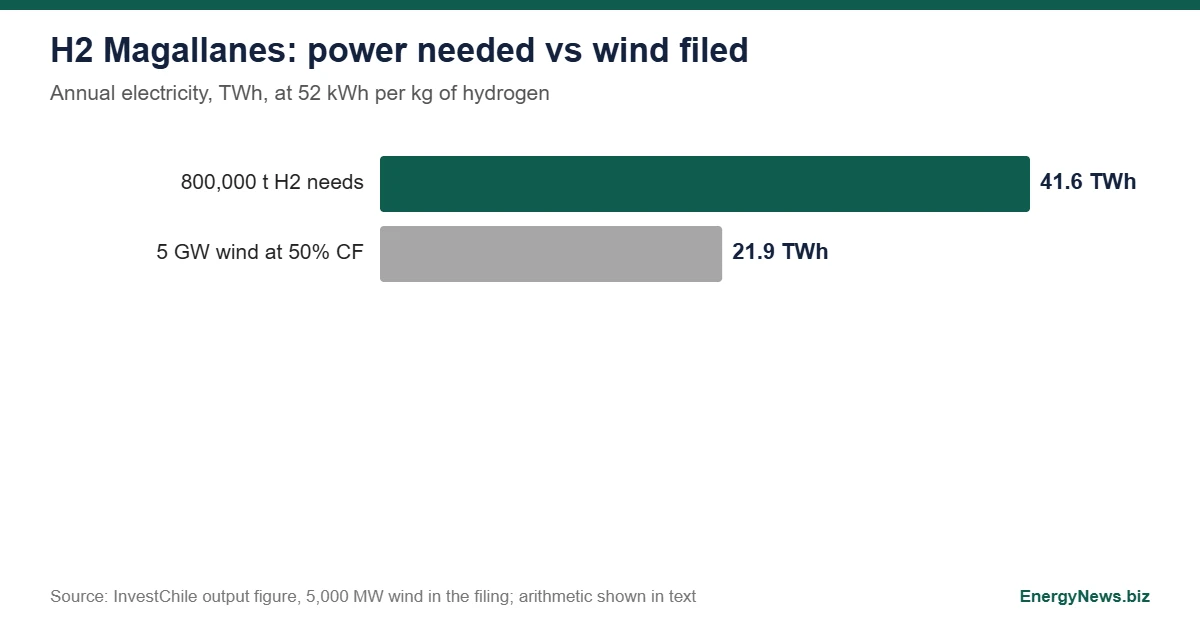
The published output therefore implies either about twice the wind capacity in the filing, or a capacity factor that no wind farm achieves. The original concept presented by Total Eren listed up to 10 GW of wind and up to 8 GW of electrolysis. The 2025 filing halved the wind, but the headline output stayed.
The H2 Magallanes ammonia figure confirms which number was carried forward. Ammonia is about 17.6% hydrogen by mass, so 4.4 million tonnes of ammonia contains roughly 780,000 tonnes of hydrogen. The ammonia line was built on the full hydrogen number, not on the wind actually filed.
Why no buyer signed for H2 Magallanes
The company’s own explanation for dropping H2 Magallanes points to the market, not to the permit. Green hydrogen in Chile costs around US$4.50 per kilogram to produce, against a national strategy goal of less than US$1.50 per kilogram by 2030. At 800,000 tonnes a year, each dollar per kilogram of that gap is US$800 million of revenue a year that a buyer, or a subsidy, has to cover.
The withdrawal follows a pattern. AES cancelled its INNA hydrogen and ammonia project in Antofagasta in January 2026, a plan for about 200,000 tonnes of hydrogen a year. In Magallanes, the regional producers’ association H2V Magallanes suspended its activities after leading members left. The same retreat is visible elsewhere, as with HyTerra’s exit in Nebraska, while large export plans such as Sahamco’s US$25 billion project in Morocco still face the same offtake test.
What is left in Magallanes
TotalEnergies says it keeps other investments in Chile. Several developers, including Consorcio Austral, Acciona with Nordex Green Hydrogen, and TEG Chile, said earlier this year that they would continue their own projects in the region. The record of the review, including the termination, is held by the Servicio de Evaluación Ambiental.
For any successor to H2 Magallanes, the test is now explicit. Either a buyer accepts delivered ammonia priced on hydrogen produced at around US$4.50 per kilogram, or the wind fleet is sized for the output it promises. Neither condition existed on 12 November 2026.
Add EnergyNews.biz as a preferred source on Google


