




PG&E vehicle-to-grid took a step wider this month. Pacific Gas and Electric Company has expanded its California vehicle-to-everything program to include electric vehicles from Kia, Volvo, Polestar and Nissan, alongside the models already enrolled. Compatible vehicles can act as home backup during outages and as grid resources that respond to system needs.
The idea behind PG&E vehicle-to-grid is to treat millions of parked car batteries as flexible capacity the utility does not have to build. An electric vehicle sits idle most of the day with a usable battery larger than a home storage system, and vehicle-to-everything hardware lets some of that energy flow back out when the grid or the household needs it.
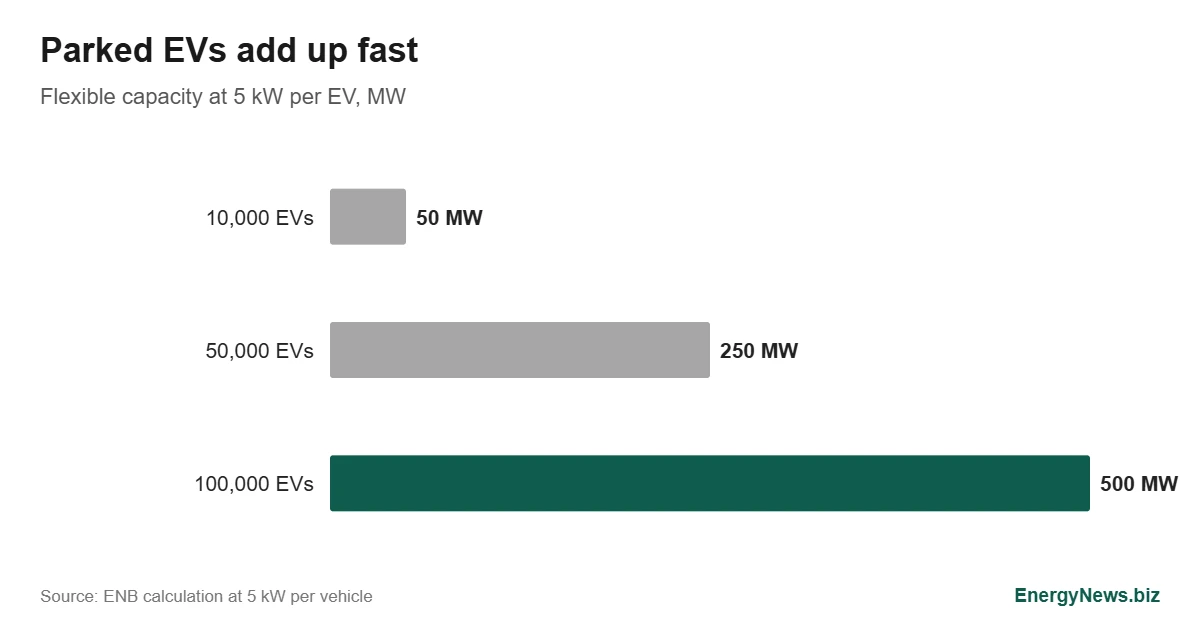
An ENB calculation of PG&E vehicle-to-grid capacity
The scale depends on enrolment. An ENB calculation shows the shape of it: if each participating vehicle can export about 5 kW, then 10,000 enrolled cars offer about 50 MW, 50,000 offer about 250 MW, and 100,000 offer about 500 MW. That is capacity measured in power, available in the evening peak without a single new power plant, limited mainly by how many owners sign up and by charger ratings.
Energy, not just power, is the other half. A typical EV battery holds 60 to 80 kWh, far more than a home battery. Even a small export per car, repeated across a fleet, shifts real energy from midday charging into the evening, which is exactly when California’s grid is tightest.
Why utilities want vehicle-to-grid
California adds solar faster than it adds evening capacity, the same mismatch driving storage retrofits such as the Sonnedix Oita battery in Japan. Vehicle-to-grid attacks that mismatch with assets ratepayers have already bought. Instead of building peaker capacity, the utility borrows it from cars and pays owners for the service.
Adding four more brands matters because interoperability has been the block. Bidirectional charging needs the vehicle, the charger and the utility program to agree on standards. Each brand that joins widens the pool of eligible cars, and the pool is what turns a pilot into real capacity. The same logic is pulling fleets toward managed charging, as hubs like EV Realty’s Torrance site show.
The number to track
How enrolment works decides the scale. A driver needs a compatible vehicle, a bidirectional charger and a utility program that pays for the service, and all three have to line up. That is why each brand added matters: it widens the pool of cars that can take part without new hardware on the utility side. The programs typically pay owners for the energy or capacity they provide, and let drivers set limits so the car keeps enough charge for the next trip.
The equity and wear questions are real. Owners worry about battery degradation from extra cycling, though modern packs and smart limits keep the effect small, and the benefit flows first to households that can afford a new EV and a bidirectional charger. For the grid, the attraction is avoided cost: capacity borrowed from parked cars is cheaper than a peaker plant that runs a few hours a year, which is why utilities across sunny, EV-heavy states are racing to widen these programs.
For now, vehicle-to-grid is a program measured by sign-ups rather than installed capacity. The vehicle-to-grid pool only becomes a planning resource once enrolment reaches a scale utilities can count on in a forecast, which is the threshold these expanded programs are built to cross.
The figure that decides whether vehicle-to-grid is real is enrolment, not eligibility. Millions of EVs could in theory feed the grid; the question is how many owners sign up and leave their cars plugged in during peak hours. If PG&E’s enrolled fleet climbs into the tens of thousands, the program crosses from demonstration into a capacity resource worth planning around. Program details are published by PG&E.
Add EnergyNews.biz as a preferred source on Google


