


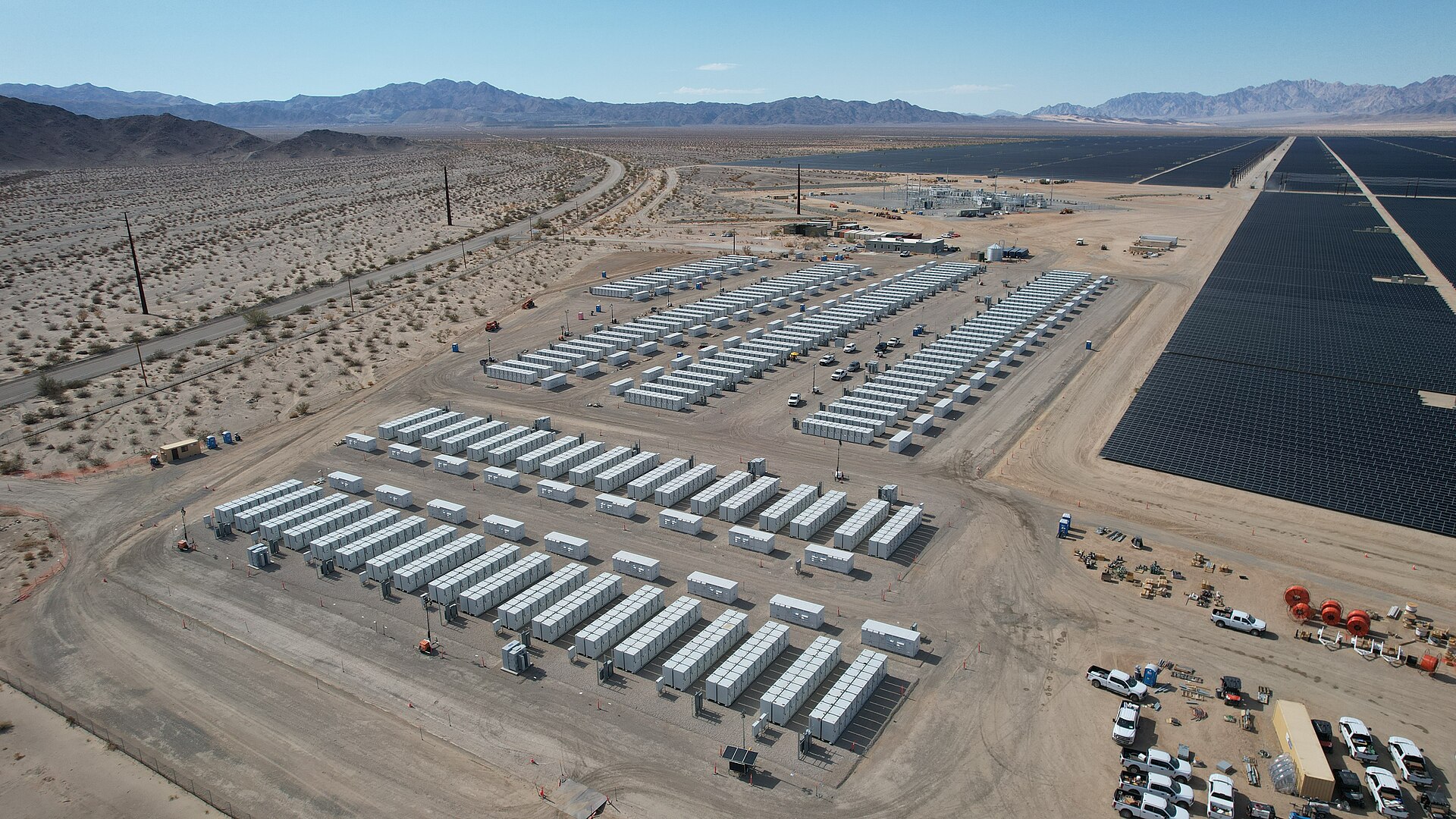


China grid-forming hybrid storage has a new flagship. A 300 MW, 1,200 MWh facility in Inner Mongolia has come online pairing lithium-ion and vanadium flow batteries in what its developers call the world’s largest grid-forming hybrid storage plant. The combination is unusual, and the reason is that the two chemistries do different jobs.
Most large batteries are grid-following: they inject or absorb power in response to a grid that other machines hold steady. A grid-forming plant does the holding itself, setting voltage and frequency the way a conventional generator does. As grids add more inverter-based wind, solar and storage and retire spinning plants, grid-forming capability becomes the scarce service, and China is building it at scale.
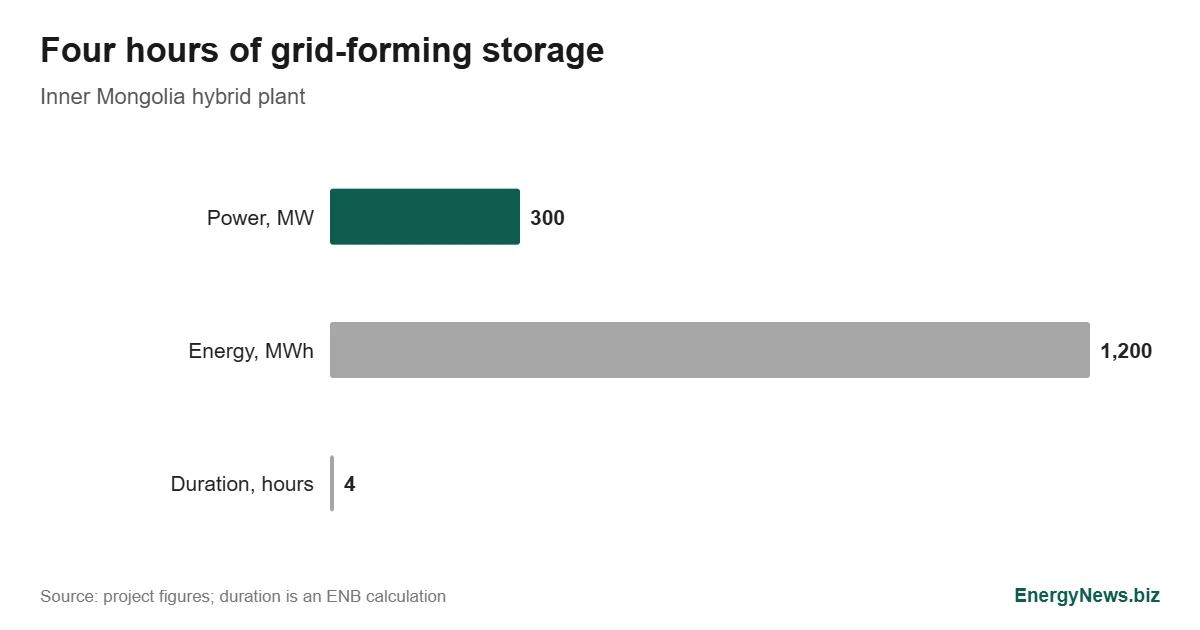
An ENB calculation of the China grid-forming hybrid storage plant
The headline figures give the duration directly. An ENB calculation on 1,200 MWh of energy and 300 MW of power gives a discharge duration of four hours at full output. That is longer than the two-hour systems common in some markets, and it fits a grid that needs to shift large amounts of wind and solar across the evening in a region with heavy renewable build-out.
Why pair vanadium flow with lithium
The two chemistries cover each other’s weaknesses. Lithium-ion is fast and cheap per kilowatt, good for rapid response and grid-forming control. Vanadium flow is slower and more expensive up front, but it tolerates deep daily cycling for decades without the degradation lithium suffers, and its power and energy scale independently. Putting them together gives fast response from lithium and long, durable cycling from flow in one plant.
The grid-forming role is the point that travels. Western grids face the same loss of spinning inertia as coal and gas retire, and are only starting to require grid-forming behaviour from new storage. China is deploying it at gigawatt-hour scale now, which gives it operating data that markets such as Europe and the United States still lack. The build-out sits alongside China’s lead in other clean technologies, from electric heavy trucks to battery manufacturing.
The metric to watch
Grid-forming is the technical heart of the project. A grid-following inverter needs an existing voltage and frequency to lock onto; a grid-forming one creates that reference itself, acting like the spinning mass of a conventional generator. As coal and gas plants retire, grids lose the physical inertia those machines provided, and frequency becomes harder to hold. Grid-forming storage replaces that service electronically, which is why it is the capability high-renewable grids now need most.
China is building this capability years ahead of most Western markets. European and United States grids face the same loss of inertia, but their rules are only starting to require grid-forming behaviour from new storage, and large hybrid plants of this kind are rare outside China. Operating a 300 MW grid-forming hybrid at gigawatt-hour scale gives Chinese operators real performance data that regulators elsewhere still lack, which matters as every grid adds inverter-based generation and sheds synchronous plants.
The China grid-forming hybrid also signals where cell demand is heading. Pairing vanadium flow with lithium in a single China grid-forming hybrid plant spreads orders across two supply chains at once, and at gigawatt-hour scale that is a meaningful pull on both the flow-battery and lithium industries.
The number that matters beyond capacity is how the plant performs as a grid-forming resource: whether the hybrid holds frequency and voltage through disturbances as reliably as the synchronous machines it is meant to replace. If it does, grid-forming hybrids become a template for high-renewable grids everywhere. National deployment data is published by China’s National Development and Reform Commission.
Add EnergyNews.biz as a preferred source on Google


