




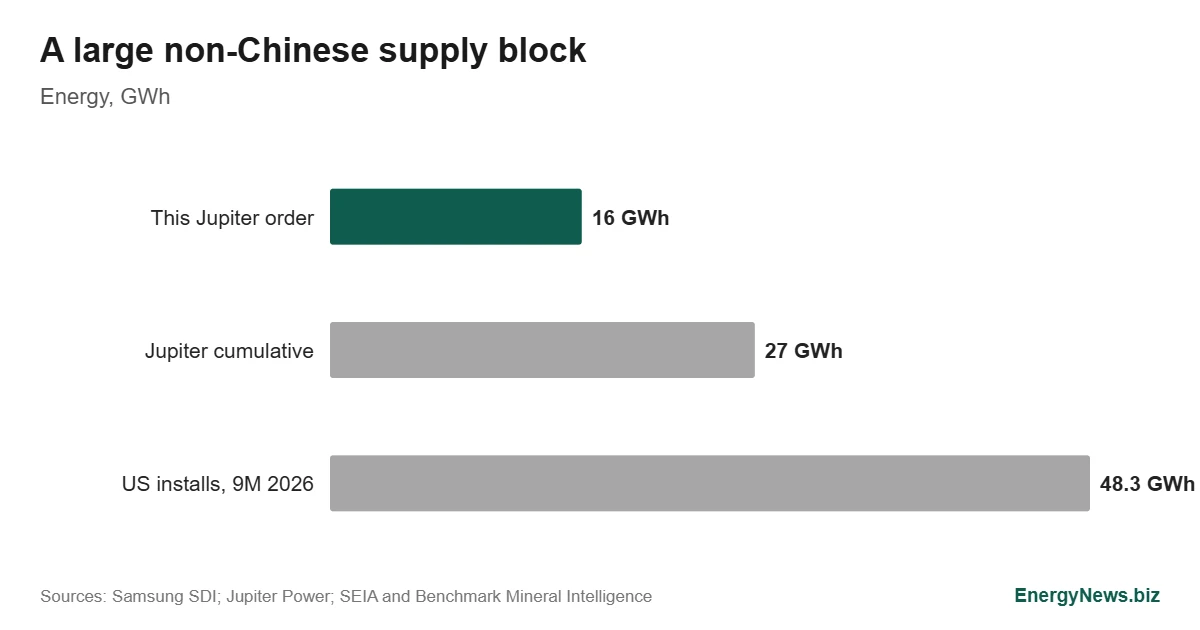
Samsung SDI has signed one of the largest orders yet for American-made grid storage cells. The South Korean manufacturer said on 16 November that its US subsidiary will supply 16 GWh of lithium iron phosphate batteries to Jupiter Power, a Texas-based developer and operator of utility-scale storage backed by BlackRock. Deliveries run over three years from 2029, and the cells will be made in Indiana.
The deal is worth watching less for its size than for where the cells come from. Samsung SDI is the only non-Chinese maker of prismatic grid-storage batteries in North America, producing at a former electric-vehicle plant it runs as a joint venture with Stellantis. In a US market reshaped by sourcing rules, that origin is the product.
What the Samsung SDI 16 GWh order costs
The companies did not disclose the price, but Korean industry estimates put it at about 3 trillion won, or roughly $2.2 billion. On those figures, the cells and systems in scope work out to about $137 per kWh of delivered energy. That is above the roughly $90 to $115 per kWh at which Chinese LFP packs have been offered into export markets this year, which is the premium US buyers are paying for domestic, non-Chinese supply.
Including an earlier contract, Samsung SDI’s cumulative orders from Jupiter Power now reach about 27 GWh. For a single customer pairing, that is a large commitment, and it extends the manufacturer’s order book past 2029.
Why US-made cells command a premium
The 2026 market runs on two rule changes. The One Big Beautiful Bill Act reshaped clean-power tax credits, and Foreign Entity of Concern rules restrict which suppliers a project can use and still claim those credits. Many Chinese suppliers have restructured ownership to stay below the thresholds, while others have been designed out. A domestic, non-Chinese cell that clearly qualifies is worth paying more for, because it protects the tax credit on the whole project.
Scale is the test. The 16 GWh order equals about a third of the 48.3 GWh the United States installed in the first nine months of 2026. A single supplier booking that volume of domestic LFP shows the reshoring of storage cells is moving from announcement to contract, alongside large project orders such as the 1,800 MWh Khavda battery abroad and new US sites like the Energizar project near Boston.
The ratio to follow
The Indiana plant is the reason the deal is possible. Samsung SDI runs the site as StarPlus Energy, a joint venture with Stellantis that was built for electric-vehicle cells and has converted lines to make prismatic lithium iron phosphate cells for stationary storage. That conversion is the quiet story of 2026: idle or underused EV capacity in the United States is being repurposed for grid batteries, which is faster and cheaper than building new plants and sidesteps the sourcing rules that now govern tax credits.
For buyers the calculation is about certainty, not just price. A project that uses cells clearly outside the Foreign Entity of Concern definitions keeps its tax credit beyond doubt, which lowers financing cost and protects the return. Paying a premium of a few tens of dollars per kilowatt-hour for that certainty can be cheaper than the risk of a disallowed credit on a multi-hundred-megawatt-hour project. That is the trade the Jupiter Power order prices.
The number that matters now is the price gap between US-made and imported cells. At about $137 per kWh against roughly $100 for imports, the premium is real but not prohibitive, and it buys tax-credit certainty. If domestic cell output scales and that gap narrows through 2027, reshored storage becomes the default rather than the hedge. Samsung SDI’s production updates are published by Samsung SDI.
Add EnergyNews.biz as a preferred source on Google


