




Data centres are on course to roughly double their electricity use to about 1,000 TWh by 2030, according to the International Energy Agency’s World Energy Outlook 2026. About three quarters of that growth is driven by artificial intelligence. The agency also tracks the money: data centres attracted about $565 billion of investment in 2025, and cumulative spending is heading for about $4 trillion by the end of the decade.
Those headline figures are large enough to be abstract. Converting them into grid terms shows why system operators, regulators and utilities are treating the build-out as a reliability question, not just an industrial opportunity.
What 1,000 TWh means for data centres and grids
A year has 8,760 hours. Dividing 1,000 TWh by that figure gives an average continuous load of about 114 GW. Data centres run around the clock at high utilisation, so the comparison is fair: by 2030 the sector would draw, on average, the output of more than a hundred large power plants running every hour of the year.
The concentration is the harder part. The IEA notes that fewer than 100 AI projects would together need about 50 GW, roughly the peak electricity demand of Great Britain. Those projects do not spread evenly across a grid. They cluster in a handful of regions where land, fibre and power are available, which is why connection queues in places such as the PJM market have become a national issue, prompting reforms like fast-track grid energization.
The investment curve behind data centres
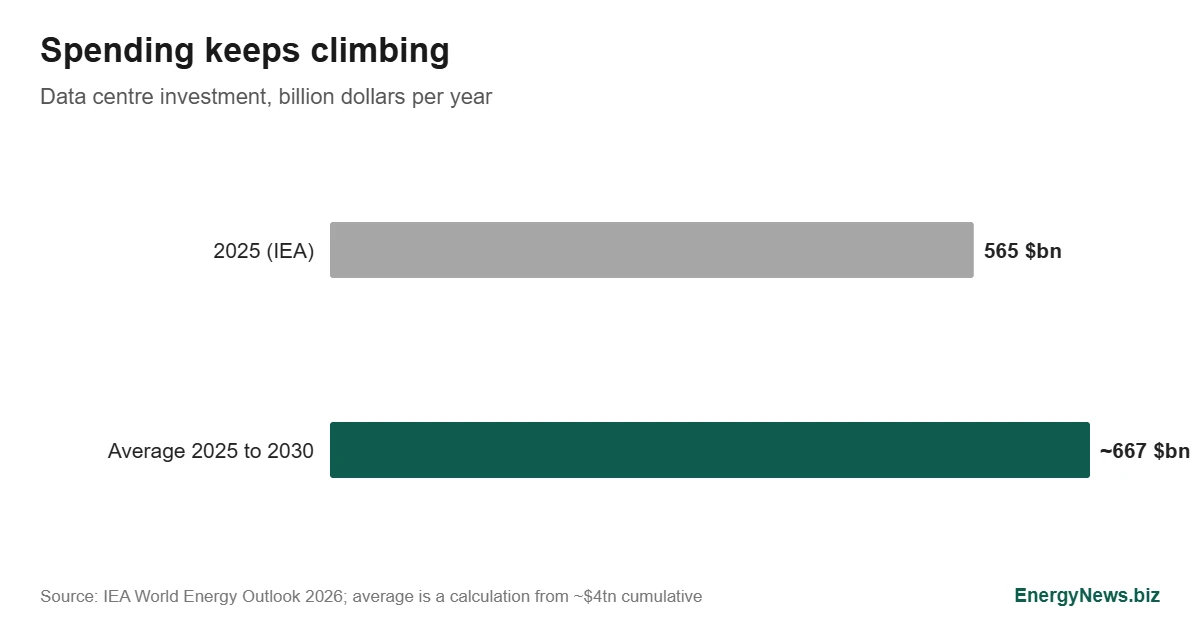
The investment numbers point the same way. If the roughly $4 trillion of cumulative spending is spread over the six years from 2025 to 2030, the average comes to about $667 billion a year. That is around 18% above the $565 billion recorded in 2025, which itself was a sharp rise on earlier years. On this reading, spending keeps climbing rather than levelling off.
The agency has also begun to measure the build-out directly. Satellite monitoring of 93 AI data centres shows their capacity increasing about tenfold in two years. That pace is why utilities report requests for connections that would, if all were built, exceed their entire existing peak load. Many of those requests are speculative duplicates, but the ones that proceed are arriving faster than new transmission can be planned.
Emissions and the power mix
The IEA expects emissions linked to data centres to rise by about 70% by 2030, even as more of their power comes from renewables. The reason is timing. New gas plants and existing coal fleets can be contracted quickly, while new wind, solar and nuclear capacity, along with the lines that carry it, take longer. Operators are bridging the gap with on-site generation and large batteries, as at the 600 MWh battery built to firm a Meta site in Utah.
That bridge matters for the long run. A data centre that starts on gas turbines may keep them for years if grid capacity does not arrive. One that starts on storage and contracted clean power locks in the opposite pattern. The choices made in the next two to three years will shape the emissions profile of data centres well into the 2030s.
The figure to follow
The single number that best captures the pressure is the gap between contracted data centre load and new firm capacity connected in the same regions. If that gap keeps widening, more sites will turn to on-site fossil generation, and prices for other customers will rise. If grids and storage keep up, data centres can become anchor customers that help finance new clean supply. The IEA scenarios, published in the World Energy Outlook 2026, show both outcomes are still possible.
Add EnergyNews.biz as a preferred source on Google


