


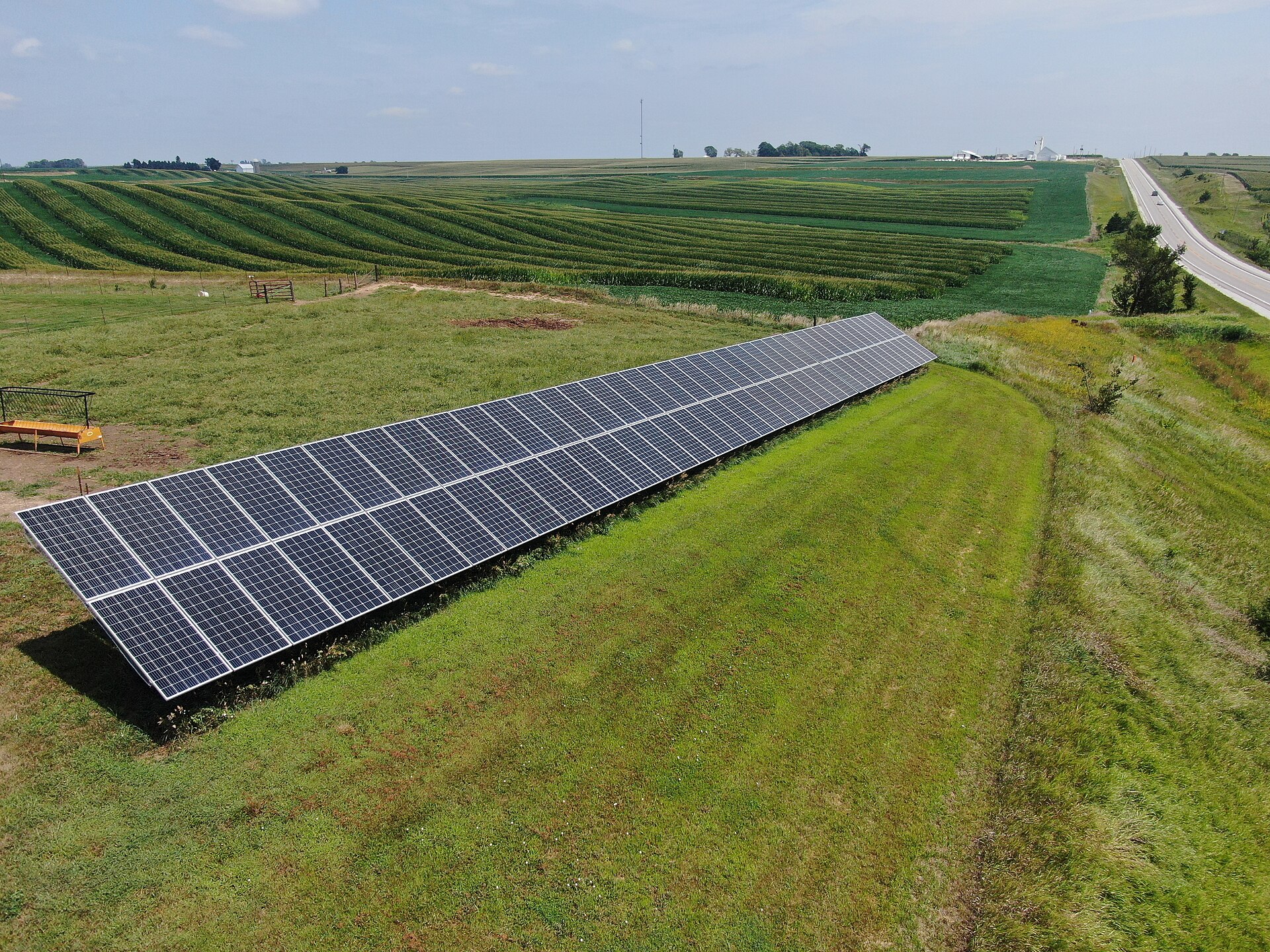


Solar power will become the largest source of electricity in the world by the mid 2030s, and it does so in every scenario the International Energy Agency modelled for its World Energy Outlook 2026, released on 19 November. That is a striking position for a technology that produced less than 10% of global electricity in 2025.
The finding is not a forecast of an energy transition that might happen if governments act. It holds in the Stated Policies Scenario, which reflects only what is already in law and regulation, as well as in the faster pathways. The question is no longer whether solar power takes the lead, but how quickly the rest of the system adapts to it.
How solar power gets to first place
The IEA puts renewables at about a third of global generation today and close to half by 2035 in the Stated Policies Scenario. Renewable capacity grows to about 2.4 times today’s level by 2035 in that case, and to about 3.6 times in the Net Zero Emissions pathway. Solar power is the largest single contributor to that growth, because it is the cheapest and fastest generation to build almost everywhere.
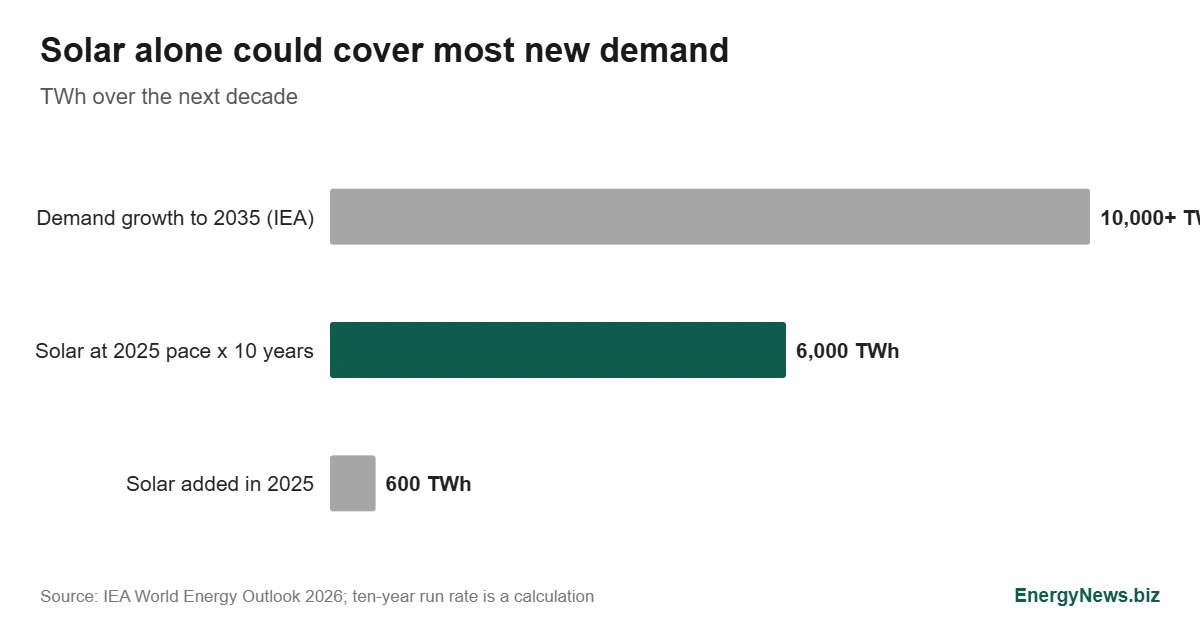
The underlying driver is demand. Global electricity use has grown by about 3.3% a year since 2019, and the agency expects it to rise by more than 10,000 TWh over the next decade, as cooling, data centres, electric vehicles and industry all pull on the grid. New supply has to come from somewhere, and most of it is coming from panels.
A calculation: the 2025 pace, held for ten years
Solar generation rose by about 600 TWh in 2025 alone, according to the IEA. A simple run-rate test shows what that means. If the world added 600 TWh of solar generation every year for the next ten years, without any further acceleration, the total would reach about 6,000 TWh. That is roughly 60% of the more than 10,000 TWh of demand growth the agency projects over the same period.
The test is conservative in one direction and generous in another. It assumes no further growth in annual installations, even though the solar build has risen almost every year for two decades. It also ignores curtailment and the fact that solar output is concentrated in daylight hours, which limits how much of the new demand it can serve without storage. The result is a rough bracket, not a projection, but it shows that solar power can plausibly carry the majority of new demand on its current trajectory.
What solar power needs around it
A system where solar power is the largest source looks different from today’s. Daytime prices fall, sometimes below zero, while evening peaks become the expensive hours. That shift is already visible in markets with high solar shares, from schemes such as Australia’s free midday solar hours to the retrofits that add batteries to existing solar plants so output can be moved into the evening.
Three things decide how smoothly the transition goes. The first is storage, because each additional gigawatt of solar is worth less if it all produces at the same time. The second is grids, because the best solar resources are often far from the largest loads. The third is flexible demand, from electric vehicles that charge at midday to industrial processes that can follow the sun. The IEA highlights all three as constraints, not as optional extras.
The number to watch
The figure that will show whether the outlook is on track is the annual increase in solar generation. If it stays at or above 600 TWh a year, the path to first place by the mid 2030s holds even on cautious assumptions. If it drops, because of trade disputes, grid connection queues or falling prices that squeeze manufacturers, the date slips. Manufacturers are already pushing new products into adjacent markets, such as hybrid power systems for data centres, to hold margins as module prices stay low.
Either way, the direction set out in the outlook is clear: within a decade, solar power is expected to generate more electricity than coal, gas, hydropower or nuclear. The full scenario tables are published in the IEA World Energy Outlook 2026.
Add EnergyNews.biz as a preferred source on Google


