





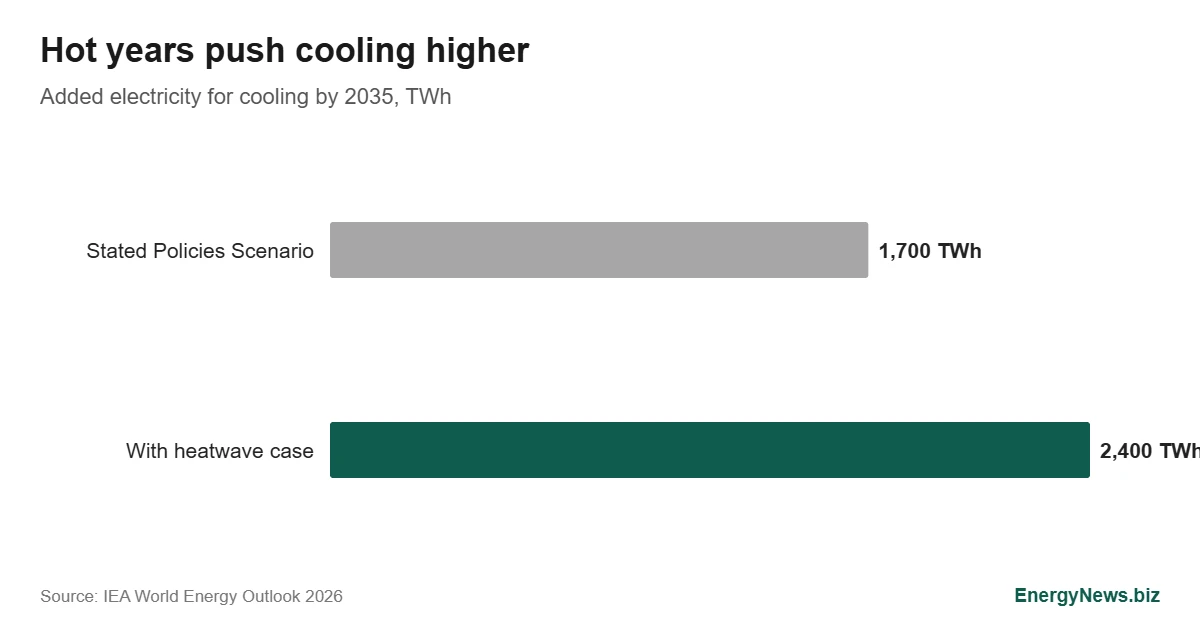
Cooling demand has overtaken heating as a driver of energy use for the first time, according to the International Energy Agency’s World Energy Outlook 2026. In the Stated Policies Scenario, the electricity used for air conditioning and other cooling rises by about 1,700 TWh by 2035. A case with more frequent and intense heatwaves adds another 700 TWh on top.
The shift is a product of geography and income. Most of the world’s population growth and economic growth is happening in hot countries in South and Southeast Asia, the Middle East and Africa. As household incomes rise there, air conditioners are among the first large appliances people buy.
How big cooling demand becomes
The IEA expects total electricity demand to rise by more than 10,000 TWh over the next decade. The 1,700 TWh increase in cooling demand is therefore about 17% of all new electricity use. In the heatwave case, the increase reaches 2,400 TWh, or about 24% of the base-case growth, nearly one in four new kilowatt-hours.
The timing of that load is what makes it difficult. Cooling peaks on the hottest afternoons and evenings, often when grids are already strained and when thermal plants lose efficiency because their own cooling water is warm. A heatwave can push peak demand far above the average, so the capacity needed to meet it is larger than the energy figure alone suggests.
Why cooling demand beats heating
Heating demand is flat or falling in many cold-climate countries, as buildings become better insulated and winters get milder. Heat pumps also deliver several units of heat for each unit of electricity, so even rapid electrification of heating adds less electricity demand than the raw heat figures imply. Cooling has the opposite profile: a growing number of users, rising temperatures and many low-efficiency units on the market.
Efficiency is the main lever. The most efficient air conditioners on sale use less than half the electricity of the typical models bought in many emerging markets. Minimum performance standards, labelling and better building design can therefore cut the growth in cooling demand substantially without reducing comfort. This was one of the themes of the sustainable cooling push at COP31, and it fits the wider goal of raising electricity to 35% of final energy, since cooling is already almost entirely electric.
Solar as a natural partner
There is a helpful match in the data. Cooling is highest when the sun is strongest, so solar generation and air conditioning load overlap through much of the day. Storage that shifts a few hours of solar output into the early evening covers much of the remaining gap. Ground-source systems, such as geothermal heat pumps, can provide both heating and cooling with high efficiency where the ground conditions allow.
The heatwave case is the warning. Planning grids for average years leaves them exposed in extreme ones, and the 700 TWh difference between the two scenarios shows how much is at stake. System operators in hot regions are already adding reserve margins and demand response programmes aimed specifically at cooling peaks. Smart thermostats that pre-cool buildings before the peak, and tariffs that reward it, can shave cooling demand at the moments that matter most.
The figure to track
The measure that will show whether cooling demand is being managed is the average efficiency of air conditioners sold each year in the fastest-growing markets. If it rises quickly, the 1,700 TWh can shrink. If cheap, inefficient units continue to dominate sales, the heatwave case becomes the more likely path. The full analysis is set out in the IEA World Energy Outlook 2026.
Add EnergyNews.biz as a preferred source on Google


