



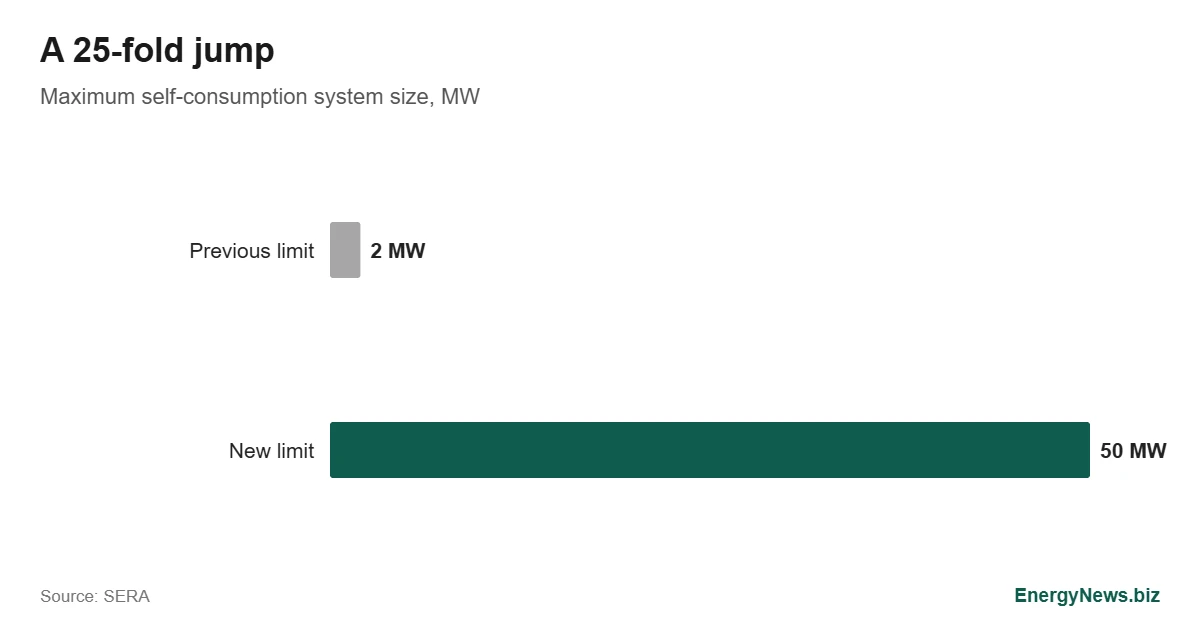
Saudi self-consumption rules have been widened sharply. The Saudi Electricity Regulatory Authority (SERA) has updated its regulation for renewable systems built to meet consumers’ own electricity needs, raising the maximum system size from 2 MW to 50 MW. The rules cover solar and other renewable installations on homes, commercial buildings and industrial sites.
The new ceiling is 25 times the old one. That brings large factories, logistics centres, malls and industrial estates into the framework, which until now applied mainly to homes and small businesses.
How the Saudi self-consumption bands work
Grid-connected systems are now split into four categories. Systems of 1 to 11 kW form the smallest band. Systems above 11 kW up to 50 kW need an accredited contractor and a feasibility study, with a connection fee of SAR 700 (about $187). Systems above 50 kW up to 2 MW need an accredited consultant or contractor and a network impact assessment, with a fee of SAR 2,300. Systems above 2 MW up to 50 MW need a study permit and a generation licence from SERA, with fees of SAR 16,500 for 2 to 4 MW and SAR 35,000 above 4 MW.
Service providers must handle connection requests in the order they arrive through an electronic platform, publish lists of qualified contractors and approved equipment, and disclose available network capacity. That transparency is meant to stop applications stalling without explanation.
Net billing for surplus power
The regulation sets out mandatory net billing. Surplus electricity exported to the grid is credited financially and carried forward to the next billing cycle, where it can be deducted from electricity charges. Credits can be used across several accounts belonging to the same consumer and remain valid for 12 months.
For industrial users, the combination of a 50 MW ceiling and net billing makes on-site solar a serious option for cutting daytime costs. Saudi Arabia has very high solar irradiation, and large flat roofs and open land around factories offer space for big systems. Pairing them with batteries can shift some output into evening hours, as utility-scale projects across the region are starting to do, such as the large battery deals now being signed by developers.
Who benefits from the Saudi self-consumption change
The biggest winners are energy-intensive sites with large daytime loads: cold storage, desalination, cement and steel finishing, data centres and shopping centres that run air conditioning through the hottest hours. Their demand curve matches solar output closely, so most of the power can be used on site and only surplus is credited under net billing.
Installers and engineering firms also gain a clear rulebook. Before the update, anyone wanting a system above 2 MW had to use other, slower routes. The licence requirement for the top band adds paperwork, but it gives larger projects a defined path and a published fee, which makes the Saudi self-consumption market easier to plan for. Clear fees and queue rules also help lenders, who can now model connection timelines for Saudi self-consumption projects with more confidence.
A rough calculation shows the scale. A 50 MW rooftop and ground system in Saudi conditions could produce in the order of 90 to 100 GWh a year, enough to cover a large share of the daytime demand of an industrial park.
What it means for the market
Saudi Arabia’s national targets focus on utility-scale projects, but distributed solar has lagged. Raising the Saudi self-consumption limit opens a new segment for installers, equipment suppliers and energy service companies that can finance systems for industrial clients. Similar rules elsewhere, such as Australia’s approach to shared solar hours, show how regulation can shape when and where solar is used.
The details of grid capacity disclosures and how quickly licences are issued for the largest systems will determine how fast the market grows. The regulation is published by the Saudi Electricity Regulatory Authority.
Add EnergyNews.biz as a preferred source on Google


