



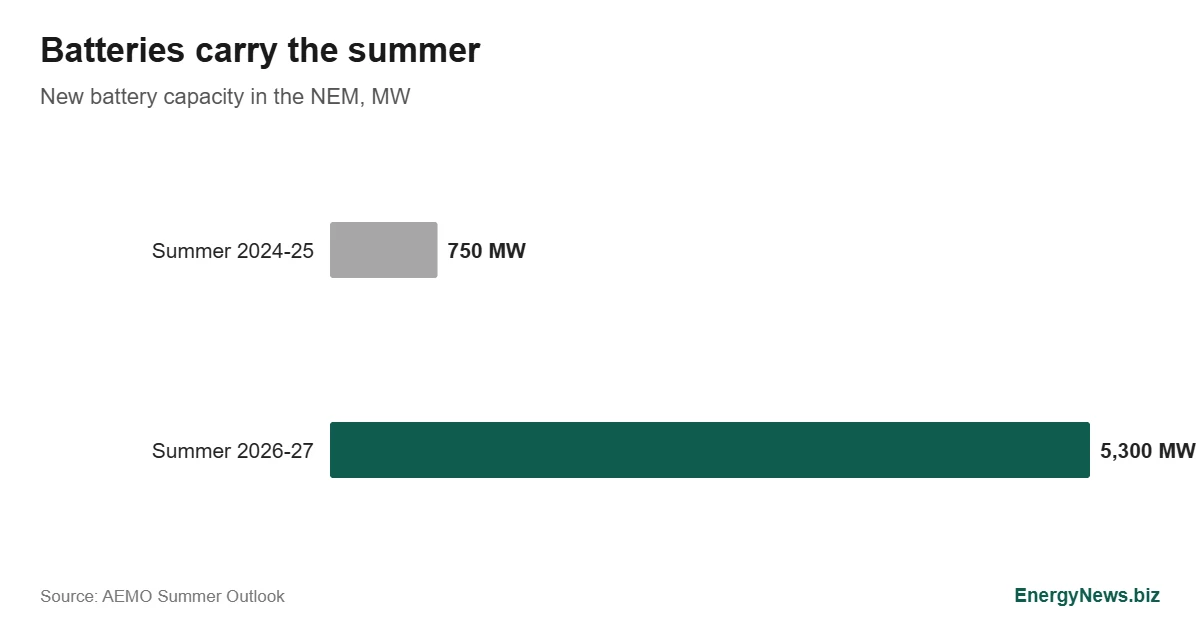
The AEMO summer outlook for 2026-27, published on 20 November, shows how quickly batteries have become the backbone of Australia’s grid. Of 8.4 GW of new projects added to the National Electricity Market since December 2025, 5.3 GW is battery storage. The Australian Energy Market Operator expects electricity and gas supplies to remain sufficient from November to March under forecast conditions, but warns that extreme heat can change that quickly.
The rest of the new capacity is 1.1 GW of solar, 0.7 GW of gas-fired generation, 0.5 GW of hybrid solar and battery plants and other generation, spread across more than 30 projects.
What the AEMO summer outlook numbers show
A calculation puts the shift in perspective. Batteries account for about 63% of the new capacity in this outlook. Two summers ago, AEMO counted 750 MW of newly commissioned storage, so the new battery fleet for this summer is roughly seven times larger. Including hybrid plants, storage-linked projects make up close to 70% of what is new.
The stored energy is growing even faster than the power rating. Energy held in NEM batteries reached a record 20.17 GWh on 6 November, up 203% in a year, according to analysis by energy transition adviser Geoff Eldridge. That is enough to supply the evening peak for longer each day, which is exactly when solar output fades and heat-driven demand stays high.
Where the risk still sits
AEMO’s reliability assessment, which models the chance of demand exceeding supply in the riskiest half hour of each day, found only a few high-risk days, in Victoria and South Australia in January 2027, at probabilities of 20% to 40%. The operator says risk peaks when extreme heat coincides with low wind and solar output, outages and depleted storage. El Niño conditions are forecast to persist into autumn 2027, and heatwaves could drive record maximum demand. Bushfire risk is elevated along major interconnectors.
That last point matters for batteries. A battery that discharges fully on a hot evening needs time and cheap energy to recharge before the next peak. Several hot days in a row test state of charge management, not just installed megawatts, which is why AEMO flags depleted storage as a risk factor. The same pattern drives the rising global cooling demand.
What the AEMO summer outlook means for other markets
AEMO also links the battery fleet to lower gas use: average gas-fired generation this summer is forecast to be similar to last summer and lower than earlier years. For grid planners in other high-solar markets, the Australian experience shows that batteries can be built fast enough to change a reliability outlook within two years, provided connection and market rules let them in. Free midday power offers, such as Australia’s Solar Sharer scheme, add to the same daily cycle of charging at noon and discharging at night.
The AEMO summer outlook also shows that batteries are now part of planning, not an add-on. Two years ago, operators treated new storage mainly as a source of frequency services. Today the outlook counts it as firm capacity for the evening peak, with the caveat that its energy is limited. That is a change other system operators are studying as they write their own summer and winter assessments.
For investors, the AEMO summer outlook confirms that revenue is moving towards evening energy shifting and reserve services, the hours when a battery is most valuable to the grid.
The figure to watch this summer is minimum battery state of charge on the hottest consecutive days in Victoria and South Australia. If it stays above zero through a multi-day heatwave, the battery-led model will have passed its toughest test. The full report is published by AEMO.
Add EnergyNews.biz as a preferred source on Google


