





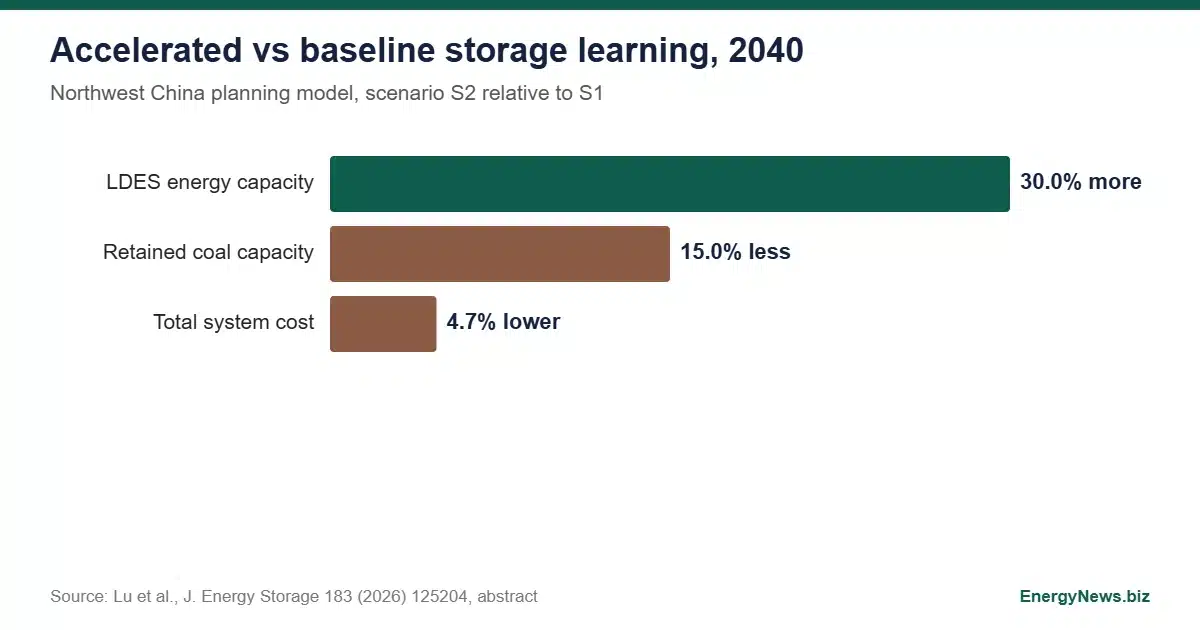
A planning study of Northwest China’s power system finds that faster cost learning in long-duration energy storage (LDES) changes both how much storage is built by 2040 and what kind. In the accelerated learning scenario (S2), LDES energy capacity is 30.0% higher, retained coal-fired capacity is 15.0% lower and total system cost is 4.7% lower than in the baseline learning scenario (S1). The results come from a paper in the Journal of Energy Storage (volume 183, article 125204, DOI 10.1016/j.est.2026.125204).
Only the abstract, highlights, introduction and section openings of the paper were available for this report. The learning rates behind S1 and S2, the absolute capacities and the cost totals are not in those parts, so they are not reported here.
What the long-duration energy storage model does
The authors, Gang Lu, Bo Yuan, Wenbo Wu and Zhaoyuan Wu, link the investment cost of storage to cumulative deployment. Storage built in one planning stage therefore changes the cost faced in the next. Most existing planning studies rely on static technology assumptions or externally prescribed cost declines, the introduction says, and under a prescribed path the cost is the same whether 1 GW or 100 GW is built. Deployment linked learning removes that independence.
Charging power, discharging power and energy capacity are chosen separately, so the model can change the ratio between them. To keep it tractable, calendar day energy balances are coupled with hourly operation on representative days. Short-duration and long-duration storage are planned together with coal unit retrofits and retirements, under renewable, carbon emission and low carbon policy targets.
The case study covers renewable rich areas of Xinjiang, Gansu and Qinghai. The 2025 reference data set the starting point for three planning stages: 2026 to 2030, 2031 to 2035 and 2036 to 2040. Regional data draw on planning documents and industry reports, and hourly wind, solar and load profiles are built from the statistical characteristics of regional historical sequences.
Power capacity grew faster than energy capacity
The abstract reports that LDES rated discharge duration falls from 33.7 to 25.4 hours because discharging power capacity expands faster than energy capacity. It does not say whether the two durations are S1 and S2 in 2040 or two points in time. If they are the two 2040 scenarios, an ENB calculation gives the implied change in discharging power: 1.30 times 33.7 hours divided by 25.4 hours is about 1.72, or roughly 72% more discharging power in S2. That reading is an assumption until the full text is checked.
| Metric | Reported result | Basis |
|---|---|---|
| LDES energy capacity | 30.0% higher | S2 against S1, 2040 |
| Retained coal-fired capacity | 15.0% lower | S2 against S1, 2040 |
| Total system cost | 4.7% lower | S2 against S1, 2040 |
| LDES rated discharge duration | 33.7 to 25.4 hours | Comparison basis not stated in the abstract |
What the scenario gap shows, and what it does not
Long-duration energy storage learning shifts the balance between storage and coal in this model. The authors describe consequences for how flexibility is allocated between storage and coal-fired generation. The numbers are scenario results for one regional system built on planning documents and industry reports for three provinces, not a forecast of Chinese storage costs. ENB covered a PV and battery payback study (grid-forming inverters) and a vendor storage launch (CATL Tener+) earlier this week.
The work was supported by a State Grid Corporation of China Headquarters Science and Technology Project. The authors state that they used ChatGPT to improve language and readability, that they take responsibility for the content and that they have no competing interests.
Open points in the full text
Four items decide how far the long-duration energy storage result travels: the learning rates assigned to S1 and S2, whether the duration change compares scenarios or stages, the absolute LDES and coal capacities behind the percentages, and which storage technologies the LDES category represents. The full paper is the only place those answers can come from.
Add EnergyNews.biz as a preferred source on Google


