


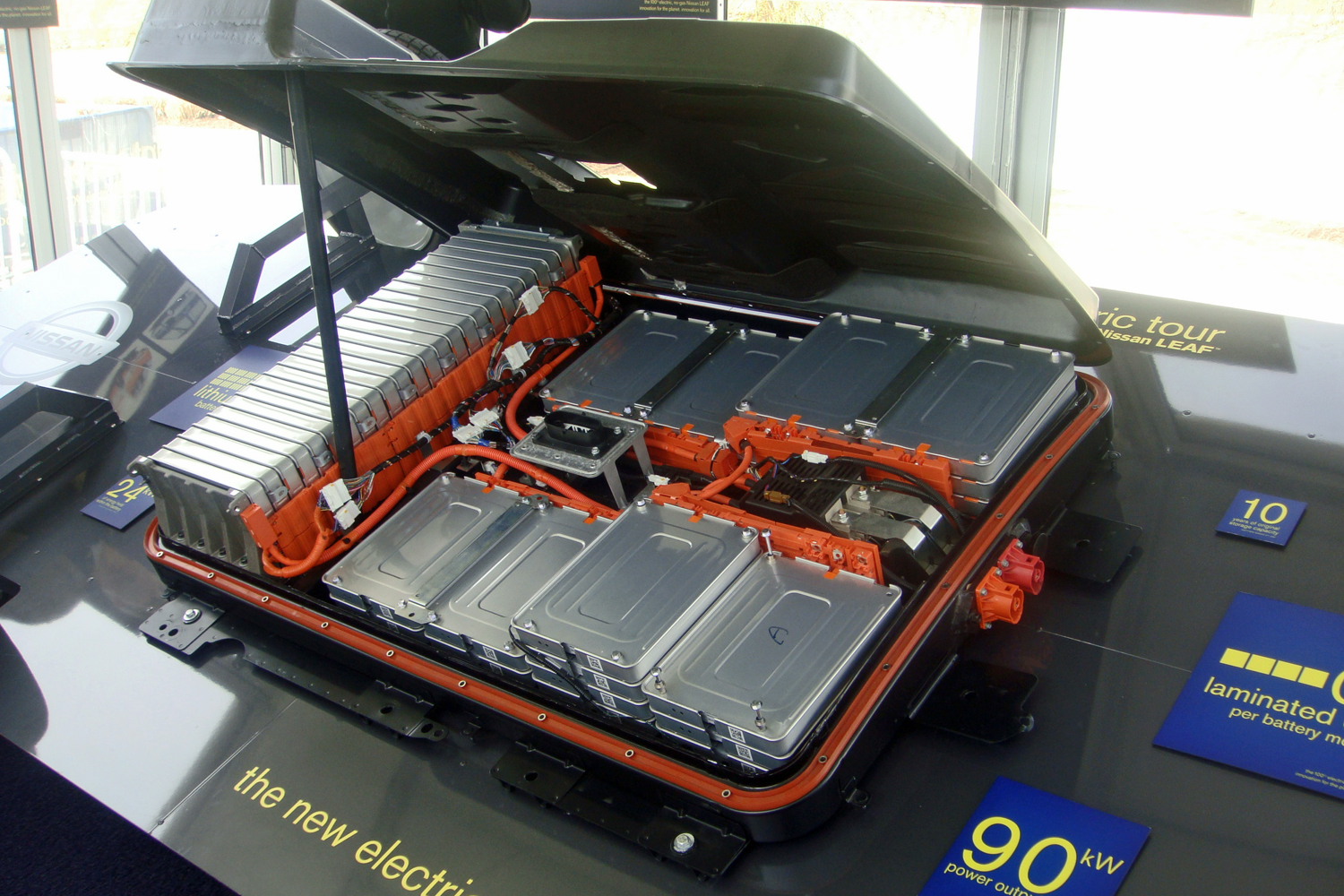


Inpow Battery says it has delivered more than 300,000 power battery packs. The first pack from the Inpow battery plant in Chonburi, Thailand, came off the line on 29 October 2026, and the accounts of the ceremony available on 30 October give no annual capacity, no cell supplier and no local content share. Inpow is the battery unit of GAC Group, and the plant is its first factory outside China.
A pack plant is the last step of a battery supply chain, not the first. A pack combines cells, modules, a cooling system and a battery management system into the unit fitted to a vehicle, while the cell is where the electrochemistry happens. Whether Chonburi is a cell story or an assembly story decides what it means for Thailand, and the numbers that would settle it are missing.
What the Inpow battery plant claims
Inpow’s statement, as reported, calls the Inpow battery plant GAC’s first overseas in house battery pack plant. It says the plant will support vehicle deliveries in Thailand and across ASEAN. Representatives of Thailand’s Energy Ministry, the Electricity Generating Authority of Thailand (EGAT) and GAC attended the ceremony. Inpow says it plans to work with EGAT and other partners on new energy vehicles, energy storage and energy equipment, with battery manufacturing at the core. No volumes or terms are given.
Inpow gives its total investment as 10.9 billion yuan, about 1.62 billion dollars at the 6.7138 yuan rate quoted in the reports. That covers a business spanning batteries for electric vehicles and energy storage, with no split for the Thai plant. The 300,000th pack rolled off on 15 October, and vehicles using Inpow batteries have travelled a combined more than 10 billion kilometers, the company says. Its batteries are used in the Aion i60, Aion N60 and Aion UT. Energy storage is the other half of the business, and a rival’s 9 MWh system, CATL’s Tener+, was announced this week.
The arithmetic on the claims
Ten billion kilometers across 300,000 packs is at most about 33,300 kilometers per pack, because the pack count is stated as more than 300,000. That figure describes a young fleet that has not been on the road long. It is mileage, not a durability test, and it says nothing about degradation or warranty claims.
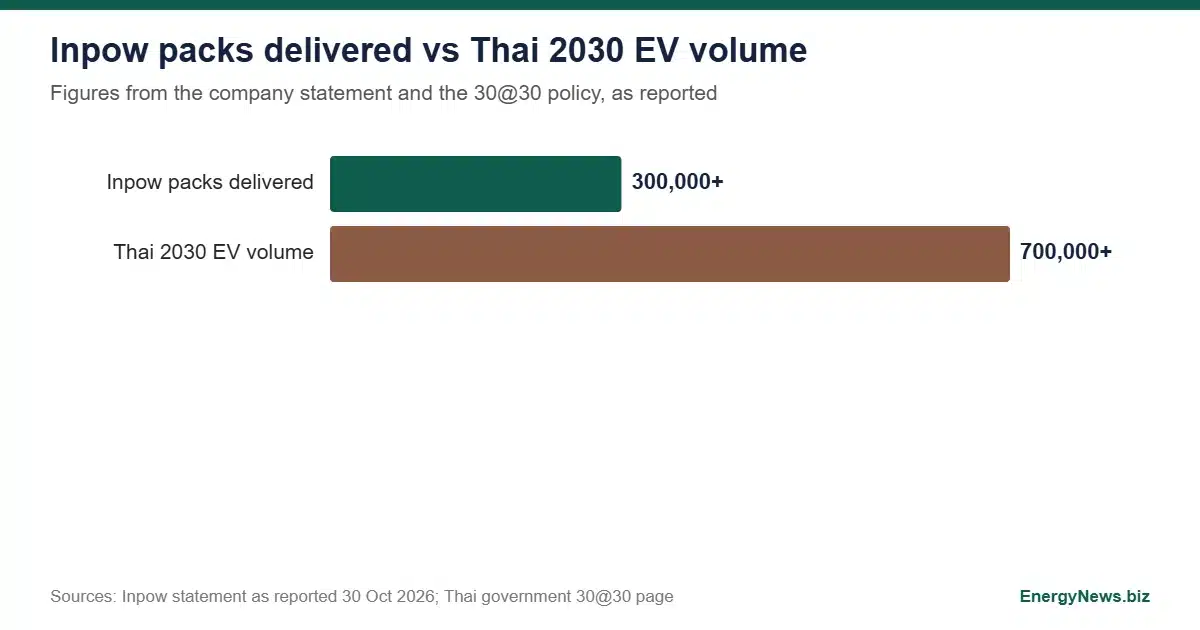
Thailand’s 30@30 policy, as described on a Thai government page, aims for at least 30% of total vehicle production in 2030 to be zero emission vehicles. Inpow’s statement converts that into more than 700,000 electric passenger vehicles. Dividing 700,000 by 0.30 implies about 2.3 million vehicles of total output, and 700,000 is 2.3 times the 300,000 packs Inpow has delivered since it started. The Inpow battery plant has to be sized against that gap, and its size is the missing number.
The same government page states that investment promotion conditions require electric vehicle makers to produce or use batteries locally, with extra tax benefits where key parts such as battery management systems are produced in the country. Whether assembling imported cells into packs counts as local production is not answered in the accounts. The page is dated January 2023, so the current conditions need checking against the latest notices of the Thai investment board.
The statement gives the 2027 Aion i60 with Inpow batteries a range of 700 kilometers. The test cycle is not stated, so the figure cannot be set against a WLTP or EPA number.
What would have to be true
For the Inpow battery plant to matter beyond a ribbon cutting, four numbers have to appear: annual output in packs or gigawatt hours, the origin of the cells, the share of local content and the terms of the cooperation with EGAT. Until then the opening is a statement of intent. A capacity figure from Inpow or the Thai investment board would be the first dated check.
Add EnergyNews.biz as a preferred source on Google


