




African green hydrogen has had plenty of announcements and very few final investment decisions. A package from the African Development Bank, announced on 18 September, does not change that on its own, but it points at the right problem. The bank will back four projects in Egypt, Morocco, Namibia and South Africa with 20 million dollars in reimbursable grants, subject to approval by its Board of Directors.
The money does not build anything. It pays for feasibility studies, engineering and design work to prepare construction tenders, and transaction advisory services. In the words of the bank’s director for renewable energy and energy efficiency, Daniel Schroth, the aim is to move projects from development to bankability.
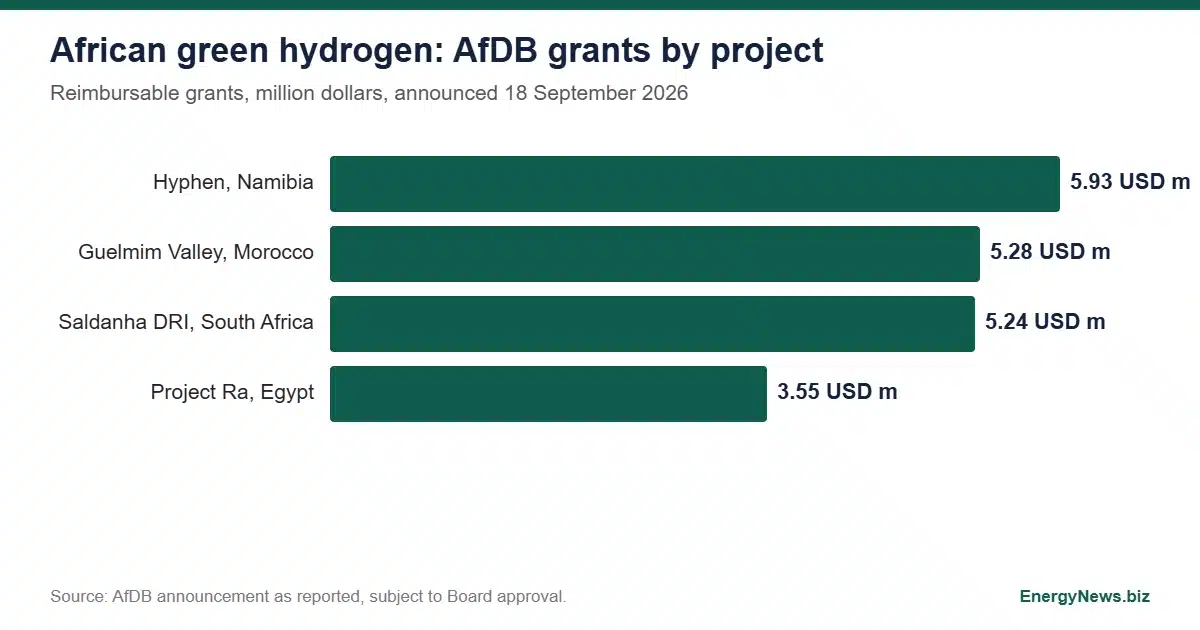
The four projects and what they receive
Project Ra in Egypt is allocated 3.55 million dollars. The Guelmim Green Hydrogen Valley in Morocco receives 5.28 million. Hyphen in Namibia gets the largest share at 5.93 million, and the Saldanha Hydrogen DRI project in South Africa, which targets direct reduced iron for steelmaking, receives 5.24 million. The four add up to the 20 million total.
Together they represent, according to the programme, about 20 GW of solar and wind and 7 GW of electrolysers, with a combined investment need of roughly 23 billion dollars. By ENB calculation the grants cover under a tenth of one percent of that figure. The point is not to fund the plants. The point is to take enough risk out of the preparatory work that a lender or equity investor will look at the next stage.
Why preparation is where hydrogen projects stall
A hydrogen project fails or succeeds long before the first electrolyser is delivered. It needs land, water, a grid or dedicated renewables, a port, a permit, and above all a buyer who will sign a long contract at a price that covers costs. The grant programme addresses the first group of problems directly. It does not, on the evidence available, address the last.
The announcement does not say what offtake the four projects have secured, and the developers are not named in the coverage reviewed. That omission matters. Financing teams that look at African green hydrogen ask the same question first: who is buying, for how many years and at what price? Without that answer, a better feasibility study produces a better document and not a financeable project.
Egypt, Morocco, Namibia and South Africa are different bets
The four countries are not interchangeable. Egypt and Morocco sit close to European demand and have the ports and renewable resources to export ammonia or hydrogen derivatives. Namibia has some of the best combined solar and wind conditions on the continent but a small domestic market, so almost everything depends on exports. South Africa has a domestic industrial case in steel, which is the most credible kind of anchor demand, because an industrial buyer needs the product at a specific place and does not depend on a distant shipping route.
That domestic logic is why the Saldanha project may be the most instructive of the four. Hydrogen used to make iron on site replaces coal and avoids the cost of transport, while a plant that must export has to compete with Gulf, Australian and North American projects chasing the same European and Asian buyers.
A funding gap bigger than the grants
Capital has become harder to find across the sector. Slower clean energy additions worldwide and tighter lending conditions have pushed many developers to delay decisions, a trend we followed in our coverage of the latest capacity slowdown. Concessional grants like these are therefore doing more than their size suggests: they keep a handful of African projects alive at a time when many elsewhere have been cancelled or postponed.
The risk is that early support becomes a substitute for the harder commitments. A programme that moves four projects to bankability has to be followed by buyers, guarantees and a pipeline of grid and port investment, otherwise the studies sit on a shelf.
What to watch
Three signals will show whether this works. Board approval of the grants. Any announcement of binding offtake agreements for the four projects. And whether the bank repeats the programme for a second round that reaches smaller developers. The institution publishes its approvals at afdb.org.
African green hydrogen will be decided by contracts, not by studies. The 20 million dollars is a sensible first step, but it only matters if a buyer is waiting at the end of it.
Add EnergyNews.biz as a preferred source on Google


