





Global demand for sustainable fuels is projected to grow by about a third between 2024 and 2030, and that is still not enough. The International Energy Agency published its first review of the Belém Pledge on 10 November 2026 at COP31 in Antalya, and it finds that 2030 demand is on course to be around 30% below the level needed to stay on track for the pledge. Sustainable fuels in the IEA’s definition include biofuels, biogases, low emissions hydrogen and derived fuels.
The Belém Pledge was launched in 2025 by Brazil, India, Italy and Japan, and the IEA report takes stock of its first year. The Belém Pledge sets a goal of quadrupling the use of sustainable fuels, and the IEA says that goal is still achievable by 2035 if countries build on current momentum, implement announced policies and remove barriers to investment.
Thirty two Belém Pledge countries, about 40% of demand
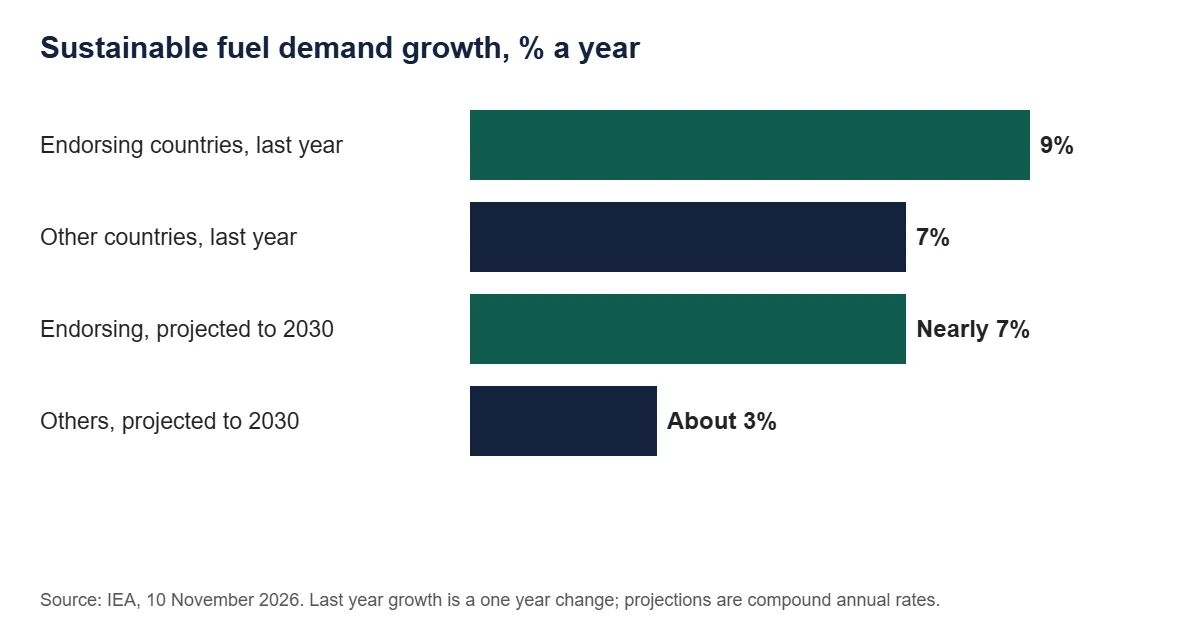
By the end of September 2026, 32 countries had endorsed the pledge, together accounting for almost 40% of global sustainable fuel demand. In the last year demand in their markets rose 9%, against 7% elsewhere. Under current policies, demand in the endorsing countries is projected to grow by nearly 7% a year through 2030, against around 3% a year outside the pledge.
The gap between the two groups is the report’s main finding on the Belém Pledge and policy: the countries that signed are growing at more than twice the projected rate of those that did not.
Biofuels carry the growth, hydrogen the surprise
Under the Belém Pledge review, liquid biofuels account for nearly 70% of projected growth through 2030, driven mainly by road transport. The IEA says their use already reduces dependence on imported fossil fuels in road transport by up to 40% in some markets, and that in 2026 several countries, particularly in Southeast Asia and Latin America, raised biofuel blending requirements in response to higher fossil fuel prices and supply pressure linked to the conflict in the Middle East. Biomethane is expected to lead growth in biogases because it can use existing gas infrastructure.
Low emissions hydrogen and hydrogen based fuels are projected to rise to nearly six times their 2024 level by 2030, but only from projects that are already operating or backed by committed investment. That condition matters for a sector where many announcements have not reached a final investment decision, as the failed and delayed projects covered in ENB hydrogen reporting show.
Two Belém Pledge figures that need the report to reconcile
The news item gives growth of about a third from 2024 to 2030 and a 2030 shortfall of around 30% against the needed level. Taken together, those imply a needed 2030 level of about 1.9 times the 2024 level (ENB calculation, 1.33 divided by 0.70), which assumes both figures refer to the same measure. The announcement does not state the trajectory the IEA used, and the full report on the IEA website would show it. The item also refers to the pledge goal of quadrupling use, with the 2035 date given in its summary line.
The IEA’s priorities for governments are clear roadmaps and targets, predictable demand, cooperation on carbon accounting, support for innovation to lower costs, supply chains and infrastructure, and access to finance, especially in emerging and developing economies. The next check for the Belém Pledge is the pace of endorsements, since 32 countries at the end of September 2026 is the baseline the IEA will measure against.
Add EnergyNews.biz as a preferred source on Google


