




US energy storage installations reached 48.3 GWh in the first nine months of 2026, a 20% increase on the same period of 2025, according to the Q4 edition of the US Energy Storage Market Outlook from the Solar Energy Industries Association and Benchmark Mineral Intelligence. Utility-scale projects made up 40.9 GWh of the total, about 85%.
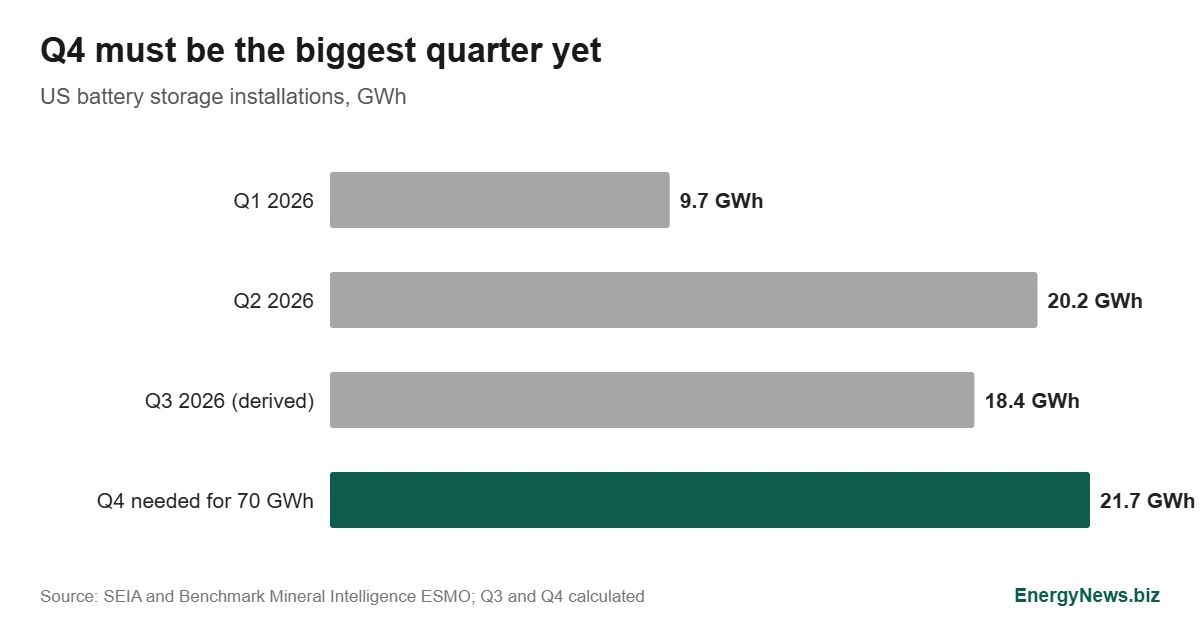
The quarterly split shows a market that runs in steps rather than a smooth line. The first quarter added 9.7 GWh. The second quarter set a record at 20.2 GWh, a 108% jump on the quarter before. Subtracting both from the nine-month total leaves about 18.4 GWh for the third quarter, slightly below the record but still the second-largest quarter on record.
What the US energy storage forecast now requires
At the start of the year, SEIA and Benchmark projected 70 GWh of US battery installations for 2026, against 57.6 GWh in 2025. With 48.3 GWh already in place, the fourth quarter needs about 21.7 GWh to hit that target. That would be the largest quarter in US history, beating the second quarter by roughly 1.5 GWh.
The fourth-quarter target is less extreme than it looks against last year. US installations in the fourth quarter of 2025 reached 17.6 GWh. Delivering 21.7 GWh in the same quarter of 2026 would mean growth of about 23% year on year, close to the 20% rate seen so far this year. In other words, the 70 GWh forecast holds if the market simply keeps its current pace.
It is not an unusual pattern. Developers push projects to commercial operation before year end to lock in tax treatment and contract dates, and the fourth quarter has often been the strongest. The question is whether this year’s supply chain can deliver that push.
Policy and supply pressure on US energy storage
The 2026 market has carried two new burdens. The One Big Beautiful Bill Act changed the tax credit landscape for clean power, and new Foreign Entity of Concern rules restrict which suppliers can be used in projects that claim credits. Many Chinese suppliers have been restructuring ownership to stay below the 25% threshold, while former EV battery lines in the US are being converted to lithium iron phosphate cells for stationary storage.
Despite this, growth of 20% year on year shows demand is stronger than the policy drag. Utilities need fast capacity for peaks, and data center load is adding to that need. Texas is on course to overtake California as the largest storage market this year, and projects such as Georgia Power’s 2.1 GWh McGrau site show that regulated utilities in the Southeast are now buying at scale too.
Texas shows how fast the base is moving. The state entered 2026 with 13.9 GW and 22.9 GWh of commercially operating grid-scale batteries, and the ERCOT fleet reached 16.5 GW and 28.8 GWh by the end of June, according to Modo Energy. That is close to 6 GWh of new capacity in a single state in six months.
Three numbers to watch into 2027
First, the utility-scale share. At about 85% of the nine-month total, grid-scale projects dominate. Behind-the-meter storage, including systems at data centers, is forecast to grow its share toward 20% by 2030.
Second, the fourth-quarter result. Delivering 21.7 GWh would confirm the 70 GWh forecast and put the US on track for the 110 GWh annual market that SEIA and Benchmark expect by 2030. A miss of several GWh would push some capacity into 2027 rather than cancel it.
Third, project size. Large East Coast projects such as the 1.2 GWh Energizar battery near Boston show that storage is moving beyond Texas and California into markets with tight grid space and high peak prices.
The quarterly reports and key findings are published by SEIA.
Add EnergyNews.biz as a preferred source on Google


