



Low-emission hydrogen is being built, but far slower than the pipeline suggests. The two reference reports of 2026, the IEA Global Hydrogen Review and the Hydrogen Council’s Global Hydrogen Compass, use different methods and arrive at the same picture: real capacity is growing, firm demand is not keeping up, and most of the 2030 pipeline is exposed.
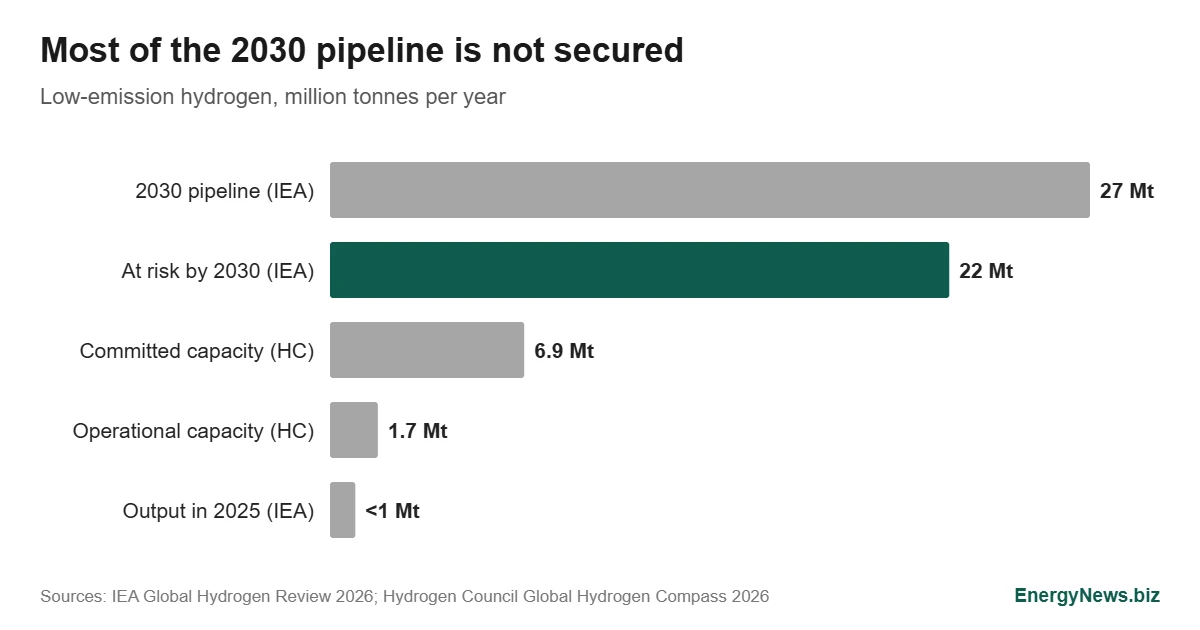
Global hydrogen demand passed 100 Mt in 2025, according to the IEA. Low-emission production was still below 1 Mt. That means less than 1% of today’s hydrogen comes from electrolysis on clean power or from fossil plants with carbon capture. The rest is grey hydrogen used in refining, ammonia and methanol.
Low-emission hydrogen projects that are real
The Hydrogen Council counts about 1,950 projects worldwide. Of these, 579 have reached final investment decision, are under construction or are operating, backed by $130 billion of committed capital. Committed capacity stands at 6.9 Mtpa and operational capacity at 1.7 Mtpa.
Electrolyser installations exceeded 4 GW in 2025, with nearly three quarters in China. Large projects are moving: NEOM in Saudi Arabia, an $8.4 billion, 2.2 GW scheme, targets commercial operations in 2027. Orica’s Hunter Valley hub in Australia took FID in July 2026. Shell’s Holland Hydrogen 1 has slipped to 2027.
Where the low-emission hydrogen pipeline breaks
The IEA puts the 2030 pipeline at 27 Mt a year and estimates that about 22 Mt of it is at risk. Put simply, roughly four of every five tonnes announced for 2030 may not arrive on time. The main reason is offtake. Only about 20% of announced offtake agreements are firm contracts with volumes, prices and penalties. The rest are memoranda that cost the buyer nothing to walk away from.
Plant level numbers show why the gap is so large. Orica’s Hunter Valley hub will use 50 MW of electrolysers to make about 4,700 tonnes of hydrogen a year, roughly 94 tonnes per MW. At that rate, replacing just 1 Mt of grey hydrogen would need more than 10 GW of electrolysers running at similar utilisation. The 22 Mt of pipeline at risk represents well over 200 GW of electrolysis that has not yet found firm buyers.
Regional gaps are stark. In Africa, one of 31 announced projects has reached FID. In India, buyers have signed 23 offtakes totalling 555,610 tonnes a year, one of the few markets where tendered demand is visible at scale.
Public money still carries the first wave
The European Union Agency for the Cooperation of Energy Regulators found that all 15 of the EU’s largest electrolyser projects at FID relied on public support. The EU’s Clean Hydrogen Valleys show the same pattern: more than 600 MW operational, about 3.3 GW past FID and over 800 MW reaching FID in 2025 alone. European Hydrogen Bank grants, such as the €139.8 million awarded to Hy2gen’s Albatros project, are now a standard part of the capital stack.
Equipment risk is the other constraint. Electrolyser owners have learned that warranties and performance guarantees can shift quickly, as the HyLYZER stop-use advice showed. For investors, the practical test is simple: a project with a firm offtake and public support is bankable, and a project with only a memorandum is not.
A ratio worth tracking
The clearest indicator is the ratio of operational to committed capacity. Today it is 1.7 to 6.9, or about 25%. If that share rises steadily as committed projects come online, the sector is executing. If committed capacity grows while operations stall, the gap between announcements and molecules is widening again.
Until firm demand catches up, low-emission hydrogen will stay a project business rather than a commodity market, and the 2030 numbers will keep shrinking with each annual review. The Hydrogen Council’s numbers and the IEA’s offtake data will show which way 2027 goes. The full IEA review is available from the International Energy Agency.
Add EnergyNews.biz as a preferred source on Google


