




The COP31 fossil fuel fight has come down to the final days in Antalya. A first draft of the summit’s cover decision, published on 16 November, calls for accelerated action to phase out fossil fuels, and several large producers have already pushed back. The conference runs to 20 November, with Turkey holding the presidency and Australia’s Chris Bowen chairing the negotiations, and ministers have until Friday to decide whether the words survive.
The COP31 phase-out language is the same fault line that split COP30 in Belem a year ago, where more than 80 countries backed a roadmap to transition away from fossil fuels but the negotiated text made no reference to it. In Antalya the draft goes further, but the presidency has signalled the final cover decision may be presidency-led rather than negotiated word by word, which lowers the bar for what counts as agreement.
An ENB contrast on the COP31 fossil fuel text
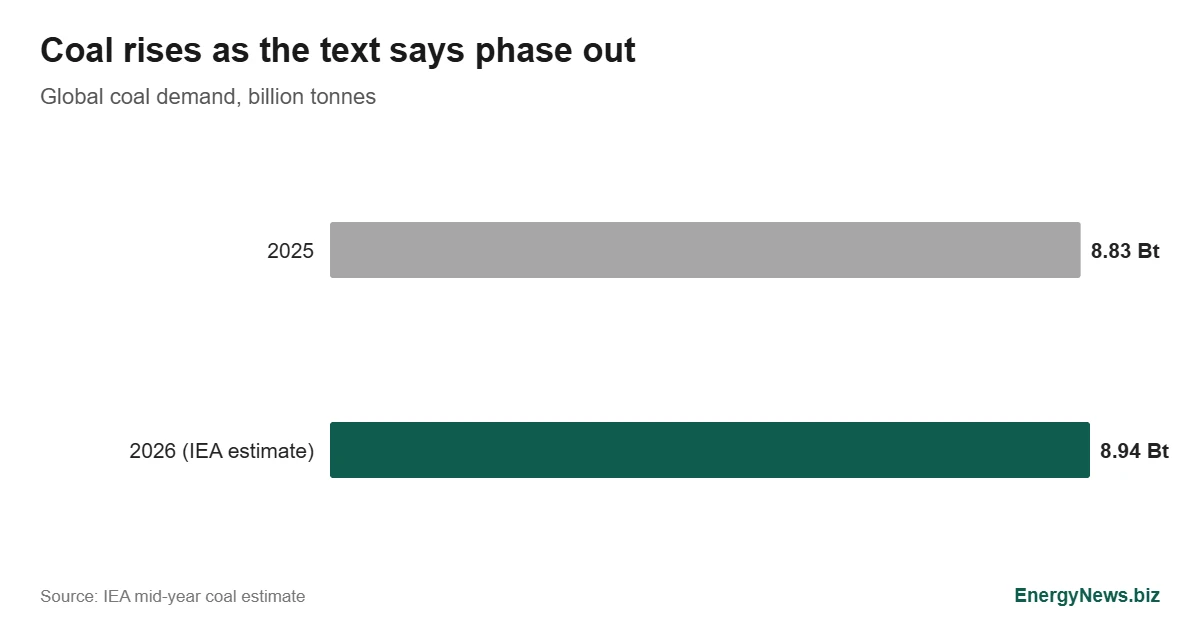
The gap between the COP31 fossil fuel text and the market is the story. As negotiators debate phasing out fossil fuels, the International Energy Agency now expects global coal demand to rise about 1.2% in 2026 to a record of around 8.94 billion tonnes, reversing an earlier forecast of decline. China and India together account for roughly 70% of global coal consumption. The words in the cover decision and the tonnes burned this year are moving in opposite directions.
What else is stuck on the COP31 fossil fuel text
Fossil fuels are not the only unresolved point. The draft runs to 144 paragraphs and leaves open the shape of climate finance, including a roughly $120 billion adaptation target, the timing of future scientific assessments, and whether Turkey’s flagship goal to lift electricity to 35% of final energy by 2035 is referenced at all. The arithmetic behind that electrification target is steep, as our analysis of useful energy and the cooling agenda set out.
Germany has poured cold water on hopes that either the COP31 fossil fuel roadmap or the electrification goal will make the final text, setting a low bar for the second week. That leaves the summit at risk of repeating Belem: strong language in the drafts, little of it in the agreed outcome.
The outcome to watch
Finance is the other half of the fight. The draft leaves open the shape of climate finance, including a roughly $120 billion adaptation target, and whether rich countries accept concrete rules for providing it. For many developing countries the fossil-fuel language is only acceptable alongside firm finance, which ties the two issues together: no money, no phase-out text, and the presidency has to balance both in a cover decision it may ultimately write itself.
If the COP31 fossil fuel phrase is dropped or softened to merely welcoming a voluntary roadmap, COP31 repeats Belem, where strong drafts produced a weak outcome. The record coal figure would then be the more honest summary of the year, and the gap between the conference’s language and the market’s direction would widen. The test on Friday is not whether the words appear in a draft, which they already do, but whether they survive into the agreed decision with any process to carry the work forward.
The single test is whether the phrase phase out fossil fuels survives into the final cover decision on Friday, and whether it comes with any process to carry the work forward. If it does, COP31 sends a signal markets can act on. If it is dropped or softened to welcoming a voluntary roadmap, the record coal figure will be the more honest summary of 2026. The negotiating texts are published by the UNFCCC.
Add EnergyNews.biz as a preferred source on Google


