




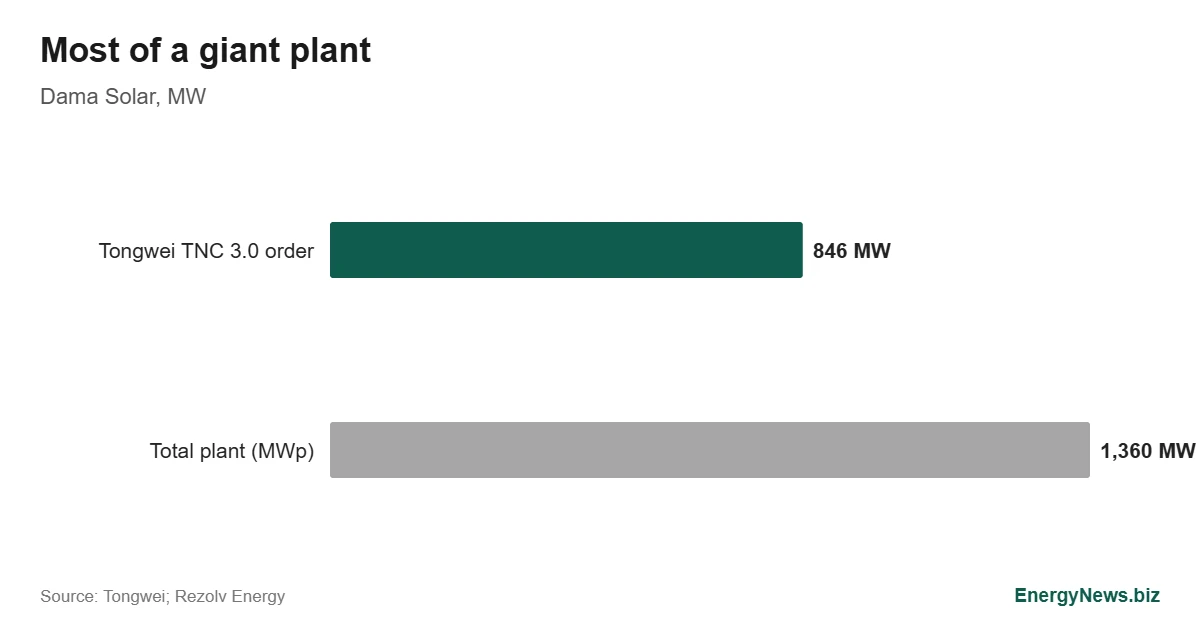
Dama Solar, a 1.36 GWp photovoltaic project being developed by Rezolv Energy in Romania, will use 846 MW of TNC 3.0 solar modules from Tongwei. The plant is expected to produce about 1,800 GWh of electricity a year once complete, making it one of the largest solar projects in Europe.
The Tongwei order covers about 62% of the plant’s total capacity. Large projects often split module supply between several manufacturers to spread risk and secure delivery slots, so the rest may come from other suppliers or later orders.
What Dama Solar will produce
An expected output of 1,800 GWh from 1.36 GWp works out to about 1,320 kWh per kilowatt-peak a year, a capacity factor of about 15%. That is a solid figure for a site in southeastern Europe. Plants of this size typically use bifacial modules, which also capture light reflected from the ground, and often single-axis trackers that follow the sun through the day.
For Romania, the plant is large. At about 1,800 GWh a year, Dama Solar alone would produce roughly 3% of the country’s annual electricity consumption, and it would add to a solar fleet that has grown quickly from a low base in recent years.
The Tongwei modules
TNC 3.0 is Tongwei’s latest generation of n-type TOPCon modules, a cell technology that has largely replaced older PERC designs across the industry. TOPCon offers higher efficiency and better performance at high temperatures, which raises yield per hectare. Tongwei is one of the world’s largest producers of polysilicon and solar cells, and has been growing its module business outside China.
Module prices remain near historic lows, which helps large projects like Dama Solar but squeezes manufacturers. Many are moving into adjacent products such as storage and hybrid systems, as with the Trina hybrid power launch. Developers are also adding batteries to solar plants to capture evening prices, as in the Sonnedix Oita storage retrofit.
Rezolv and the European context
Rezolv Energy is a developer focused on Central and Eastern Europe, backed by investors including Actis. Romania has become an attractive market thanks to good solar resources, available land and contracts for difference that give investors stable revenue. Grid connection capacity is the main constraint, and large plants increasingly need to be paired with storage or grid reinforcement.
European buyers also face questions about supply chain origin. The EU’s rules on forced labour and on resilience criteria in auctions may affect which modules projects can use in coming years. For now, Chinese manufacturers still supply most solar modules installed in Europe, because domestic production capacity remains small.
Financing for projects of this scale usually combines equity from the developer and its investors with debt from commercial and development banks. Revenue certainty from contracts for difference makes that easier, because lenders can model income over many years. Dama Solar’s size means its financing structure will be watched as a reference for other large solar plants planned in the region.
The construction itself is a large logistics task. A 1.36 GWp plant needs well over a million modules, along with inverters, cabling and substations, delivered and installed over many months. Module supply contracts like the Tongwei order lock in prices and delivery slots, which reduces the risk of delays if the market tightens.
For Romania’s grid operator, plants of this size bring both supply and balancing questions. Midday output from Dama Solar will be large relative to local demand, so export capacity to neighbouring markets and storage on the system will determine how much of its power can be used at the best prices.
The next milestones for Dama Solar are module deliveries and construction progress. Project details are published by Rezolv Energy.
Add EnergyNews.biz as a preferred source on Google


