





ENTRA1 Energy has signed an agreement with engineering firm Sargent & Lundy to support the deployment of plants based on NuScale small modular reactors, the companies said on 18 November. ENTRA1 is NuScale’s exclusive commercialisation partner and is responsible for developing, financing and delivering plants that use its reactor modules.
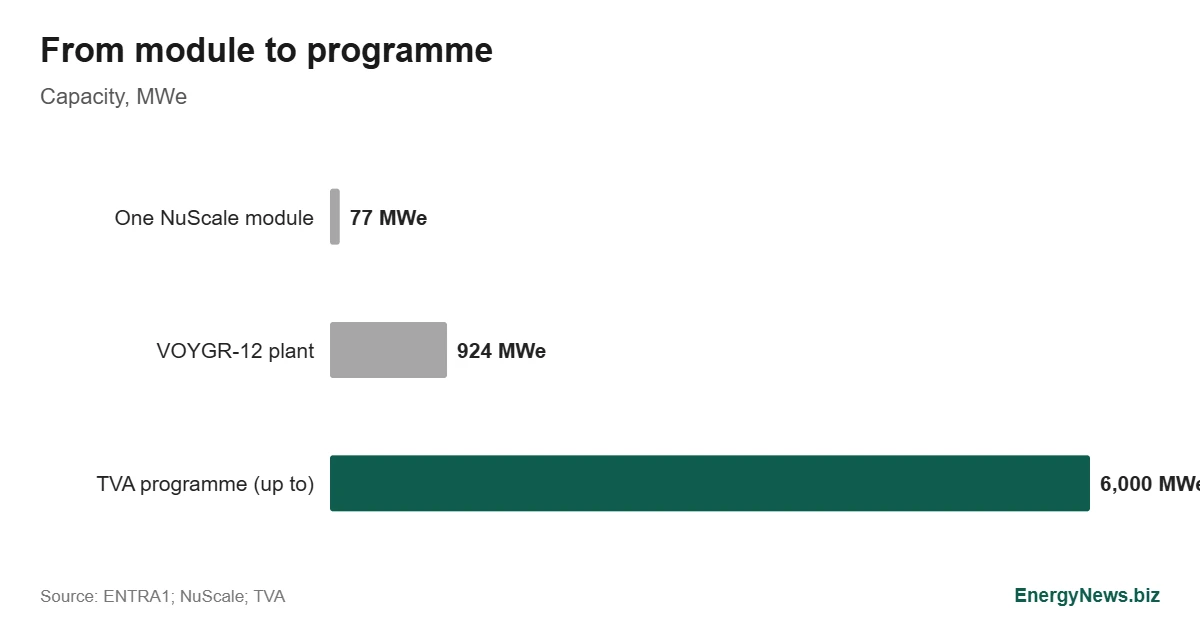
Each NuScale module produces 77 MWe. The standard VOYGR-12 plant combines 12 modules for a total of 924 MWe. NuScale’s design first received approval from the US Nuclear Regulatory Commission in 2020, and the uprated 77 MWe version received its own standard design approval in 2025.
What ENTRA1 is building
The agreement supports ENTRA1’s programme with the Tennessee Valley Authority, under which it plans up to 6 GW of NuScale capacity. That is enough, according to the companies, to power about 4.5 million homes or about 60 data centres. At 77 MWe per module, 6 GW would require about 78 modules, or roughly six and a half VOYGR-12 plants.
Sargent & Lundy is one of the oldest engineering firms in the US power sector, with long experience in nuclear plant design, licensing and owner’s engineering. Its role is to help turn the standard reactor design into site-specific plants, including the balance of plant, grid connection and safety systems around the reactor modules.
Why engineering partners matter for ENTRA1
Small modular reactors are pitched as faster and cheaper to build than large plants because modules are made in factories and repeated across sites. In practice, the engineering around the modules, from cooling and buildings to control rooms, still has to be designed and licensed for each site. Lining up experienced engineering partners early is one way to reduce the schedule risk that has hurt nuclear projects.
The sector has a large gap between commitments and steel in the ground. Billions of dollars are committed to developers and fuel supply, while few units are physically being built, as the analysis of the small modular reactor wave set out. NuScale itself cancelled its first planned project in Utah in 2023 after projected costs rose and subscribers withdrew.
Fuel and demand
NuScale modules use conventional low-enriched uranium fuel, unlike some advanced designs that need high-assay low-enriched uranium, whose supply is still being built up, as with Urenco’s HALEU plans. That removes one supply chain risk for ENTRA1’s programme, though fuel fabrication capacity for a new reactor type still has to be arranged.
Demand is the strongest argument in the programme’s favour. Data centres and industrial users want firm, low-carbon power around the clock, and utilities such as TVA expect strong load growth in their regions. A 924 MWe plant built in modules could add capacity in steps as demand materialises, rather than in a single large unit.
Cost remains the open question. No VOYGR plant has yet been built, so the price per kilowatt and construction time are still estimates. The first plants under the TVA programme will provide the evidence that later projects, and other utilities, will rely on when deciding whether to follow.
ENTRA1 also has to arrange the supply chain beyond the reactor modules, which are to be fabricated by industrial partners. Large forgings, steam generators, turbines and control systems all have to be ordered years ahead. A multi-plant programme gives suppliers the order volume they need to invest in capacity, which is the main argument ENTRA1 makes for planning gigawatts rather than single units. Repetition across plants is also where cost savings are expected to come from.
The next milestones for ENTRA1 are site selection, licence applications and financing decisions under the TVA programme. Company information is available from Sargent & Lundy.
Add EnergyNews.biz as a preferred source on Google


