


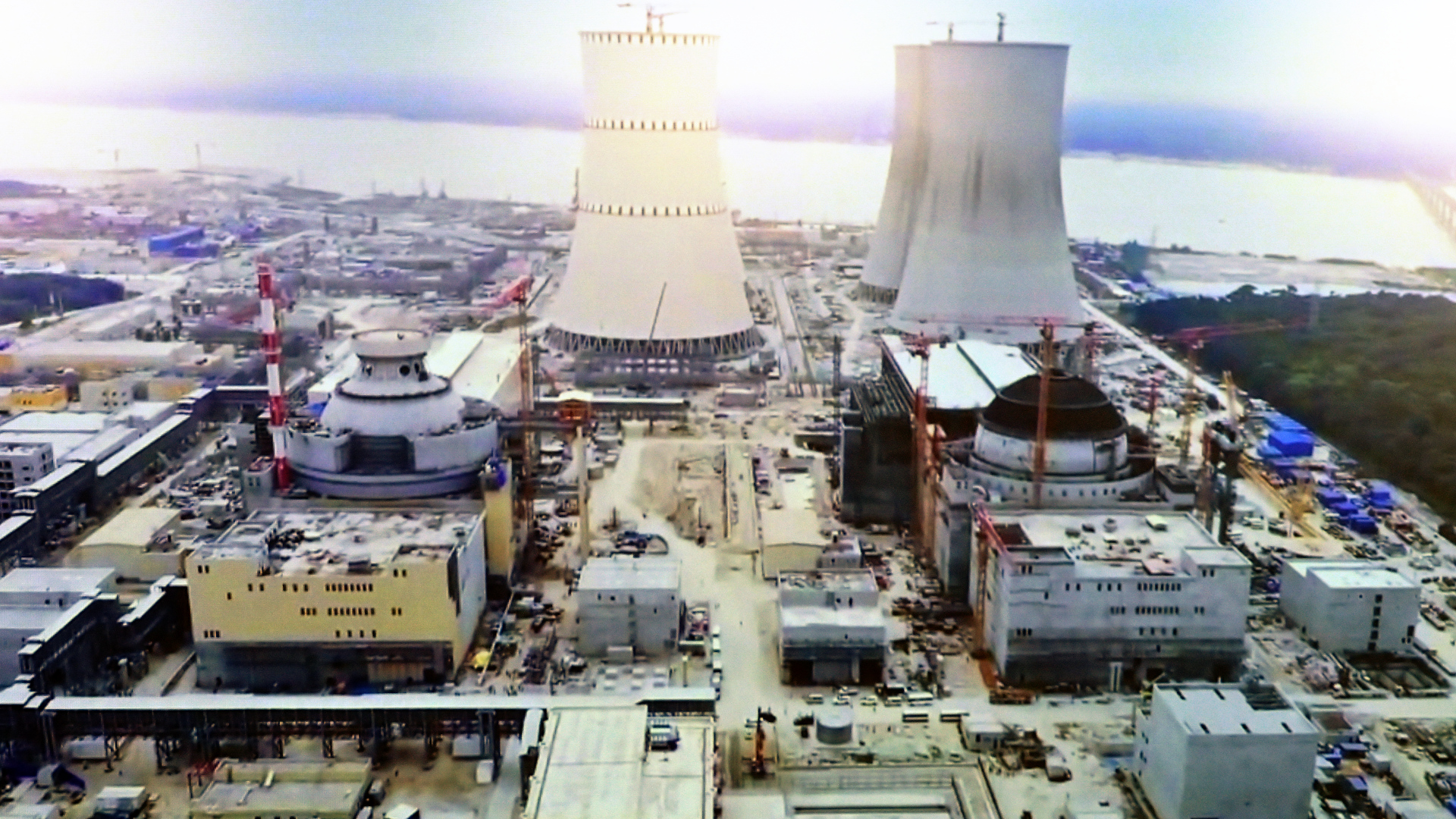


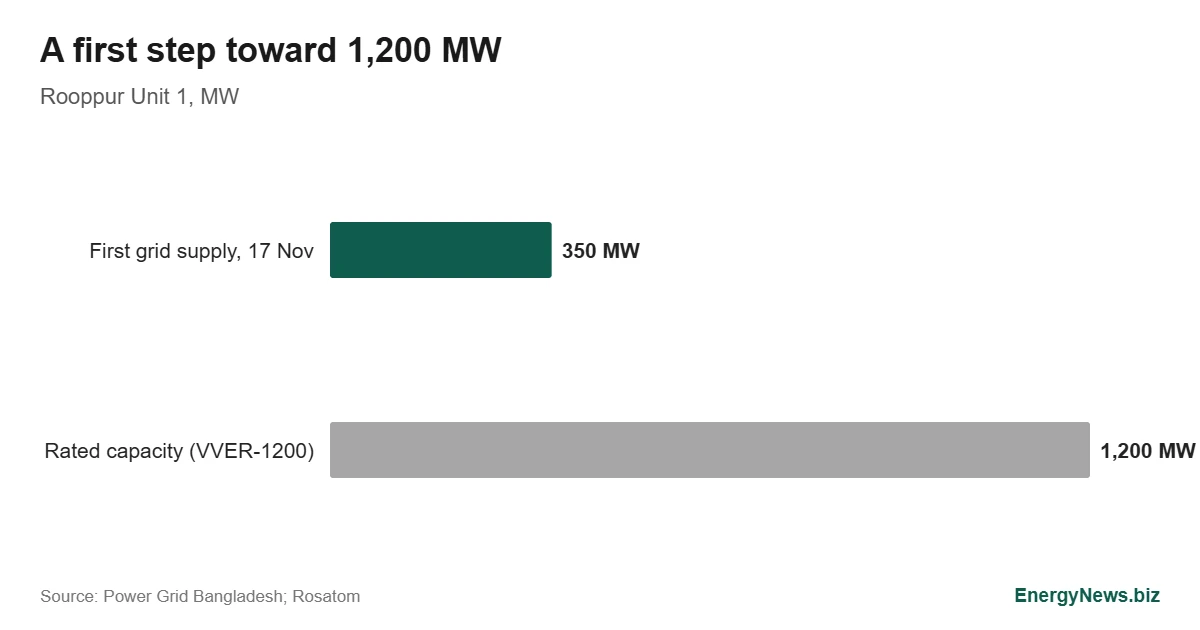
Rooppur Unit 1 has delivered the first nuclear electricity in the history of Bangladesh. The unit supplied about 350 MW to the national grid for between 8 and 10 hours on 17 November, according to Power Grid Bangladesh, the state transmission company. The milestone follows months of start-up work at the plant on the Padma River in Pabna district.
Rooppur Unit 1 is a VVER-1200 pressurised water reactor built by Russia’s state nuclear company Rosatom. Its rated capacity is about 1,200 MW, and a second identical unit is under construction at the same site. Together the two units are designed to supply about 2,400 MW, a large share of the country’s firm generating capacity.
What Rooppur Unit 1 delivered
The first supply was a test run at reduced power, a standard step before a new reactor raises output in stages. An ENB calculation puts the energy delivered in that run at between 2,800 and 3,500 MWh, depending on whether the unit ran for 8 or 10 hours at 350 MW. At the midpoint of nine hours, that is about 3,150 MWh.
The test output was about 29% of the unit’s rated capacity. New reactors typically move through several power plateaus, with checks at each, before reaching full output and commercial operation. The schedule for those steps depends on the results of each stage and on approval from the national regulator.
Why Rooppur Unit 1 matters for Bangladesh
Bangladesh relies heavily on imported gas, coal and oil for its electricity, and fuel shortages have caused repeated load shedding in recent years. A large nuclear unit running at high utilisation gives the grid steady output that does not depend on spot fuel markets. Once at full power, Rooppur Unit 1 alone could generate several terawatt-hours a year.
The grid itself has been a constraint. New transmission lines were needed to carry Rooppur’s output to demand centres, and delays in that work were one reason the start-up timeline moved. The plant’s progress toward the grid was followed in the earlier report on Rooppur nearing the grid.
A newcomer in a growing nuclear field
Bangladesh joins a small group of countries that have started their first nuclear plant in recent decades. It is part of a wider build: global nuclear construction is at its highest level in more than 35 years, though most of the capacity is in countries that already operate reactors. Smaller designs get more attention in Western markets, but few are being built yet, as the analysis of the small modular reactor wave set out.
Operating a first nuclear plant also means building a new workforce and regulator. Bangladesh has trained hundreds of engineers and operators in Russia and at home, and the national regulator has to inspect each step of the start-up. Rosatom staff are expected to support operations during the early years, a common arrangement for first-time nuclear countries that buy a turnkey plant.
For the grid operator, a single 1,200 MW unit brings its own challenge. If Rooppur Unit 1 trips offline at full power, the system must replace that output within seconds, so reserves and protection settings have to be sized for the largest unit on the network. That requirement grows when Unit 2 joins.
Financing for Rooppur came largely through a state loan from Russia, and the plant’s spent fuel is to be returned to Russia under the agreement between the two governments. Those terms, and the cost of servicing the loan, will shape the economics of the project for decades.
The next milestones are the stepwise rise in output from Rooppur Unit 1, its formal entry into commercial operation, and progress on Unit 2. Grid updates are published by Power Grid Bangladesh, and project information is released by Rosatom.
Add EnergyNews.biz as a preferred source on Google


