




BW ESS, the global battery storage owner-operator, has partnered with Lyon-based developer Wattmen to develop around 500 MW of battery energy storage projects in France over the next three years. The partnership will focus on sites with connection capacity of at least 100 MW, close to grid connection points and with enough space for battery systems offering at least four hours of storage.
The deal builds on BW ESS’s recent entry into France, when it acquired two 100 MW/400 MWh projects from Recurrent Energy.
What the BW ESS pipeline means in MWh
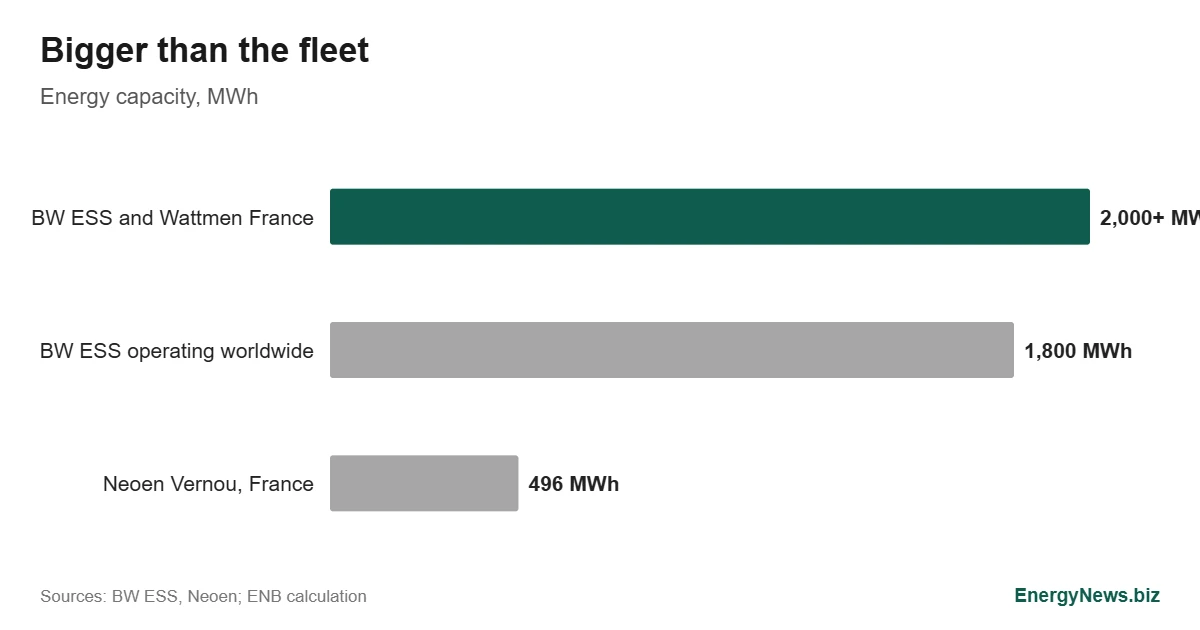
A power figure only tells half the story for batteries. ENB calculated the energy capacity: 500 MW at a minimum of four hours means at least 2,000 MWh. BW ESS says it currently operates more than 1.8 GWh of batteries worldwide, with about 10 GWh under construction or in pre-construction. The French pipeline alone would therefore be larger than everything the company runs today.
The comparison shows how fast the company plans to grow, and how much capital the French programme will need once projects reach construction. It would also dwarf individual French projects. Neoen’s planned battery at Vernou-la-Celle-sur-Seine, described as France’s largest when announced, is 248 MW/496 MWh. A 100 MW four-hour site from the BW ESS and Wattmen programme would be 400 MWh on its own.
Why France, and why four hours
France has the largest nuclear fleet in Europe and growing solar output. That combination creates long periods of cheap midday power in spring and summer, and evening peaks when solar fades. Four-hour batteries are well suited to moving midday energy into the evening, and to providing reserve and congestion services for the grid operator RTE.
France was already third in Europe for operational battery capacity behind the United Kingdom and Germany, according to the consultancy Clean Horizon in 2025. The market is now moving from short duration systems used mainly for frequency response toward longer duration assets that trade energy. BW ESS operates in the UK, Australia, Italy, Germany, Spain, Sweden and France, and its Hams Hall project in England, at about 1.24 GWh, is one of Europe’s largest batteries.
What Wattmen brings to BW ESS
Wattmen is a French developer focused on originating and developing grid-scale battery projects. In France, local development work is often the bottleneck: securing land near substations, applying for grid connections and handling permits. Jean-Marc Guenée, chief executive and co-founder of Wattmen, said the deal combined complementary strengths and a shared ambition to develop high-quality battery storage projects in France.
For BW ESS, the partnership is a way to build scale quickly in a new market without buying finished projects at a premium. For landowners near large substations, it means another well-funded buyer looking for sites. Grid connection capacity near 225 kV and 400 kV substations is likely to become the scarce resource, as it has in other markets such as Germany.
Revenue models are the other variable. French batteries can earn from the wholesale market, from balancing services and from the capacity mechanism, but none of these offers the long-term contracts that Italy’s MACSE or the UK’s cap and floor schemes provide. That makes the BW ESS approach, owning and operating assets over their full life, a bet on French power price volatility staying high as solar grows. Investors will watch how the company finances the first sites, whether through project debt, tolling agreements with utilities or its own balance sheet.
The number to watch
The number to watch is how many of the planned sites receive grid connection agreements in 2027. Without them, a three-year plan stays on paper. More details are available from BW ESS.
Add EnergyNews.biz as a preferred source on Google


