


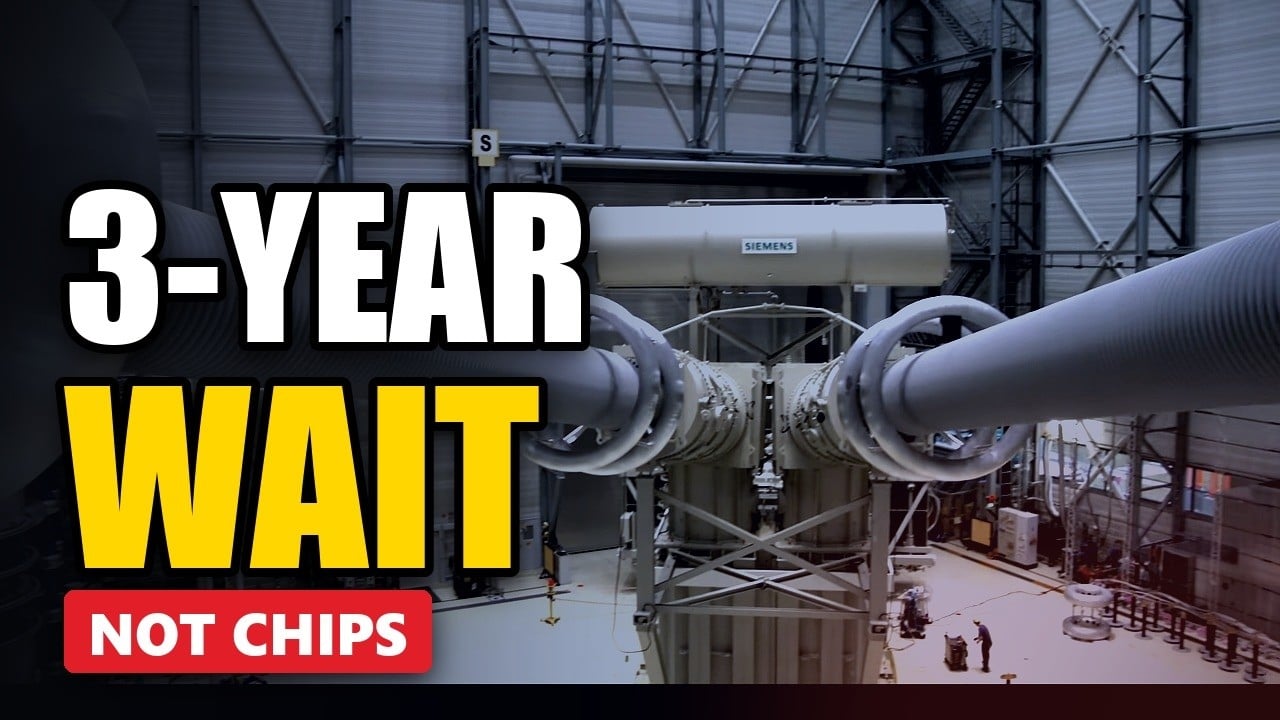


The transformer shortage has become the quiet limit on the AI build-out in the United States. In December 2025, BloombergNEF said American data centers would need 106 GW of power by 2035. In July 2026, it raised the figure to 194 GW. Between the chips and that power sits a machine whose basic design dates from the 1880s, with a waiting list now measured in years, and the fastest way around it may be built outside America.
The video above sets out the problem in 12 minutes. This analysis checks the numbers behind it, adds the latest data and works through what the transformer shortage means for developers, utilities and the people who pay electricity bills.
The transformer shortage meets a forecast that does not add up
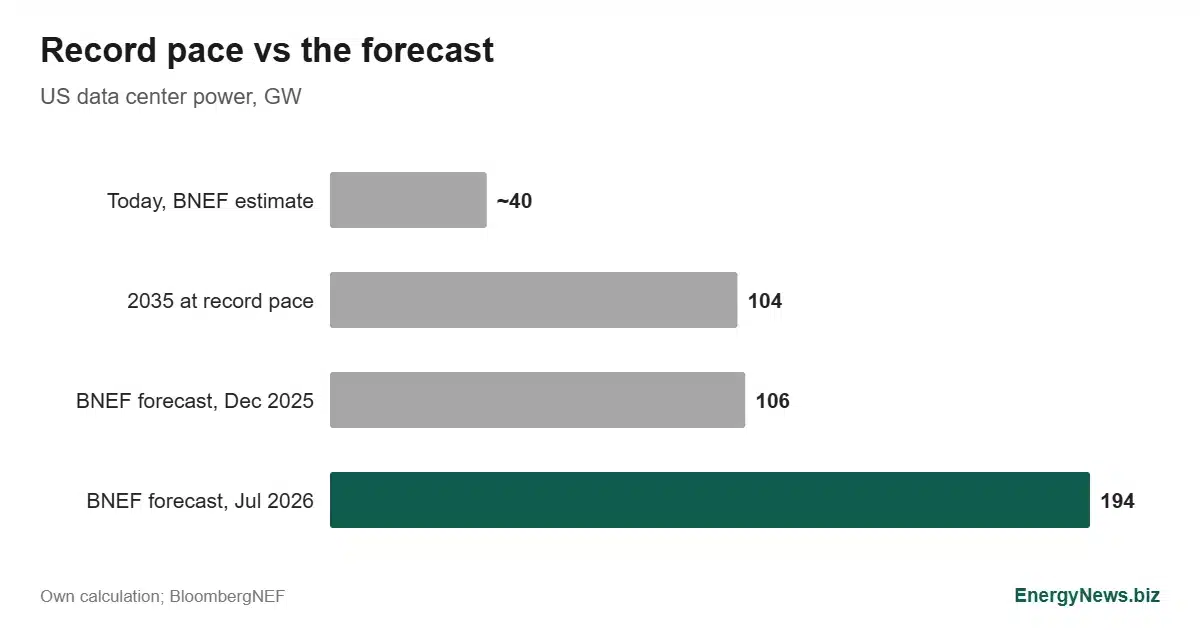
BloombergNEF published its 106 GW outlook on 1 December 2025 and its 194 GW outlook on 22 July 2026, an increase of 83% in eight months. In the same report, BloombergNEF noted that the most data center capacity ever connected to the US grid in a single year is 7.1 GW.
Estimates of the US data center fleet today range from about 25 GW to about 40 GW, depending on who is counting and what is counted. A simple calculation shows the scale of the gap. Starting from 40 GW, reaching 194 GW by 2035 means adding about 17 GW a year for nine years, 2.4 times the record. Starting from 25 GW, it means almost 19 GW a year, 2.6 times the record. And there can be no slow year in between.
The calculation can be turned around. If the US repeated its record year of 7.1 GW every year from 2027 to 2035, it would reach about 104 GW. That is almost exactly the old forecast of 106 GW, and 90 GW short of the new one.
The International Energy Agency sees the same squeeze from the other side. In its 2025 Energy and AI report it expects global data center electricity use to more than double to around 945 TWh by 2030, and warns that around 20% of planned projects could face delays because the grid cannot connect them. In November 2026, it lifted its 2030 figure to around 1,000 TWh.
Forecasts of this kind swing hard, and part of the pipeline was never going to be built. On 30 July, Exelon cut its high-probability data center pipeline from 18 GW to 11 GW, a reduction of 39%. PJM trimmed the near-term part of its 2026 load forecast in January. In August, Texas Governor Greg Abbott ordered the state regulator and ERCOT to audit every data center in the interconnection queue. But the projects that do go ahead all hit the same wall. That wall is not chips. It is the transformer shortage.
Why every data center needs a transformer
The grid moves power at tens of thousands of volts because high voltage wastes less energy over distance. Servers cannot use that. Somewhere between the transmission line and the rack, the voltage has to be stepped down, and the machine that does it, a core of special steel wound with copper, has barely changed in principle since the 1880s.
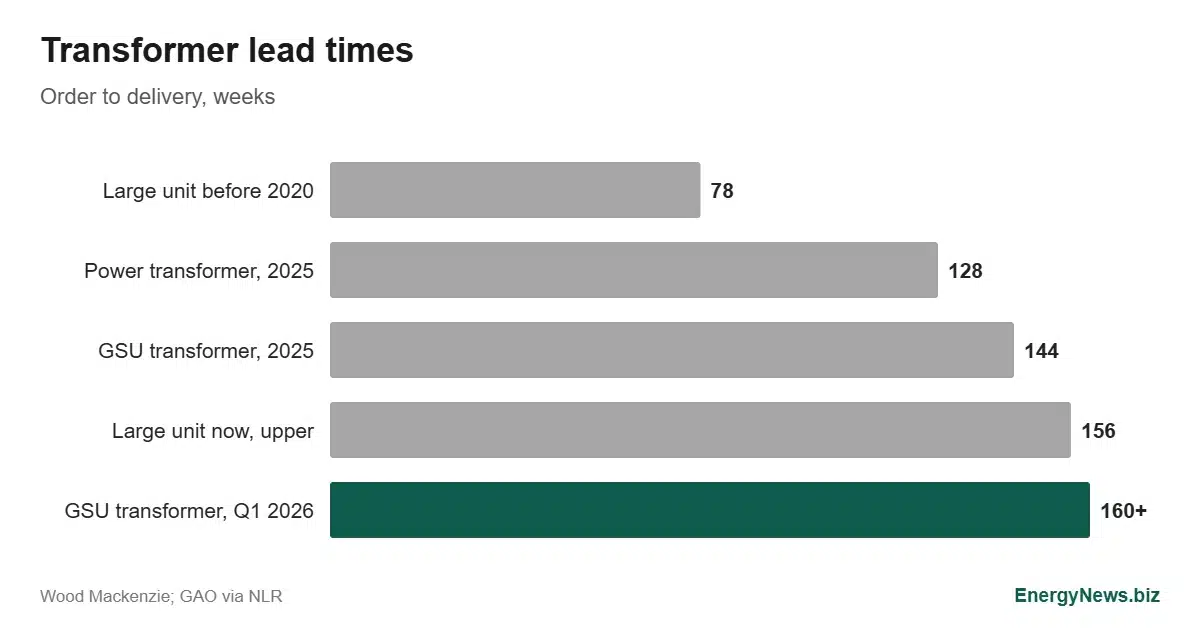
The transformer shortage shows up first in lead times. Wood Mackenzie’s survey for the second quarter of 2025 put the average lead time for a power transformer at about 128 weeks, or roughly two and a half years. Generator step-up units, which connect power plants to the grid, took about 144 weeks, and by the first quarter of 2026, more than 160 weeks. A May 2026 report from the National Laboratory of the Rockies, formerly NREL, cites the Government Accountability Office: order-to-delivery times for large units have stretched from 12 to 18 months to 30 to 36 months, and extra high voltage units can take up to five years.
Prices have moved with the transformer shortage too. By Wood Mackenzie’s estimate, power transformers cost 77% more than in 2019. A unit that cost $1 million then costs about $1.77 million now, before any tariff.
Why not just build more transformers?
Three problems keep the transformer shortage from fixing itself.
First, imports. The United States brings in roughly three-quarters to four-fifths of its large power transformers, depending on the source and the size class counted.
Second, steel. The core is made of grain-oriented electrical steel, and Cleveland-Cliffs is the only domestic producer. Its expansion at Butler Works in Pennsylvania, backed by a federal grant, is scheduled for completion in 2028.
Third, demand for the biggest units has exploded. Wood Mackenzie counts demand for generator step-up transformers up 274% between 2019 and 2025.
New factories are coming, but slowly. Hitachi Energy broke ground on a $457 million large power transformer plant in South Boston, Virginia, on 29 June, billed as the largest in the country. Output is expected around 2028 to 2029. Siemens Energy’s plant in Charlotte has slipped to early 2027. Eaton plans production in South Carolina in 2027, and HD Hyundai Electric expects to finish its second Alabama plant in April 2027.
Goldman Sachs estimates that announced expansions add only 2% to 4% to US capacity in 2027 and 2028, while demand grows 9% to 12%. That leaves a gap of roughly 5 to 10 percentage points a year. Wood Mackenzie expects most categories to stay in marginal shortage through 2030. On these numbers, the transformer shortage outlasts most of the data centers now being planned.
Who has the factory slots in a transformer shortage?
Mostly one country. China Daily, citing the China Electricity Council, says China held about 60% of global transformer manufacturing capacity in 2025. Treat that as an industry claim, but the trade data points the same way. Goldman Sachs figures show Chinese exports of large power transformers up 52% in 2025, up another 61% in the first two months of 2026, and exports to the United States up 182%. China Customs reported a record export value for all transformers in 2025.
Here is the twist. China still holds only about 4% of the US transformer market. This is not a takeover. It is a signal that, in a global transformer shortage, buyers who cannot get a machine anywhere else are placing orders wherever there are slots.
Korea is the other winner. Korean transformer exports reached a record of about $1.3 billion in 2025, with roughly $738 million going to the United States, and in the third quarter of 2026 the US took 62% of Korea’s large transformer exports. HD Hyundai Electric reported an order backlog of $8.8 billion at the end of September, and Hyosung Heavy Industries a record backlog of ₩18.9 trillion.
That leaves an uncomfortable picture. A race between two AI superpowers may run through the same factories.
Skip the machine: the solid-state transformer
There is a way around the transformer shortage, at least on paper. A solid-state transformer, or SST, replaces most of the iron and copper with power electronics: banks of fast-switching semiconductors that do the same job. Faster switching shrinks the magnetic parts, which means less metal, less weight, and, in theory, a shorter wait.
It also fits where AI data centers are heading. NVIDIA is pushing the industry toward 800 V direct current inside the data center. An SST can take medium voltage grid power and convert it straight to 800 V DC, skipping several conversion steps. NVIDIA’s list of power system partners includes ABB, Eaton, GE Vernova, Heron Power, Hitachi Energy, Schneider Electric, Siemens and Vertiv, with Delta as a component supplier. Full-scale 800 V DC is planned with the Kyber rack generation in 2027.
The list of companies moving is long:
- Siemens and Reinhausen announced a partnership on 14 August to develop and industrialise an SST for grids up to 36 kV with an 800 V DC output. No rating or launch date has been given.
- Eaton: its chief technology officer for electrical has said mass adoption could come in a two- to three-year timeframe. Eaton reports orders for 10 SST prototypes.
- Sungrow launched EnerNeo on 9 July, a 3 MW unit that converts medium voltage AC straight to 800 V DC. The company claims 98.5% efficiency and a footprint one third to one fifth of conventional setups, and says it has signed 130 MW of agreements. These are company claims, not independent tests.
Researchers have noticed. A search of Elsevier’s ScienceDirect lists 46 papers on solid-state transformers for 2021 and 95 so far in 2026, roughly double.
The catch
Commercial SSTs working in the field are still rare. One industry count finds more than 30 companies that have released SST products, but only a few in mass production and delivery. Hitachi Energy says building them compact at 34.5 kV brings significant design and manufacturing challenges. Utilities replace equipment slowly, because a conventional transformer can run for decades, and a new design has to prove it can do the same.
Even the first wave of 800 V data centers may not use SSTs. Early designs are expected to pair existing transformers with industrial rectifiers, a route that SPOC Energy says can reach about 97.3% grid-to-rack efficiency with supply chains that already exist.
The efficiency gap is real but modest. Comparing Sungrow’s claimed 98.5% with the 97.3% rectifier route on a data center drawing 100 MW, losses fall from about 2.8 MW to about 1.5 MW. That saves around 1.2 MW, or roughly 11 GWh a year at full load, worth about $0.9 million a year at $80 per MWh. Useful, but not enough on its own to justify an unproven machine on a critical path. The real prize of the SST is time: a way out of the transformer shortage, if it can be delivered faster than a 30-month transformer.
So the iron machine gets a stay of execution. It is not dead. It just has a long queue.
Who owns the technology?
If the transformer shortage pushes buyers toward SSTs, it matters who controls the technology. PatSnap’s 2026 solid-state transformer patent landscape counts 2,078 patent families, with China the top jurisdiction. The leading filers:
| Applicant | Patent families | Home market |
|---|---|---|
| Huawei Digital Power | 136 | China |
| Delta Electronics | 106 | Taiwan |
| State Grid | 100 | China |
| Hitachi Energy | 74 | Switzerland and Japan |
| ABB | 59 | Switzerland |
A narrower search of the World Intellectual Property Organization’s PATENTSCOPE database for records that mention both solid-state transformers and data centers returns a small set dominated by Huawei entities. Patents are a map of who is investing, not a scoreboard of who is winning. The question is not who invented the SST. It is who can build a thousand of them that do not fail.
Why the transformer shortage reaches electricity bills
Every cost of the transformer shortage ends up somewhere. Transformer prices are up 77% since 2019. Utilities recover equipment costs through rates, and regulators decide how much lands on households. In PJM, the market monitor estimates that forecast data center load added billions of dollars to the 2026/27 capacity auction, a cost that flows into retail bills.
Regulators are starting to push back. Exelon has signed transmission security agreements, approved by FERC, that make large data center customers post collateral and pay shortfall charges if they do not show up. Exelon says these agreements have secured about $1 billion in customer protections.
If the forecast is right, the grid needs far more of these machines. If it is wrong, someone is left holding equipment nobody needs. Either way, the transformer shortage has an address on the bill.
Three dates to watch
| When | What | Why it matters |
|---|---|---|
| Late 2026 to 2027 | NVIDIA’s next platforms ship and the first 800 V DC designs appear | Shows whether data centers choose SSTs or transformer plus rectifier |
| 2027 to 2028 | New US plants from Siemens Energy, Eaton and HD Hyundai Electric start up; Sungrow EnerNeo deliveries | First real test of whether supply catches up |
| 2028 to 2030 | SST mass adoption window; Hitachi South Boston output; Wood Mackenzie expects shortage through 2030 | Decides how much of the 194 GW gets built on time |
What developers and utilities should check now
- Order timing. The transformer shortage rewards early buyers. Some utilities have moved from ordering transformers one year ahead to about three years ahead. A project energising in 2029 that has not reserved a large unit is already late.
- Design choice. Decide early whether a site follows the conventional transformer and rectifier route or waits for SSTs, and keep the switchgear layout able to take either.
- Supplier spread. In a transformer shortage, Mexico, Korea and China all hold slots, but tariffs on steel content and grid equipment change the delivered price. Compare offers on landed cost, not ex works.
- Forecast discipline. Utilities that screen speculative load, as Exelon and ERCOT now do, reduce the risk of ordering machines for demand that never arrives, and ease the transformer shortage for real projects.
For the scale of the loads now being requested, see the analysis of the 6 GW SpaceX data center plan in Arizona.
The number to watch
7.1 GW. That is the record for data center capacity connected to the US grid in one year. As long as yearly connections stay near it, the 194 GW forecast is a ceiling, not a plan. If 2027 brings a year well above 10 GW, the transformer shortage is easing. If it does not, the iron machine from the 1880s will decide how fast AI grows.
The transformer shortage will not end in one step. The iron transformer has a waiting list of years. The chip version has prototypes, a patent race, and a long list of things that can still go wrong. And one question remains open: if the machines that power AI are built in one country and the chips are designed in another, who really depends on whom?
Add EnergyNews.biz as a preferred source on Google


