






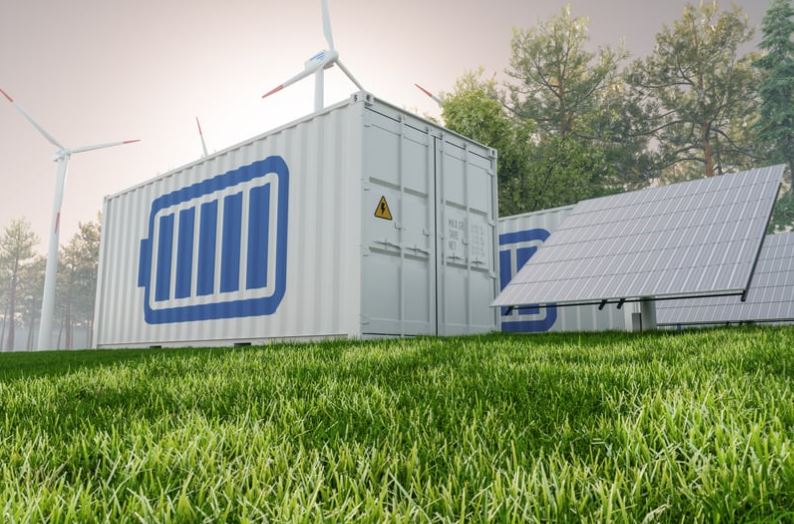
The global vanadium redox flow battery market was valued at $495 million in 2025 and is projected to surpass $3 billion by 2035, growing at a compound annual rate of nearly 20%. Against that backdrop, Invinity Energy Systems has announced the sale of a 32 MWh vanadium flow battery system to Pacific Steel Group for the Mojave Micro Mill project in Kern County, California, a deployment described as the largest vanadium flow battery installation in North America to date once delivered.
The project pairs the storage system with a 40 MWp photovoltaic array to supply solar power to an electric arc furnace that will process 500,000 tons of scrap steel annually into construction rebar. The combination of an intermittent renewable generation source, a large-scale flow battery, and one of the most power-intensive industrial loads in manufacturing makes the Mojave project a meaningful stress test of whether vanadium flow technology can anchor industrial decarbonisation at scale.
The energy profile of the application is demanding. Modern electric arc furnaces typically consume approximately 350 to 600 kilowatt-hours of electricity per ton of liquid steel, depending on furnace size, raw material quality, and process efficiency. At 500,000 tons per year, the Mojave mill’s annual electricity demand would fall in the range of 175 to 300 gigawatt-hours, a load that a 40 MWp solar array can only partially serve under California solar irradiance conditions. The 32 MWh battery is sized for daily cycle applications, smoothing solar output across the generation curve rather than providing multi-day or seasonal storage. It will not displace grid power entirely, but it can shift significant volumes of solar generation into the mill’s peak consumption windows and reduce demand charges that represent a substantial fraction of industrial electricity costs.
Why Flow Chemistry Suits This Application
The choice of vanadium flow technology over lithium-ion for this project reflects a set of performance characteristics that are well matched to the industrial context. Vanadium redox flow batteries store energy in a liquid electrolyte held in external tanks, with energy capacity and power output scaled independently. This decoupled architecture allows a project developer to size the energy reservoir to the specific duration requirement without oversizing the power conversion stack. At 32 MWh, the Mojave system represents a large energy reservoir designed for sustained discharge over multiple hours, a profile that suits solar integration in a facility running continuous industrial processes rather than a utility peaker application demanding short, high-power discharge.
Vanadium redox flow batteries capture the majority of storage needs above six hours but hold a much smaller share of applications below four hours, where lithium retains the price lead. For an industrial facility that needs to carry midday solar generation through to evening production shifts, the economics of flow chemistry are more competitive than that overall market split suggests. The California grid’s duck curve, with its pronounced midday solar surplus and steep evening ramp, makes multi-hour storage particularly valuable for industrial users seeking to maximise self-consumption from co-located solar assets. The 40 MWp array and 32 MWh battery together constitute a system that Pacific Steel Group can operate as an integrated energy asset rather than simply as a cost-reduction measure.
The Industrial Decarbonisation Case
The steelmaking context adds a dimension to this project that pure grid storage deployments do not carry. Scrap-based electric arc furnaces are 60 to 70% less energy-intensive than primary steelmaking routes that use blast furnaces. The Mojave mill’s scrap recycling model, therefore, starts from a significantly lower carbon baseline than integrated steelmaking. Adding co-located solar with battery buffering extends that advantage by reducing the carbon intensity of the electricity supply to the furnace. EAF steelmaking typically emits about 0.4 to 0.6 tons of CO2 per ton of steel, depending on the carbon intensity of the electricity grid, and since emissions are closely tied to electricity use, cleaner power sources and higher energy efficiency reduce the EAF carbon footprint materially. A mill that sources a meaningful fraction of its electricity from on-site solar, buffered to match its load profile, reduces its grid-sourced consumption and the associated grid emission factor, which in California is declining but not yet at zero.
The California Energy Commission’s Long-Duration Energy Storage Program, which provided grant funding for the Mojave project, reflects a state policy framework that treats industrial energy storage as a component of grid decarbonisation rather than an isolated facility investment. The CEC’s involvement signals that the project was evaluated partly on its demonstration value for the broader industrial sector, not only on its economics to Pacific Steel Group. Invinity’s selection following a competitive process based on technical characteristics and its track record in CEC-funded projects indicates the agency has prior operational data on vanadium flow deployments in the California context, which reduces the technology risk evaluation burden compared to a first-of-kind installation.
Scale, Supply Chain, and the North American Market
North America is forecast as one of the fastest-growing regions for vanadium flow batteries globally, driven by federal and state incentives for energy storage and grid resilience programs. Invinity’s plan to manufacture the batteries in the United States, with delivery expected to commence in the first quarter of 2027, positions the project to benefit from domestic content requirements embedded in US clean energy incentive structures. The Inflation Reduction Act’s investment tax credit provisions for energy storage and the potential for additional manufacturing credits for domestically produced battery systems create a financial architecture that improves project economics over importing equivalent systems.
The manufacturing commitment also carries execution risk. Vanadium flow battery production at a 32 MWh scale requires vanadium electrolyte supply, membrane materials, and power conversion equipment across a supply chain that has historically been concentrated in Asia. Established Asian producers continue to advance their cost and performance positions, and for Invinity to manufacture competitively in the US, it will need either domestic vanadium electrolyte sourcing or supply agreements that do not erode the cost competitiveness that US policy incentives are designed to create. Vanadium is produced in meaningful quantities in the United States, giving the project a plausible domestic supply path for its most critical input.
What the Mojave Project Needs to Demonstrate
The Mojave Micro Mill is the first new steel mill built in California in 50 years, with construction begun in June 2025 and mill operations targeted for the second half of 2027. The battery system is expected to be delivered starting in the first quarter of 2027, leaving a narrow window between delivery and commissioning. Industrial energy storage projects of this scale involve integration with facility electrical infrastructure, grid interconnection coordination, and operational commissioning, which are not trivial at 32 MWh, and the timeline implies a compressed execution schedule for both the battery installation and the mill startup.
The broader significance of the project will be measured by the operational data it generates once running. Large industrial deployments where the battery must perform against a demanding and variable load profile, rather than a utility dispatch schedule, remain uncommon in the vanadium flow sector. If the Mojave system demonstrates reliable multi-hour cycling alongside an active electric arc furnace load, and if the economics prove out through reduced demand charges and increased solar self-consumption, it will establish a reference case for the many industrial decarbonisation projects currently evaluating long-duration storage options across the US manufacturing sector.