


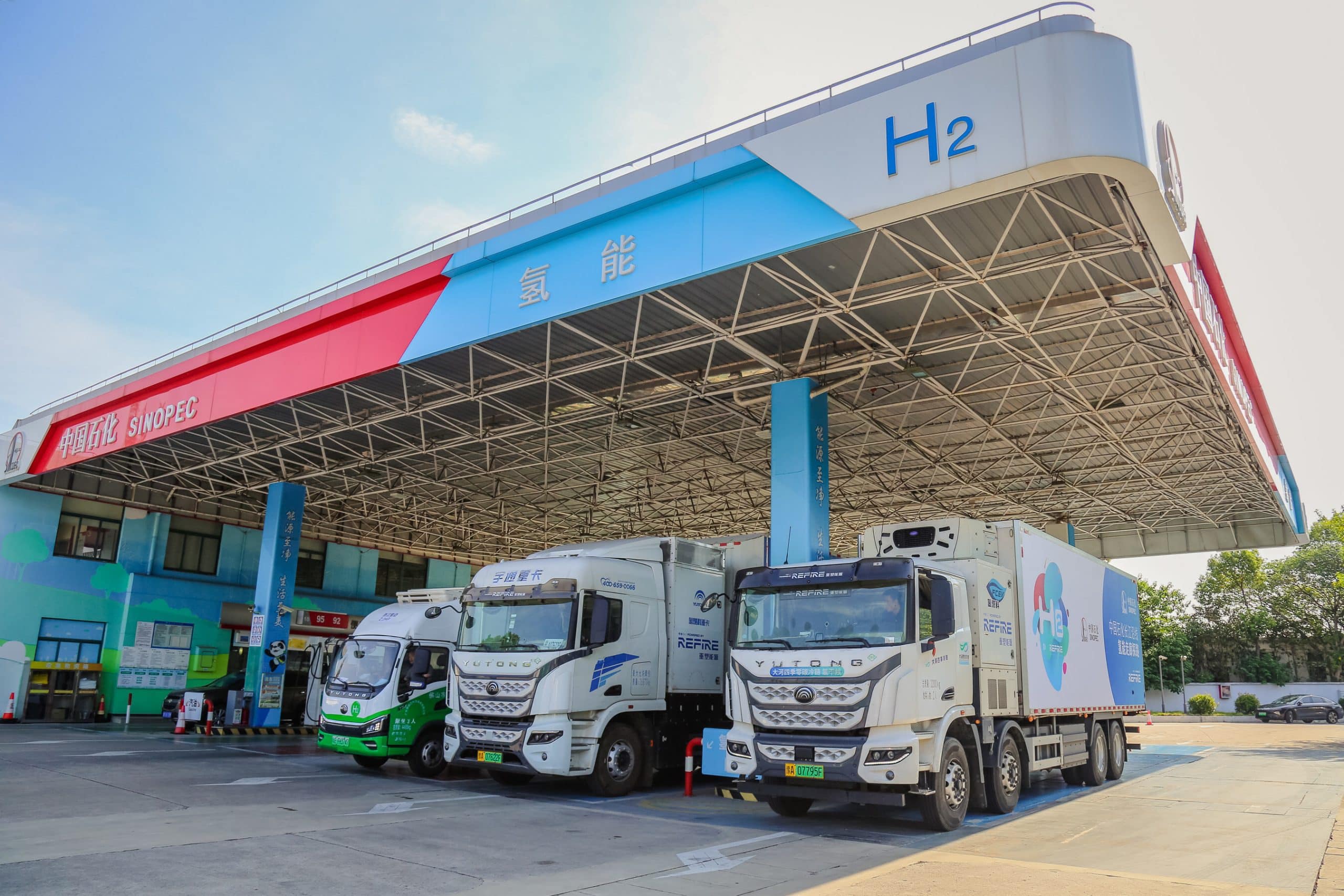


Sinopec’s 260-megawatt Kuqa facility in Xinjiang, once billed as the world’s largest green hydrogen plant, has spent years running at roughly 20% of its intended capacity because its alkaline electrolyzers cannot operate safely when renewable power output drops below a minimum threshold. A new multi-objective optimization study cites Kuqa as the real-world case that motivates its research, and its own modeling results explain with some precision why the plant’s problems were predictable rather than incidental.
Alkaline water electrolysis, the technology used at Kuqa and the most commercially mature electrolyzer type available, cannot simply throttle down to match falling solar or wind output the way a gas turbine can. Below a minimum partial load of roughly 10% to 40% of rated capacity, hydrogen can diffuse across the cell’s diaphragm in concentrations high enough to create a flammable gas mixture in the oxygen stream, a safety constraint that forces either a shutdown or a supplementary power source rather than continued low-load operation. Ryu, Kim, Won and Park’s optimization study, published this year, treats the electricity needed to sustain that minimum load, what the paper calls baseload power, as a variable to be optimized rather than a fixed backup supply, and models the resulting trade-off between the levelized cost of hydrogen and its carbon emission intensity across solar, wind and hybrid renewable configurations.
The study’s central finding is a genuine and quantified trade-off rather than a clean win for any single configuration. A photovoltaic-only system achieved the lowest hydrogen production cost, between 4.56 and 5.08 dollars per kilogram at a 20% minimum partial load, but also the highest carbon intensity, up to 9.03 kilograms of CO2 per kilogram of hydrogen, since solar’s daily generation pattern requires more supplementary baseload power to bridge nighttime hours. A wind-only configuration cut emissions to 7.87 kilograms of CO2 per kilogram of hydrogen but raised costs by roughly 40%. Relaxing the minimum partial load constraint from 30% to 10%, which requires less supplementary power to sustain operation, cut carbon intensity by 53% to 71% in single-source systems but raised the levelized cost by 26% to 35%, a direct illustration that the flexibility improving electrolyzer economics and the flexibility improving its emissions profile pull in opposite directions unless the underlying baseload power itself is decarbonized. Only the hybrid photovoltaic-wind configuration improved both measures simultaneously, cutting cost from 6.04 to 5.20 dollars per kilogram and carbon intensity from 5.67 to 5.44 kilograms of CO2 per kilogram of hydrogen, reaching 3.39 kilograms under a 2050 projection scenario that assumes continued efficiency gains.
That 2050 figure sits just under the paper’s own defined threshold for low-carbon hydrogen, 4 kilograms of CO2 per kilogram of hydrogen, and the paper is explicit that reaching even that modest, sub-4 threshold requires renewable complementarity, decarbonization of the baseload power supply and projected efficiency improvements acting together, with the study stating plainly that “no single measure being sufficient on its own.” That is a more cautious conclusion than headline figures about falling green hydrogen costs typically convey: even in an optimistic 2050 scenario built into the model’s own assumptions, hitting a “low-carbon” rather than a genuinely zero-carbon standard depends on every major lever moving in the right direction simultaneously, not on renewable capacity additions or efficiency gains alone.
Kuqa’s real-world experience validates the paper’s modeling in a way that is more specific than a general cautionary example. Sinopec originally planned roughly 1,000 megawatts of solar capacity to power the plant’s 260 megawatts of alkaline electrolyzers but built only 361 megawatts, providing on average about 58% of the facility’s power needs, with the remaining share drawn from sources that BloombergNEF described Sinopec as characterizing only vaguely as “nearby wind farms or other clean power sources.” If any portion of that supplementary power comes from the regional coal-heavy grid, the resulting hydrogen’s actual carbon intensity would diverge from its green hydrogen label in exactly the direction the optimization study quantifies: supplementary power with higher carbon intensity worsens the plant’s overall emissions performance even as it may be necessary to keep the electrolyzers above their minimum partial load. Sinopec’s own operational response to insufficient renewable supply, switching from running all electrolyzer stacks uniformly at reduced load to an approach where some stacks run at full capacity while others shut down entirely, was described by one analyst as likely to accelerate stack degradation and shorten electrolyzer lifespan, a real-world instance of the same start-stop degradation penalty the paper cites from prior literature, where accounting for cycling-related degradation raised modeled hydrogen costs from 8.8 to 9.8 dollars per kilogram while cutting the stack replacement interval from 6.5 to 4.9 years.
The study’s hybrid configuration, its best-performing design on both cost and emissions, also carries a specific methodological limitation worth noting. Because usable wind and solar resource data were not available from a single site, the wind profile was drawn from Chuja Island and the solar profile from Gangjin, two separate locations in South Korea, meaning the hybrid system’s modeled performance reflects a synthetic combination of two distinct locations’ hourly generation patterns rather than the actual correlation and complementarity a real, co-located wind-solar-electrolyzer project would experience. A genuine hybrid site’s wind and solar output would be correlated through shared regional weather systems in ways two geographically separate datasets cannot fully replicate, meaning the specific cost and emissions figures reported for the hybrid case describe an idealized upper bound on complementarity benefits rather than a validated outcome for any specific real project location. That caveat does not undermine the paper’s central conclusion that baseload composition governs the cost-emission trade-off as strongly as renewable capacity choice itself, but it does mean the precise numbers attached to the hybrid scenario should be read as directional rather than as a specific performance guarantee transferable to an actual hybrid electrolysis project sited on a single piece of land.
Add EnergyNews.biz as a preferred source on Google


