






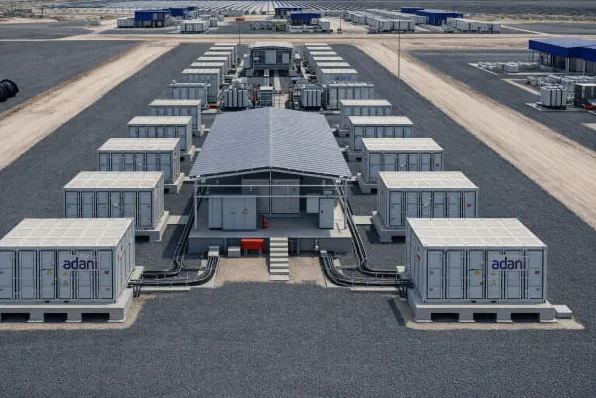
Adani Green Energy Limited has commissioned 3.37 GWh of battery energy storage capacity at Khavda, Gujarat, positioning the site among the world’s largest single location battery storage deployments outside China.
The company said the project was completed within 10 months of on site construction, with 1.37 GWh added in March 2026. The battery system is integrated into AGEL’s broader Khavda renewable energy development, where the company plans to build 30 GW of renewable capacity by 2029, of which 9.9 GW is already operational.
The deployment reflects a broader shift in India’s energy transition strategy. Renewable energy expansion is increasingly exposing the limitations of generation focused growth models that lack corresponding investment in dispatchable flexibility infrastructure.
India’s renewable energy targets require balancing rapidly expanding solar generation with increasingly volatile demand patterns. Solar output concentration during daylight hours continues to create curtailment risks and evening peak supply deficits, particularly in regions with limited flexible generation assets.
Battery energy storage systems are emerging as one of the primary tools to manage those imbalances. By storing surplus renewable electricity during periods of high generation and releasing it during demand peaks, utility scale batteries can reduce grid instability, lower renewable curtailment, and improve transmission utilization rates.
AGEL stated that the Khavda system could provide enough electricity to support nearly one million homes for a day. While such comparisons simplify actual dispatch dynamics, they illustrate the scale at which storage is beginning to enter India’s power infrastructure planning.
Although AGEL describes the installation as the largest single location battery deployment outside China, the comparison itself highlights China’s overwhelming dominance in grid scale battery storage.
China accounted for the majority of global battery storage additions in recent years, supported by vertically integrated supply chains, large scale lithium ion manufacturing, and aggressive domestic renewable integration mandates. India, by contrast, remains heavily dependent on imported battery materials and cells despite efforts to localize manufacturing through production linked incentive schemes.
This creates a strategic vulnerability for large scale Indian storage expansion. Battery deployment targets can accelerate rapidly on paper, but supply chain exposure to lithium pricing, imported components, and geopolitical trade disruptions continues to shape project economics.
The Khavda renewable park in Gujarat is increasingly functioning as a large scale test environment for integrating high shares of variable renewable generation into India’s grid.
The challenge is not simply adding renewable megawatts. The operational issue lies in maintaining frequency stability, voltage control, and reliable dispatch during periods of fluctuating renewable output. As renewable penetration increases, traditional coal based balancing becomes less economically efficient and more carbon intensive.
Battery systems can respond to grid fluctuations within milliseconds, making them particularly valuable for ancillary services and peak shaving applications. However, their economics remain highly sensitive to utilization rates, cycling frequency, and evolving market structures for storage compensation.
India’s electricity market still lacks the mature ancillary service pricing mechanisms seen in some developed markets, creating uncertainty around long term revenue visibility for battery operators.
Lithium ion battery prices have declined significantly over the past decade, helping accelerate utility scale storage adoption globally. Yet project profitability remains highly dependent on local electricity pricing structures, renewable curtailment levels, and capacity payment frameworks.
In India, storage deployment has increasingly been supported through hybrid renewable tenders that combine solar, wind, and storage assets into integrated supply contracts. This model improves renewable dispatchability but also introduces more complex project financing requirements.
AGEL’s stated ambition to scale battery storage capacity beyond 10 GWh in fiscal year 2027 and eventually toward 50 GWh over five years signals confidence in the commercial role of storage infrastructure. At the same time, scaling to that level would require substantial capital deployment and long term confidence in both electricity demand growth and regulatory support.