





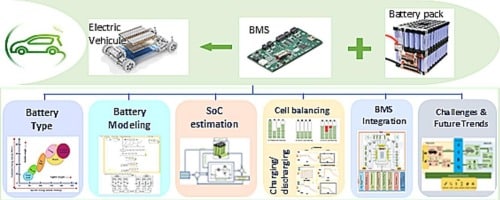
Electric vehicle sales exceeded 20% of global new car market share in 2024 and reached 35% in the first quarter of 2025. The battery management system sitting at the centre of every one of those vehicles has evolved in parallel, but less visibly than the cells it monitors. A review published in the Journal of Energy Storage in 2026 by researchers from Moroccan universities provides a structured account of where BMS technology currently stands: the gap between what the system needs to do to support next-generation batteries and what current commercial implementations can reliably deliver is wider than the EV industry’s growth figures suggest.
The core function of a BMS has not changed: monitor cell voltage, current, and temperature; estimate state of charge and state of health; control charging and discharging; and balance cells within a pack to prevent any single cell from degrading faster than the ensemble. What has changed is the scale at which those functions must operate and the tolerance for error. A pack containing thousands of individual lithium-ion cells, typical of long-range passenger vehicles and commercial trucks, requires continuous high-frequency monitoring across a parameter space that no single algorithm can optimise simultaneously without trade-offs. The review characterises the current generation of BMS as entering its “intelligent” phase, integrating sophisticated SoC and SoH estimation algorithms with cloud connectivity and real-time diagnostics. The distance between that framing and actual deployed capability in mass-market vehicles is the gap this analysis examines.
The Wired-to-Wireless Transition and Its Unresolved Trade-offs
The transition from conventional wired BMS to wireless BMS architectures has accelerated over the past four years, driven by weight reduction, modularity, and the disassembly advantages that wireless modules offer for second-life battery repurposing. General Motors deployed wireless BMS technology in the Ultium platform, and the approach is gaining industrial recognition across Tier 1 battery suppliers.
The weight savings are real. A conventional wired BMS in a large battery pack involves harnesses connecting every cell to monitoring modules, with CAN bus protocols routing signals to a central microcontroller. Eliminating those harnesses reduces pack weight measurably and simplifies the mechanical design, which matters for both vehicle efficiency and the labour cost of battery assembly and disassembly. For second-life applications, where battery modules extracted from end-of-life vehicles are redeployed into stationary storage, wireless modules that retain their individual state data and can be integrated into new packs without rewiring reduce reconditioning costs significantly.
The trade-offs are also real. No single wireless communication protocol satisfies all BMS requirements simultaneously. ZigBee provides low power consumption and mesh topology that maintains network continuity on node failure, but its throughput of 250 kilobits per second limits real-time transmission of high-resolution SoH and remaining useful life data. Bluetooth Low Energy offers lower latency but has a reduced range and limits on simultaneous connections, constraining multi-module data aggregation when high-frequency measurement is required. Wi-Fi protocols provide throughput suitable for cloud integration and IoT diagnostics but consume significantly more power and are sensitive to the electromagnetic interference that a high-voltage automotive environment generates continuously. The review’s assessment that no single protocol perfectly meets the combined requirements of reliability, data security, transfer speed, and interference tolerance leads logically to hybrid architectures combining BLE for intra-pack communication with LPWAN or Wi-Fi for external transmission, but hybrid architectures introduce their own integration and certification complexity.
State Estimation: Where the Performance Gap Is Most Consequential
State of charge estimation accuracy determines how much of a battery’s capacity can safely be used without risking over-discharge or overcurrent events that accelerate degradation. State of health estimation determines whether a vehicle’s predicted range, warranty claims, and second-life valuation reflect the actual condition of its cells. Errors in either are not merely academic inconveniences: they translate directly into range anxiety, premature battery replacement, or, in the safety-critical direction, thermal events caused by operating cells beyond their actual limits.
The review characterises accurate SoX estimation as “absolutely crucial” for safe operation, which is accurate but understates the difficulty of achieving accuracy across the operating envelope of a commercial battery pack. SoC estimation using Coulomb counting accumulates sensor errors over the integration period. Model-based approaches using equivalent circuit models or electrochemical models improve accuracy but require the model parameters to remain valid across temperature, ageing state, and cycling history, which they do not over the life of the pack without continuous recalibration. The intelligent third-generation BMS integrates these approaches with machine learning models that can adapt to cell ageing in real time, but machine learning approaches require training data representative of the actual cells and operating conditions, and the model that performs well in controlled testing may degrade in accuracy as the battery ages beyond the conditions the training data captured.
SoH estimation adds a further layer of difficulty because capacity fade and impedance rise in lithium-ion cells are influenced by factors including temperature history, depth of discharge patterns, fast charging frequency, and manufacturing variance between cells in the same pack. A BMS that accurately estimates SoH for the average behaviour of its cell population may still misestimate the state of outlier cells, which are precisely the cells most likely to initiate thermal runaway events. The review’s emphasis on the shift toward integrated closed-loop systems that coordinate modelling, estimation, charging, and balancing reflects the recognition that these functions are not separable in a high-performance BMS: a charging algorithm that does not account for the current SoH estimate of individual cells will produce cell imbalance faster than a balancing system can correct.
Thermal Management as the Safety-Critical Subsystem
Thermal management is where BMS performance has the most direct safety consequences. Lithium-ion cells operate safely within a temperature window of approximately 15 to 45 degrees Celsius during charging and up to 60 degrees Celsius during discharge, with thermal runaway initiating above approximately 80 degrees Celsius depending on cell chemistry. Maintaining uniform temperature across a pack that generates heat non-uniformly during fast charging, regenerative braking, and high-power discharge requires thermal management systems that respond to BMS monitoring signals in real time.
The performance demands on thermal management are intensifying as fast charging capability becomes a commercial differentiator. Charging at rates above 2C generates heat at a pace that liquid cooling systems must dissipate continuously to prevent localised hotspots. The challenge is compounded by cell-to-cell variation within a pack: cells at the edges of a liquid-cooled module run cooler than cells in the centre, creating systematic temperature gradients that accelerate differential ageing and degrade pack uniformity over time. Advanced BMS designs address this by modulating charging rate dynamically across cells or modules based on real-time temperature measurement, but implementing this at the cell level in a large pack requires either a highly distributed BMS architecture or a centralised system with sensor density that adds cost and failure modes.
Cybersecurity as a Design Requirement, Not an Add-On
The review’s inclusion of cybersecurity as a future challenge for BMS reflects a shift in how battery management systems are understood architecturally. A BMS connected to cloud platforms for remote SoH monitoring, over-the-air software updates, and fleet management is no longer an isolated embedded control system. It is a node in a connected ecosystem with attack surfaces that did not exist in the wired BMS generation. Unauthorised access to BMS software could allow manipulation of charging parameters, falsification of SoH data in second-life certification, or interference with safety protection functions in extreme cases.
Vehicle cybersecurity regulation under UN ECE Regulation 155, which entered into force for all new vehicle types in EU markets in 2024, requires manufacturers to implement cybersecurity management systems covering the full vehicle lifecycle including software updates. BMS software is within scope. The practical challenge is that BMS firmware updates must be validated against the full parameter space of cell behaviour, and an update that improves SoC estimation accuracy for fresh cells may behave differently on aged cells with altered electrochemical characteristics. Validating updates across the ageing trajectory of deployed packs introduces a testing burden that the automotive industry is still developing processes to manage at scale.
Digital Twins and the Trajectory Toward Predictive Management
The most technically ambitious direction in current BMS research is the integration of digital twin models: continuously updated virtual representations of individual cells and packs that track electrochemical state, thermal history, and degradation trajectory in real time. A digital twin-enabled BMS does not merely estimate current SoH from measured signals; it maintains a physics-based model of each cell’s internal state that can be used to project future capacity fade, predict remaining useful life under different usage scenarios, and optimise charging and discharging strategies to maximise lifespan for the specific operating profile of each vehicle or storage system.
The computational requirements for digital twin BMS are substantial. Electrochemical models accurate enough to capture the coupled effects of solid electrolyte interphase growth, lithium plating, particle cracking, and electrolyte decomposition require significantly more processing power than the equivalent circuit models deployed in current commercial systems. Edge computing architectures that perform computationally intensive estimation locally rather than offloading to cloud platforms can reduce latency for safety-critical control decisions, but hardware cost and power consumption remain constraints at the vehicle level. Machine learning approaches that approximate the physics-based model with a trained neural network reduce computational load but reintroduce the generalisation and reliability concerns that make regulators and manufacturers cautious about deploying learned models in safety-critical control paths.