



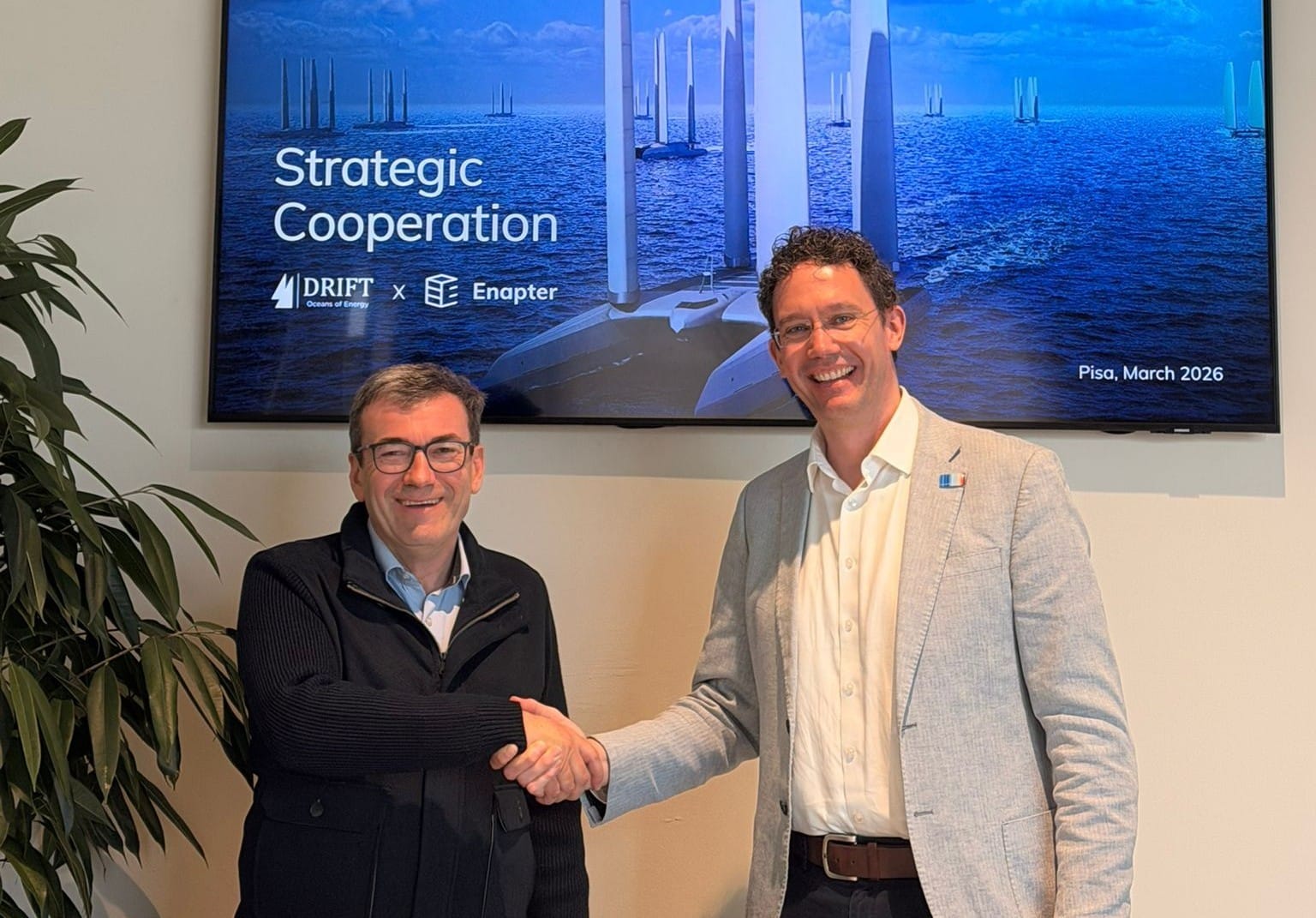
DRIFT Energy and Enapter have signed a collaboration agreement to adapt anion exchange membrane electrolyser technology for deployment at sea, a move that directly addresses one of the sector’s most persistent technical bottlenecks.
The agreement focuses on marinizing Enapter’s AEM electrolyser platform for integration into DRIFT’s energy harvesting vessels, which are designed to convert wind and ocean energy directly into green hydrogen offshore. While hydrogen production at sea has been widely discussed as a way to bypass grid constraints and reduce offshore transmission costs, few projects have progressed beyond pilot scale due to equipment reliability concerns. Electrolysers are typically optimized for stationary, land-based operation, not constant motion, salt exposure, and limited maintenance access.
DRIFT’s order book includes more than 30 energy ships, creating a defined demand signal for modular, mid-scale electrolysers capable of operating autonomously offshore. The partnership aims to accelerate the energy storage component of DRIFT’s system, positioning hydrogen not just as a fuel but as a stabilizing vector for intermittent marine energy generation. The companies have also identified offshore wind as a secondary application, where mid-sized electrolysers could convert curtailed wind power into hydrogen at sea rather than relying on congested onshore grids.
AEM electrolysis is central to this strategy. Compared with conventional alkaline and proton exchange membrane technologies, AEM systems promise lower material costs and reduced reliance on critical minerals, though long-term durability remains under scrutiny. Enapter has commercialized modular AEM units onshore, but offshore deployment introduces new variables, including mechanical stress from vessel motion and accelerated corrosion risks. Marinization efforts will focus on materials selection, stack configuration, and system redundancy, all critical for maintaining uptime in remote environments.
Development work will be led from Enapter’s production facility in Pisa, with both companies engaging classification societies to meet marine certification requirements. Certification is a non-trivial hurdle. Marine standards impose stricter safety and reliability thresholds than industrial hydrogen installations, and failure to meet these standards has delayed multiple offshore energy concepts in recent years. The partners expect a first maritime-ready unit to be available by 2027, a timeline that reflects both the technical complexity and regulatory scrutiny involved.
From a market perspective, the collaboration highlights a shift away from speculative offshore hydrogen concepts toward systems anchored by specific use cases and defined deployment volumes. However, questions remain around cost competitiveness. Offshore electrolysis must contend with higher capital costs, challenging maintenance logistics, and uncertain hydrogen offtake pricing. Without clear long-term demand signals from maritime fuel markets or offshore energy hubs, scaling beyond early deployments will depend on policy support and carbon pricing mechanisms that can bridge the cost gap.