





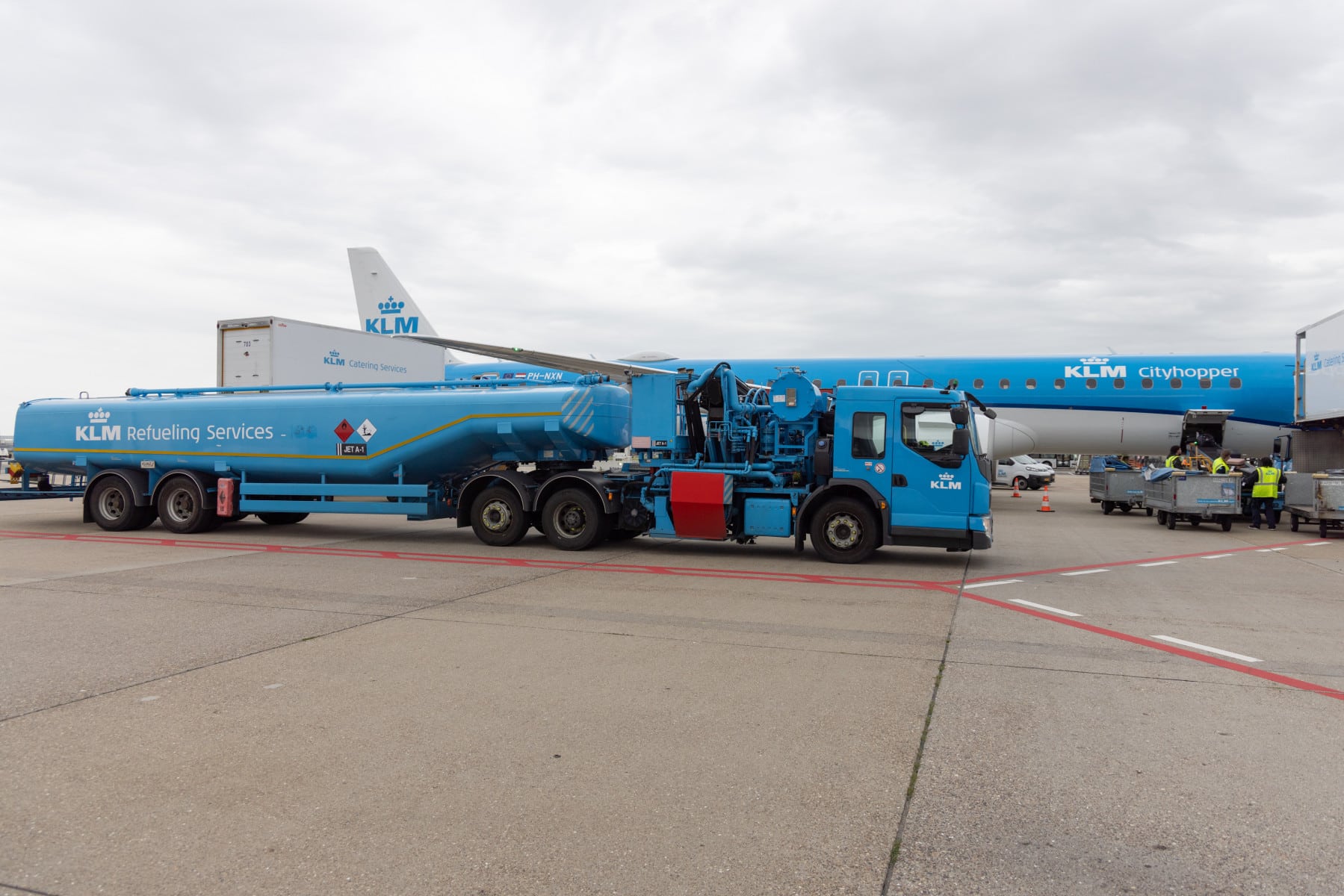
KLM’s flight from Amsterdam to Hamburg this week carried passengers on a 5% blend of synthetic kerosene, the first e-SAF passenger flight to Germany. The fuel, produced by INERATEC using renewable electricity, CO2, and water, was blended by MB Energy and loaded at Schiphol before departure.
The operation was technically routine. The volume involved was not 200 litres of e-SAF, down from the 500 litres used when KLM operated the world’s first commercial e-SAF passenger flight on the Amsterdam to Madrid route in 2021. That the blend volume has shrunk over four years of effort is the most honest data point in the announcement, and it frames the real state of the market more accurately than any of the positive statements accompanying it.
Synthetic sustainable aviation fuel is produced via the power-to-liquid pathway, combining green hydrogen with captured CO2 to synthesise hydrocarbons that are chemically compatible with existing jet engines and fuelling infrastructure. Its lifecycle emissions reduction potential, cited at over 90% compared to fossil kerosene, is among the highest of any drop-in aviation fuel. The problem is not the chemistry. It is everything that comes after it.
The Gap Between Mandate and Production
ReFuelEU Aviation, the European regulation governing sustainable aviation fuel blending, sets a sub-target of 1.2% e-SAF as a share of total aviation fuel uplifted at EU airports by 2030. KLM’s own statement acknowledges that today, only a fraction of that mandate is in production. The gap is not marginal. Global e-SAF production capacity remains in the range of tens of millions of litres annually at a time when European aviation alone consumes tens of billions of litres of jet fuel each year. Closing that gap in four years would require a rate of capacity addition that current project pipelines do not support.
The cost structure reinforces the supply constraint. E-SAF is currently priced at roughly four times the cost of conventional SAF and approximately eight times the price of fossil kerosene. SAF itself, produced primarily from waste oils and agricultural residues via the hydroprocessed esters and fatty acids pathway, already commands a significant premium over fossil fuels. E-SAF sits at a further multiple above that. For airlines operating on thin margins in a highly price-sensitive market, voluntary uptake at these cost differentials is structurally limited. Mandate-driven blending shifts the economics somewhat by creating a compliance obligation. Still, the cost is ultimately passed through to ticket prices, and the distributional and competitive implications of differential e-SAF availability across EU and non-EU carriers remain an active policy concern.
Why Scale Has Not Arrived
The production barrier has several distinct components that policy discussions tend to conflate. The first is electrolyser capacity and the cost of green hydrogen. E-SAF synthesis requires hydrogen produced from renewable electricity at a cost and scale that Fischer-Tropsch or methanol-to-jet synthesis plants can work with economically. Green hydrogen costs have fallen significantly in markets with abundant renewable generation, but they remain above the threshold needed to produce e-SAF at a price competitive with fossil kerosene without subsidy.
The second component is permitting and project development timelines. KLM explicitly flags the difficulty of obtaining construction and environmental permits for e-SAF production facilities in Europe as a constraint on supply growth. Power-to-liquid plants are novel industrial facilities with CO2 intake infrastructure, electrolysis halls, and synthesis units, and permitting processes in most European jurisdictions have not been adapted to accelerate their development in the way that solar and wind project permitting has been in recent years.
The third component is policy certainty. KLM’s statement references uncertainty over possible changes to ReFuelEU legislation as a factor dampening investment. This is a genuine risk for project developers weighing 15 to 20-year infrastructure investments against a regulatory environment that has seen multiple revisions to SAF and e-SAF framework proposals. Without long-term offtake certainty anchored in stable policy, the cost of capital for e-SAF projects remains elevated relative to what the economics of the sector can support.
What INERATEC’s Position Reveals
INERATEC, the Frankfurt-based power-to-liquid technology company that produced the synthetic kerosene for the Hamburg flight, has positioned itself at the commercial-scale end of the e-SAF technology spectrum. Its CEO, Tim Boeltken’s statement that the company is “ready to deliver” reflects a genuine capability at demonstration and early commercial scale. INERATEC operates modular Fischer-Tropsch synthesis units designed for distributed production, which addresses one aspect of the supply chain problem: the ability to co-locate production with renewable electricity sources and CO2 feedstock rather than depending on centralised mega-facilities.
The modular approach has advantages in capital efficiency and deployment speed, but it also has limits. Per-unit production costs at small scale remain significantly higher than they would be at the volumes required to make a material dent in European aviation fuel demand. The pathway from technically viable demonstration flights to the fuel volumes needed to meet even the 1.2% e-SAF sub-target by 2030 requires not just more INERATEC units but a parallel scaling of renewable electricity supply, CO2 capture infrastructure, and the logistics chain connecting production to airport fuelling systems.
MB Energy’s role in the Hamburg operation, handling blending and supply chain logistics, points to an underappreciated part of the scaling challenge. Even when e-SAF is produced, integrating it into existing aviation fuel supply chains requires certified blending facilities, documentation for regulatory compliance under ReFuelEU, and physical logistics that most airports and fuel distributors have not yet built for synthetic fuels at scale. The infrastructure readiness that Hamburg Airport’s Christian Kunsch cited is genuine at the airport’s end, but it represents one node in a supply chain where most other nodes remain underdeveloped.
The Policy Work That Remains
The technical demonstration value of flights like the Amsterdam to Hamburg service is limited at this stage. Drop-in compatibility of e-SAF with existing engines and infrastructure has been established. The question is no longer whether it works in an aircraft; it is whether the production and supply system can be built at the necessary scale and cost. That is a question answered by investment, permitting reform, and regulatory stability rather than by further demonstration flights.
The ReFuelEU sub-mandates create a compliance mechanism, but mandates without adequate supply produce price spikes and competitive distortions rather than the intended decarbonisation. Several European carriers have already begun signalling the cost exposure embedded in the 2030 e-SAF sub-target given current production trajectories. The more useful near-term policy interventions are probably on the supply side: streamlined permitting for power-to-liquid facilities, contracts for difference structures that reduce revenue risk for early commercial-scale plants, and coordinated CO2 supply infrastructure that can serve multiple e-SAF producers in industrial clusters. Without those, the 1.2% target for 2030 risks becoming a compliance cost rather than a decarbonisation mechanism.