




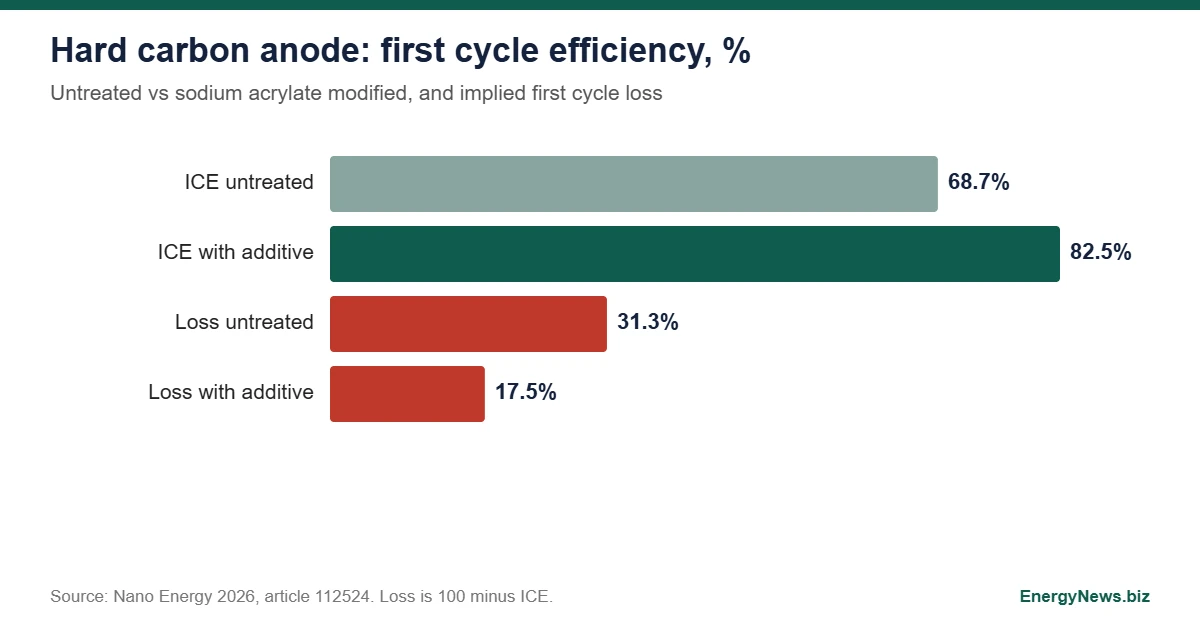
Adding sodium acrylate to a hard carbon anode raises the initial Coulombic efficiency of a sodium ion half cell from 68.7 percent to 82.5 percent, according to a paper published online in Nano Energy on 22 October 2026. The result targets the central weakness of the hard carbon anode: the sodium consumed irreversibly in the first cycle.
The hard carbon anode problem
Hard carbon is regarded as one of the most promising anode materials for sodium ion batteries, but the authors, led by Yue Wang and Shujiang Ding, note that its practical use is limited by low initial Coulombic efficiency and by continuing interfacial degradation from uncontrolled electrolyte decomposition. Every point of efficiency lost in the first cycle is sodium that the cathode has to supply and the cell cannot recover, which cuts usable energy density.
How sodium acrylate changes the hard carbon anode
Sodium acrylate molecules are introduced onto the carbon surface and alter its local chemistry. During the first cycles the molecules evolve electrochemically and take part in forming the solid electrolyte interphase. The authors report a thin, uniform, inorganic rich interphase that suppresses electrolyte decomposition and reduces irreversible sodium consumption.
What the numbers mean
The optimised electrode delivers a reversible capacity of 287.5 mAh per gram and retains 181.2 mAh per gram after 6,000 cycles at 10 C. The efficiency gain is 13.8 percentage points, a 20 percent relative improvement. Put as loss, the share of first cycle sodium consumed irreversibly falls from 31.3 percent to 17.5 percent, a reduction of about 44 percent. Both figures are calculated from the reported efficiencies.
The cycling number is harder to judge. The abstract does not give the capacity at the start of the 10 C test, so a retention percentage cannot be derived from what is published. A full cell with a sodium vanadium phosphate cathode also showed improved performance, but without figures in the abstract.
Limits of the hard carbon anode result
An efficiency of 82.5 percent still leaves 17.5 percent of first cycle sodium lost, and the measurements are electrode level results from a laboratory study. The approach is a simple surface modification, but cost, scaling and behaviour in large cells are not addressed in the abstract. For the policy backdrop to battery chemistry choices, see our analysis of China’s 2030 battery plan. The paper is available at Nano Energy, article 112524.
Add EnergyNews.biz as a preferred source on Google


