




Hydrogen ammonia sector coupling expands the electrolyser fleet, but not for the reason many planners assume. A 25 year optimisation model published in the International Journal of Hydrogen Energy (DOI 10.1016/j.ijhydene.2026.158116) finds that adding ammonia synthesis to a hydrogen back-up power system raises electrolyser capacity by 20% to 25%, yet capacity factors stay at only 35% to 36%.
The extra build is justified by a roughly 64% price premium for low-carbon ammonia, not by smoother demand. Only the abstract, highlights, introduction and snippets were available, so this report rests on those and not on the full results.
What the hydrogen ammonia sector coupling model tests
Hydrogen for back-up electricity is highly variable, while demand for ammonia synthesis is relatively steady. The intuition is that pairing them keeps electrolysers busier and justifies more of them. The authors built a mathematical model that optimises investment and operation over 25 years, with ammonia synthesis as an optional use whose attractiveness depends on the carbon abatement value under evolving carbon rules. Direct ammonia combustion for power was excluded because the authors regard it as an immature field with uncertain timelines and costs.
The numbers behind hydrogen ammonia sector coupling
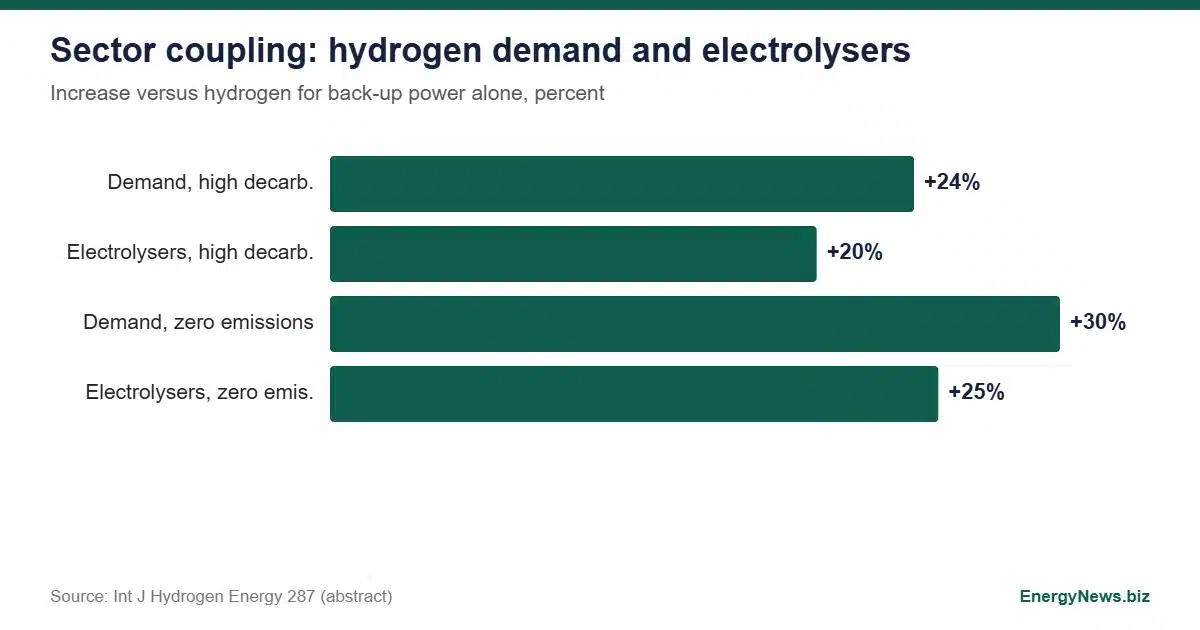
Sector coupling raised hydrogen demand by 24% under high decarbonisation and by 30% under zero emissions. Electrolyser capacity rose by 20% and 25% in the same two cases. The arithmetic is worth a pause: demand grew a few percent faster than capacity (1.24 against 1.20, and 1.30 against 1.25), yet the abstract reports electrolyser capacity factors held at 35% to 36%.
At that utilisation a new electrolyser sits idle for about 64% of the hours in a year, so each added megawatt is a capital cost spread over little output. The abstract does not explain the small gap between demand and capacity growth, and the full results would be needed to say more.
That is why the authors reject the stable demand story. The scale-up is justified by the premium of about 64% earned by low-carbon ammonia over its conventional counterpart. When biomethane prices fell in a sensitivity case, hydrogen was prioritised for power and ammonia output was eliminated, which shows how sensitive the ammonia route is to its competition.
Fuel cells take the small scale, turbines take the growth
The model also sorts the hydrogen-to-electricity step by scale. Allowing small-scale operability shifts about 14% of reconversion from modified gas turbines to fuel cells. Early, small hydrogen uses favoured fuel cells, while turbines met growing demand later. For developers deciding what to install first, that implies a staged pathway rather than a single technology choice.
What policy makers should take from it
The authors conclude that frameworks aimed at accelerating hydrogen should prioritise the economic competitiveness of hydrogen-derived products, because demand diversification plays a subordinate role. The paper’s introduction supports the cost framing: it cites International Energy Agency figures for 2024 renewable hydrogen costs of about 3.4 euros per kilogram in resource-rich regions and above 8.5 euros elsewhere, and notes that electricity price and electrolyser capital cost make up over 75% of production cost.
Conventional ammonia made from natural gas accounts for about 2% of global energy use and roughly 450 million tonnes of CO2 a year. See the IEA’s hydrogen overview for context, the IEA projects database for deployment data, and recent coverage of Germany’s hydrogen package and green hydrogen costs in China for the policy side.
Caveats are material. The results come from a model, not a built system, the abstract does not name the region or the price inputs, and the 64% premium appears to be a scenario input rather than an observed market price, which the abstract does not clarify. The conclusion that product competitiveness beats demand stability should be read as conditional on those inputs.
For investors, the hydrogen ammonia sector coupling result is a reminder that capacity and utilisation are different questions. Hydrogen ammonia sector coupling can justify a larger electrolyser fleet without improving its load factor, so project returns depend on the ammonia price rather than on the dispatch pattern. Planners who model hydrogen ammonia sector coupling should therefore test the product premium first and treat demand smoothing as a secondary benefit.
Add EnergyNews.biz as a preferred source on Google


