




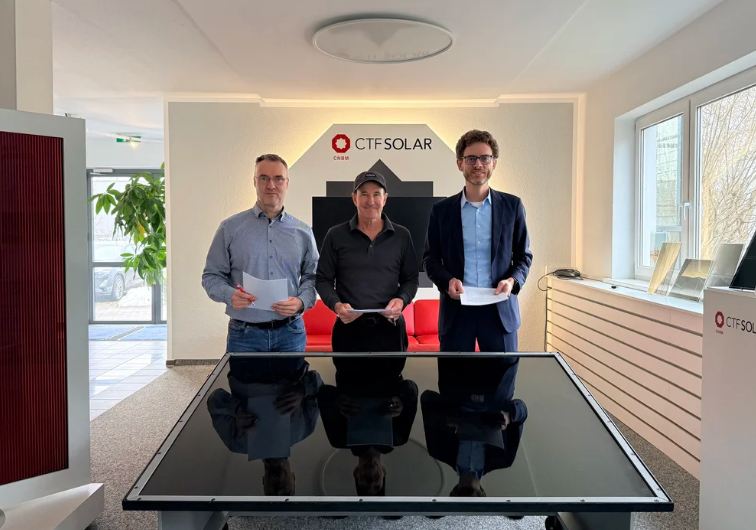
SunHydrogen, Inc. has signed a Technology and Manufacturing Services agreement with CTF Solar GmbH, a subsidiary of China National Building Materials Group, in an effort to move its sunlight-driven hydrogen panels closer to industrial reality.
The agreement formalizes a contracted manufacturing development program intended to translate pilot data into a controlled production workflow. The near-term target is the fabrication of 1,000 full-size hydrogen modules, each with an active area of 1.92 square meters. While modest by industrial standards, this scale is significant for a company whose technology remains pre-commercial and whose shares trade on the OTCQB market, where investor scrutiny of execution risk is typically high.
SunHydrogen’s approach bypasses conventional electrolyzers by integrating photoelectrochemical processes directly into modular panels that use sunlight and water to generate hydrogen. In theory, this architecture could reduce system complexity and balance-of-plant costs. In practice, however, photoelectrochemical hydrogen systems have historically struggled with durability, efficiency losses over time, and manufacturing reproducibility at scale. The agreement with CTF Solar is designed to address precisely these bottlenecks by embedding SunHydrogen’s process learnings into a manufacturing environment accustomed to tight process control.
The partnership builds on earlier collaboration milestones, including agreements signed in December 2023 and July 2024, and an expanded memorandum of understanding announced in November 2025. What differentiates the latest agreement is its binding structure, with defined deliverables and validation objectives aimed at locking in a pathway to repeatable production. Manufacturing discipline, rather than further laboratory optimization, now appears to be the central focus.
CTF Solar’s involvement brings experience from the photovoltaic manufacturing sector, where scaling from pilot lines to mass production has historically delivered steep cost reductions through standardization and yield improvements. Whether those dynamics can be replicated for hydrogen panels remains an open question. Unlike solar modules, hydrogen-generating panels must manage gas separation, corrosion resistance, and long-term catalyst stability under real-world conditions, factors that complicate both quality control and certification.
From a strategic standpoint, the agreement also reflects broader geopolitical and industrial trends. European-based manufacturing development in Dresden positions the project within a regulatory environment that increasingly favors domestically anchored clean energy supply chains, while CNBM’s backing provides access to industrial-scale manufacturing know-how and capital depth that smaller technology developers typically lack.
SunHydrogen’s management has framed the agreement as a step toward securing an initial offtaker within the coming year. That objective highlights a critical inflection point. Without a contracted customer willing to validate performance, cost, and reliability under operational conditions, even a successful 1,000-unit production run would remain a technical demonstration rather than a commercial breakthrough. Offtakers in today’s hydrogen market are increasingly demanding bankable performance data and clear pathways to levelized hydrogen costs that can compete with both conventional electrolysis and fossil-based hydrogen with carbon capture.
The agreement does not disclose expected efficiencies, projected hydrogen output per module, or anticipated manufacturing costs, leaving key commercial metrics untested.