



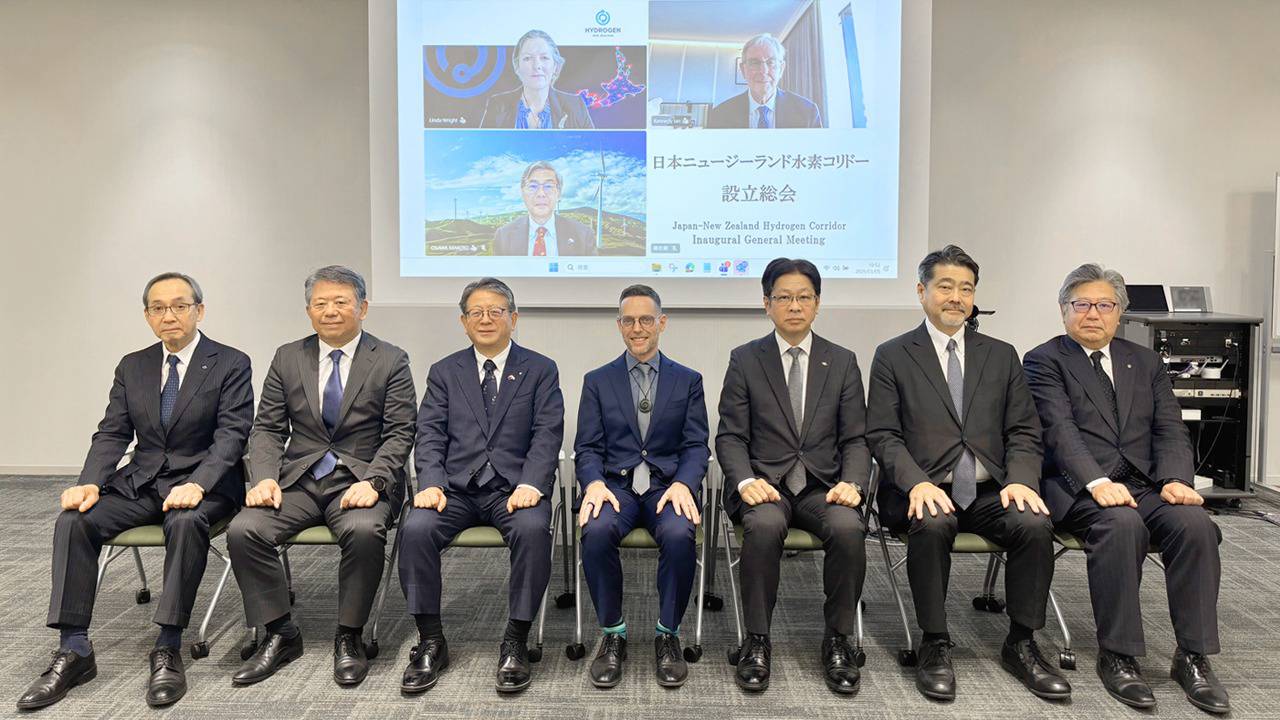
Japan imported approximately 87% of its energy in 2023, a dependency that has deepened since the Fukushima nuclear disaster and one that its domestic renewables landscape cannot structurally resolve. Against that backdrop, the establishment of the Japan–New Zealand Hydrogen Corridor on March 5, 2026, by Mitsui O.S.K. Lines, Obayashi Corporation, Kawasaki Heavy Industries, and Chiyoda Corporation represents less a commercial opportunity and more a strategic hedge against a future where green hydrogen demand outpaces any realistic domestic supply scenario.
The Supply Gap That Necessitates a Pacific Corridor
Japan’s energy self-sufficiency rate stood at approximately 15.3% as of fiscal year 2023, with renewable energy accounting for roughly 22.9% of total electricity generation. The government’s 7th Strategic Energy Plan, approved in January 2025, targets a renewable share of 40 to 50% in the power mix by 2040, but even critics within Japan’s Renewable Energy Institute argue that this falls well short of what would be needed for meaningful self-sufficiency, estimating that a 90%-plus renewable electricity system by 2040 could push overall primary energy self-sufficiency to around 75%.
The government has publicly acknowledged that meeting large-scale future hydrogen demand through domestic production alone is not feasible. Green hydrogen produced domestically via electrolysis currently ranges between USD 3.0 and 10.3 per kilogram, against a government target cost of approximately USD 0.30 per cubic meter by 2030. That cost gap is structural: Japan’s electricity prices are among the highest in the OECD, electrolyser manufacturing costs remain elevated relative to Chinese and European competitors, and suitable land for utility-scale renewable buildout is geographically constrained. Japan’s hydrogen targets, which call for 3 million tonnes of consumption per year by 2030, scaling to 20 million tonnes by 2050, require international supply chains that domestic infrastructure cannot substitute.
Why New Zealand, and What the Numbers Support
New Zealand’s renewable energy profile presents a compelling feedstock case. As of 2024, approximately 45.5% of the country’s total primary energy supply derives from renewable sources, and around 85.5% of its electricity is generated from hydropower, geothermal, and wind. That baseload renewable intensity, particularly the geothermal and hydropower components, matters specifically for green hydrogen economics: electrolysers need consistent, low-carbon electricity to produce hydrogen at competitive costs, and intermittent solar or wind resources require substantial storage and grid management overhead that raises the delivered cost.
New Zealand’s government formalised its commitment to hydrogen sector development in November 2024 through its Hydrogen Action Plan, which focuses on expanding a market-led low-emission hydrogen industry by reducing regulatory barriers and improving the investment environment. The country’s total current production capacity, however, remains limited. The largest green hydrogen facility to have reached a final investment decision as of early 2026 is a 5MW plant in South Taranaki, modest by any measure of the export volumes Japan would require at a commercial scale. Obayashi, one of the four consortium members, exported the first green hydrogen from New Zealand to a demonstration facility at Lautoka Port in Fiji in January 2025, a proof-of-concept milestone but one that underscores how early-stage the operational infrastructure remains.
Consortium Composition and the Shipping-Logistics Axis
The composition of the consortium reflects the full technical scope of what a hydrogen export corridor requires. Kawasaki Heavy Industries developed the world’s first liquefied hydrogen carrier and completed Japan’s first liquefied hydrogen receiving terminal in 2020, giving it direct experience in hydrogen’s most demanding logistics challenge: cryogenic marine transport at scale. Chiyoda Corporation holds significant intellectual property in methylcyclohexane-based hydrogen carriers, an alternative transport modality that converts hydrogen into a liquid organic carrier that can be handled using conventional tanker infrastructure, reducing the capital intensity of receiving terminals.
Mitsui O.S.K. Lines brings the shipping network and vessel management expertise, while Obayashi contributes construction and production site development experience on the New Zealand side. The combination addresses the full supply chain from production through liquefaction or chemical conversion, maritime transport, and receiving infrastructure in Japan. Whether the corridor ultimately adopts liquid hydrogen, ammonia, or an organic carrier approach will likely be determined during the feasibility studies scheduled for fiscal year 2026.
The 2030s Timeline and Its Dependencies
Feasibility work beginning in fiscal 2026, with commercial imports and exports commencing in the early 2030s, reflects the practical lead times involved in scaling green hydrogen export infrastructure from near-zero. For context, Australia, which has been more advanced in its hydrogen export development than New Zealand, has seen project after project push timelines to the mid to late 2030s as cost, electrolyser supply chain, and offtake agreement challenges have accumulated.
The Japan–New Zealand corridor faces several dependencies that will determine whether the early 2030s target is achievable. First, green hydrogen remains significantly more expensive than conventional fuels: at current prices, it costs approximately 10 times as much as natural gas, and Japan’s government has introduced a 15-year subsidy programme for hydrogen buyers purchasing a minimum of 3,000 metric tonnes per year, to be implemented from 2030, which partially bridges the commercial gap. Second, New Zealand must scale its renewable generation and electrolysis capacity from its current limited base substantially within the next five to seven years to meet any meaningful export volume. Third, the corridor will need to demonstrate a competitive delivered cost to Japan relative to alternative hydrogen supply sources, including Australia, the Middle East, and Canada.
Japan’s revised Hydrogen Basic Strategy in 2023 allocated a JPY 15 trillion public-private investment plan across the hydrogen supply chain, and the government has framed hydrogen imports explicitly within its security-of-supply criteria, requiring projects to deliver at least 1,000 tonnes of hydrogen equivalent per year and lower carbon intensity to levels consistent with post-subsidy self-sufficiency.
The Strategic Dependency Calculus
The diplomatic dimension is not incidental. Japan maintains long-established trade and security relationships with New Zealand, which reduces the geopolitical risk profile relative to sourcing from markets where strategic leverage could be weaponised. The rare earth export controls introduced by China in 2025, which caused production halts in the automotive sector, have recalibrated how Japanese industry and policymakers think about supply chain concentration. Diversifying energy import sources across politically stable partners is now an explicit objective of Japan’s revised energy security framework.
What the consortium has not resolved, and what feasibility studies over the next several years will need to confront, is whether the economics of a New Zealand to Japan hydrogen corridor can close without sustained government support on both ends, given the distance involved, the scale of production infrastructure required, and the competition from established hydrogen export corridors that are already further along in development. Japan’s JPY 20 trillion GX Economic Transition Bond programme, designed to fund decarbonisation investment, provides the fiscal architecture for support, but the cost-competitiveness question remains open.
The World Economic Forum has noted that Japan’s hydrogen deployment risks creating a new form of energy dependency if import reliance becomes structural before sufficient domestic production capacity matures, a paradox that applies directly to the New Zealand corridor. Meeting Japan’s 2050 carbon neutrality target at the 20 million tonne hydrogen scale will require multiple international supply corridors operating simultaneously, and the Japan–New Zealand Hydrogen Corridor, if the feasibility work delivers commercially viable results, would represent one node in that broader architecture.