




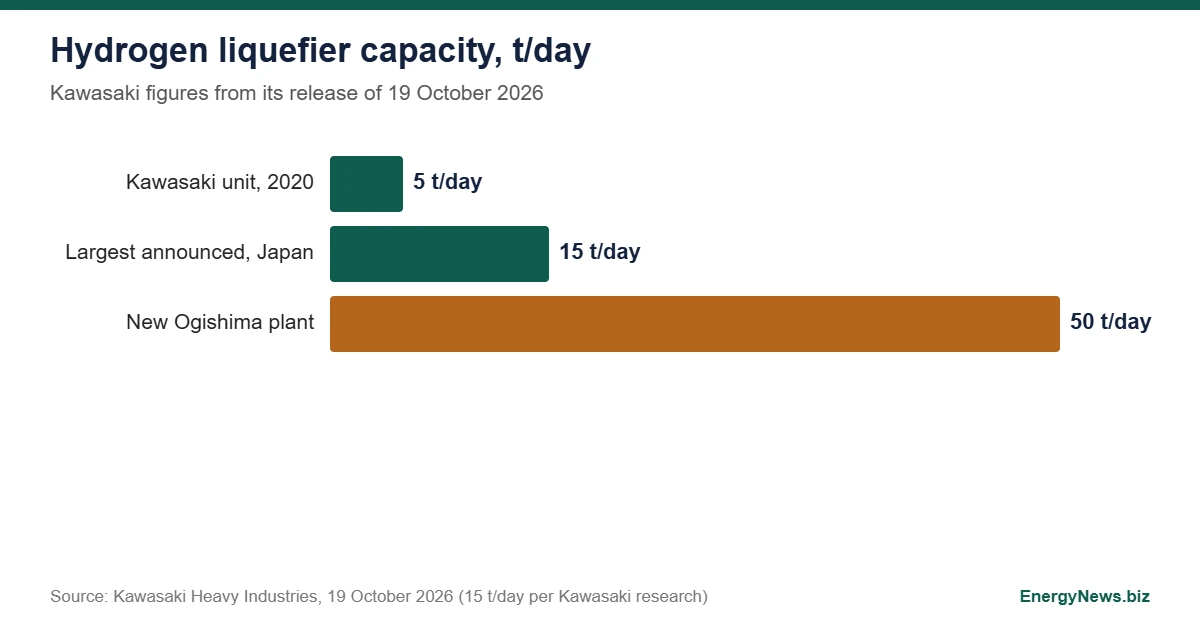
Kawasaki Heavy Industries announced on 19 October 2026 that construction has started on a hydrogen liquefier with a capacity of 50 tonnes per day at the Kawasaki LH2 Terminal in Ogishima, Kanagawa. Completion is scheduled for the end of 2028, and a commercialization demonstration follows from 2030.
The capacity is a tenfold step from the 5 tonnes per day liquefier Kawasaki began selling in 2020, and more than three times the 15 tonnes per day the company says is the largest publicly announced in Japan. The date matters as much: 2030 is the start of a demonstration, not of commercial supply, and the release gives no liquefaction energy figure.
What the release states about the hydrogen liquefier
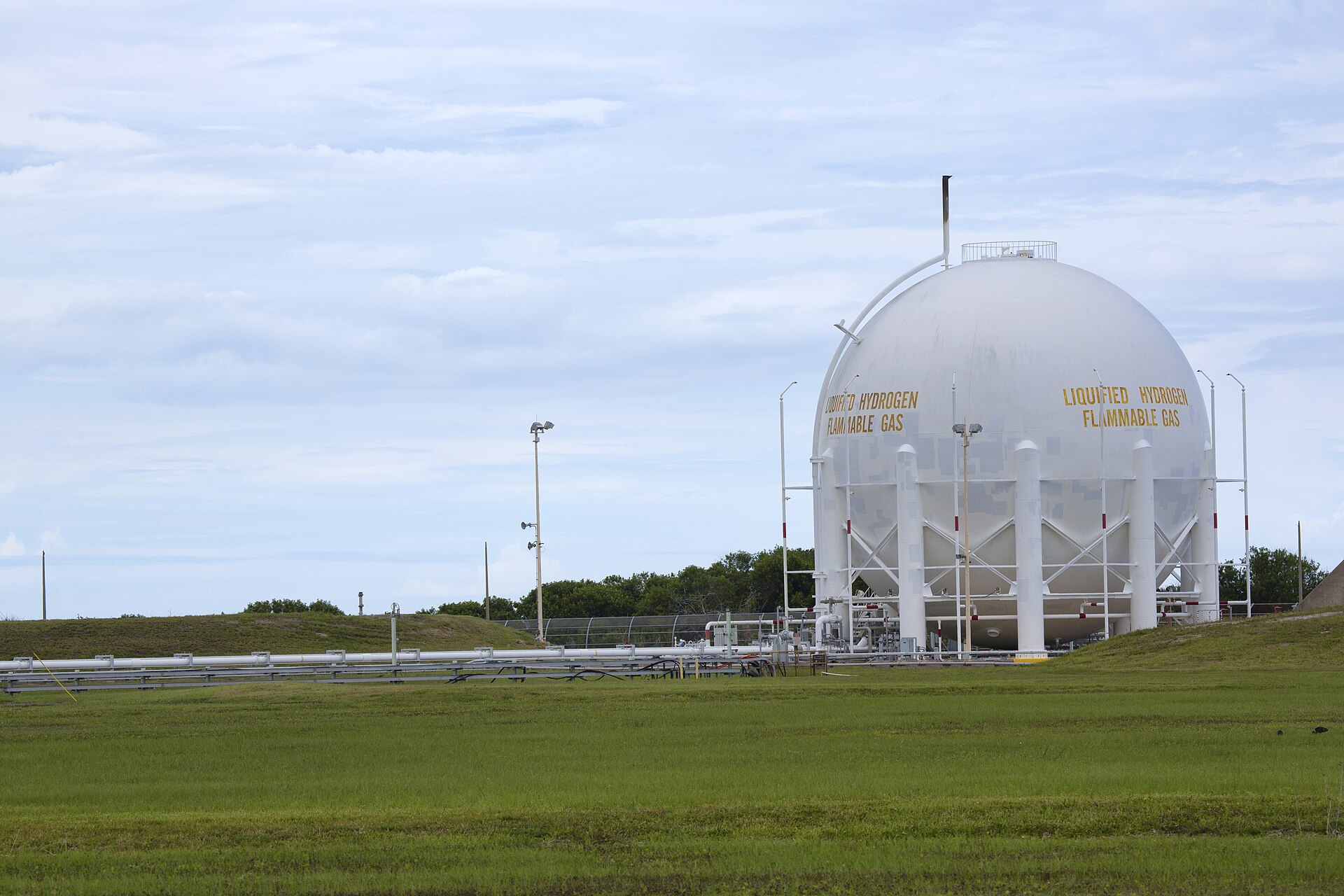
The plant serves the Liquefied Hydrogen Supply Chain Commercialization Demonstration, part of the Large-scale Hydrogen Supply Chain Establishment project under the NEDO Green Innovation Fund. It is the liquefaction facility for the terminal being built by Japan Suiso Energy. Liquefying at minus 253 degrees Celsius cuts hydrogen to about 1/800 of its gaseous volume.
Fifty tonnes of hydrogen liquefier capacity in energy terms
At the lower heating value of 33.3 kWh per kg, 50,000 kg a day is 1.67 GWh a day, a hydrogen energy flow of about 69 MW, before any liquefaction losses. That is the product leaving the plant, not the electricity entering it, and the release does not state the second number.
A hydrogen liquefier efficiency claim without a unit
Kawasaki says the plant will reach one of the world’s highest liquefaction efficiencies among facilities of equivalent capacity. No kWh per kg value is given, and few comparable plants exist, so the claim cannot be checked from the release. Kawasaki also says it is considering further upsizing for customers such as Australia and the Middle East. Context on moving liquid hydrogen: liquid hydrogen shipping cost against methanol and ammonia.
The dated tests
Two dates decide it: completion by the end of 2028, and the 2030 demonstration, which is the first point where the efficiency and cost claims can be measured against delivered liquid hydrogen.
Add EnergyNews.biz as a preferred source on Google


