






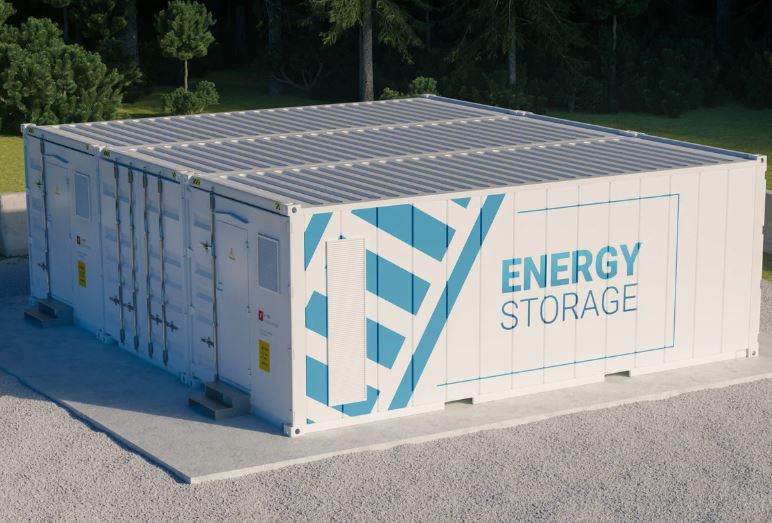
Masdar has begun commercial operations at its 35 MW/70 MWh Royle Barn Road battery in Rochdale, northern England, adding another grid scale storage asset to the UK’s rapidly expanding battery market as the country accelerates investment in flexibility to support a more renewable power system.
The facility is Masdar’s second operational battery project in the UK following its 20 MW/40 MWh Welkin Road system in Stockport, which entered commercial operation in December 2025. The company says the Rochdale project can supply enough electricity for approximately 35,000 homes per day based on two charging and discharging cycles and can respond to changes in electricity supply and demand within milliseconds.
The project is part of Masdar’s commitment to invest £1 billion in UK battery storage, with a targeted pipeline of 3 GWh. The investment strategy follows Masdar’s 2022 acquisition of UK energy storage developer Arlington Energy and reflects a broader shift in the UK storage market from development pipelines toward operating assets and bankable portfolios.
Masdar’s portfolio also includes projects in Chesterfield and Cardiff totaling 150 MW/300 MWh. Financing for four projects was completed in July, with Sumitomo Mitsui Banking Corporation and ING providing up to £97 million of financing.
The Rochdale commissioning comes as the UK’s storage market enters a more consequential phase. Government data show that grid scale battery storage power capacity reached 7.5 GW by the end of 2025, with 2.3 GW energized during the year alone. The government estimates that 7.3 GW was operational by June 2026, indicating that deployment has continued at a substantial pace despite connection constraints.
The scale of future requirements is considerably larger. The UK’s Clean Power 2030 framework anticipates a substantial expansion in electricity storage as renewable generation increases and demand becomes more flexible. Ofgem’s January 2026 market assessment cited a requirement for 23 to 27 GW of battery storage by 2030, compared with 6.8 GW in 2025.
This represents a fundamental change in how batteries are positioned within the electricity market. Storage is no longer primarily being developed as an adjunct to individual solar or wind projects. It is increasingly being treated as system infrastructure capable of shifting electricity across periods of high and low demand, providing balancing services and supporting network stability.
For a two hour asset such as Rochdale, however, the distinction between energy shifting and system balancing remains important. A 70 MWh battery cannot provide the same service as a multi day storage facility. Its value comes primarily from rapid response and repeated cycling rather than from covering prolonged periods of low renewable generation.
The Economics Depend on More Than Installed Capacity
Britain’s battery market has faced concerns over how effectively storage assets are dispatched through the Balancing Mechanism. Government data show that battery skip rates averaged 49% during the first half of 2025, falling to 38% during the first half of 2026.
The improvement is significant, but it also illustrates the underlying issue. A battery only creates its full system value if market and operational arrangements allow it to respond when it is economically and technically appropriate.
NESO has been working to improve dispatch processes and transparency, while also widening participation in balancing markets. The operator has described batteries as increasingly important for securing and balancing the electricity system and estimates that four to five times today’s battery capacity will be needed by 2030. This makes market design increasingly important to investment returns.
Battery projects can earn revenue from several sources, including energy arbitrage, balancing services, frequency response and capacity mechanisms. The relative importance of each revenue stream changes as more batteries enter the market. Greater deployment can reduce price spreads and increase competition for ancillary service revenues, potentially weakening the economics of projects that depend on a narrow set of services.
The industry’s next phase will therefore be determined not simply by how many gigawatts are installed, but by whether assets can stack multiple revenue streams while providing measurable system value.
The rapid growth of battery development has also created a new infrastructure problem.
Ofgem reported in January that the primary obstacle to achieving the UK’s 2030 battery storage target was the length of the electricity connections queue. Applications for battery storage already exceeded the government’s 2030 target in aggregate, but not all projects in the queue are considered viable or sufficiently advanced to justify connection.
This creates a paradox for the storage sector. Britain needs significantly more batteries to accommodate renewable generation, but the electricity network itself has limited capacity to connect the projects being proposed.
The government and Ofgem have consequently been reforming the connections process to prioritize projects that are viable and capable of contributing to the future electricity system.
For developers such as Masdar, projects that have already secured connections and reached financing therefore have a strategic advantage over a much larger pipeline of speculative applications.
The issue also changes how investors should assess the UK’s storage market. A headline pipeline measured in tens of gigawatts does not necessarily represent deployable capacity. Grid connection dates, planning status, land rights, financing, technology selection and revenue certainty increasingly determine which projects can move from development to construction.
Short Duration Batteries Are Not the Entire Storage Solution
The UK is also beginning to address a different problem: the need for storage that can operate for substantially longer periods.
In June, Ofgem announced a minded to position to support 7.6 GW of long duration electricity storage across 16 projects through a proposed cap and floor mechanism. The projects collectively represent 137 GWh of storage capacity and include pumped storage hydropower, long duration lithium ion batteries, a vanadium flow battery and compressed air energy storage.
Rochdale’s 35 MW/70 MWh configuration provides two hours of storage at maximum output. It can react extremely quickly to changes in system conditions, making it suitable for short duration balancing and energy shifting.
A 137 GWh long duration portfolio is intended to address a different requirement: shifting electricity over much longer periods and reducing the system’s exposure to extended periods when renewable output is low.
The UK’s future electricity system therefore needs a portfolio of storage technologies rather than a single battery model. Lithium ion batteries can address high frequency balancing and short duration flexibility, while pumped storage, flow batteries, compressed air and other technologies can provide longer duration services.
Government policy increasingly reflects this distinction. The proposed cap and floor regime is designed to provide more predictable revenues for long duration projects whose system value may not be adequately captured through existing merchant markets.
Another important development is the growing interest in co locating batteries with renewable generation. The UK government has identified co location as one way to make more efficient use of scarce grid infrastructure. A battery located alongside a solar project, for example, can store electricity when generation exceeds immediate demand and discharge later, effectively changing the output profile of the combined site.
But co location introduces regulatory and market complexities, particularly where renewable projects receive support through mechanisms such as Contracts for Difference.
The challenge is to allow batteries and renewable generators to share infrastructure without obscuring the operational characteristics of individual assets or creating unintended costs for consumers.
The emerging model therefore moves beyond the conventional concept of a battery as an independent grid asset. Solar, wind, storage and network infrastructure can increasingly be developed as integrated systems, provided market rules evolve sufficiently to recognize the different roles of each component.
Masdar’s £1 billion UK commitment is significant in this context because it is being deployed across multiple projects rather than through a single large battery. The company committed to developing a 3 GWh UK storage pipeline after acquiring Arlington Energy in 2022. The Rochdale facility and Stockport’s Welkin Road project give Masdar operating assets from which to build experience in Britain’s merchant and balancing markets, while the Chesterfield and Cardiff projects expand its physical footprint.
The portfolio approach can provide advantages in financing, operations and market participation. It also spreads exposure across different grid locations and connection points, although it does not eliminate the underlying volatility of battery revenue markets.
The recent £97 million financing from SMBC and ING is another indication that lenders are becoming more comfortable with utility scale storage as an infrastructure asset, although financing structures remain closely linked to the quality of project contracts, market exposure and grid connection status.
Electricity demand is expected to increase as transport, heating and industry become more electrified, while wind and solar are taking a larger role in generation. That creates a growing need for flexibility at multiple timescales.
Batteries are particularly well suited to the fastest timescales because they can change output almost instantaneously. NESO is already using and expanding markets for balancing, reserve and network services, while its wider balancing program is being redesigned to accommodate a more flexible and increasingly low carbon power system.
The first grid forming battery projects have also demonstrated that batteries can provide services beyond conventional energy arbitrage and frequency response. NESO says the first grid forming battery projects in Scotland are designed to contribute to system stability and estimated that the associated Stability Pathfinder contracts could deliver approximately £500 million in benefits over 10 years.
That evolution matters for developers because it expands the potential role of batteries from energy shifting to broader power system support.