



The $8.4 billion Oxagon facility is more than 90% complete and moving into commissioning. That milestone now sits inside a Saudi giga-project program that has been retrenching, next to a joint-venture partner that has written down close to $6 billion on comparable clean-hydrogen bets elsewhere in the past sixteen months.
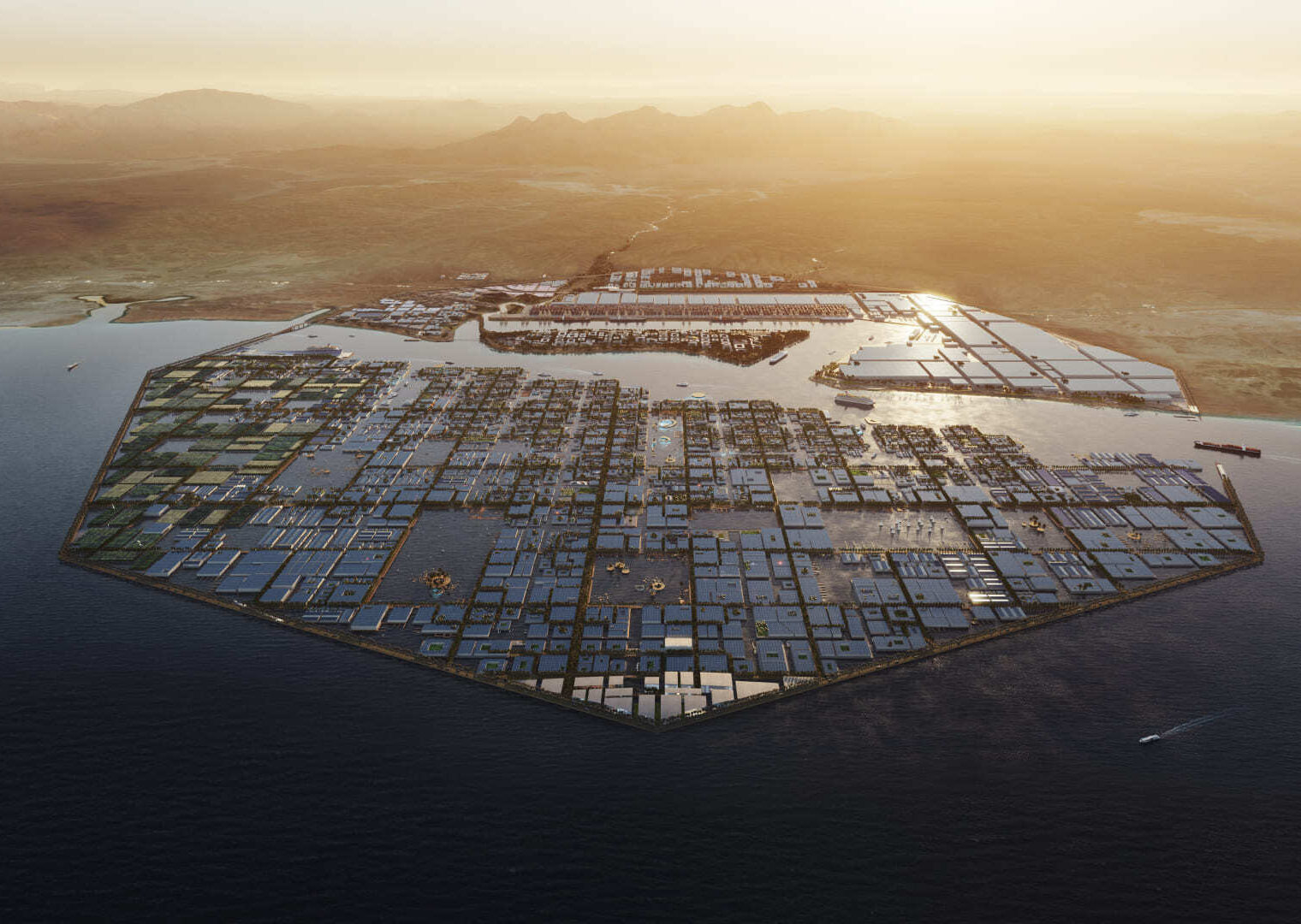
The NEOM Green Hydrogen plant at Oxagon has moved into commissioning, with energization underway across a facility that is now more than 90% complete, according to disclosures from NEOM Green Hydrogen Company (NGHC) and joint-venture partner Air Products. The $8.4 billion complex, financed in 2023 with $6.1 billion in non-recourse debt from 23 banks, is built to produce 600 tonnes of hydrogen a day from roughly 4GW of dedicated solar and wind capacity, then convert it into as much as 1.2 million tonnes of green ammonia annually for export. Commercial product availability is now targeted for 2027, a schedule that has already slipped from the “end of 2026” start NGHC set out when the project reached financial close.
The scale of what has been built is not in dispute. Larsen & Toubro delivered the renewable-generation and transmission packages; thyssenkrupp supplied the electrolysis system; a 400MWh battery system firms the output. Solar accounts for 2.2GW of the renewable base and 257 wind turbines for another 1.6GW, feeding a dedicated grid built to move 4GW of power into electrolysers rather than a conventional load. Air Products, which holds a one-third equity stake alongside ACWA Power and NEOM itself, is also the primary EPC contractor on a $6.7 billion construction contract and the plant’s exclusive offtaker under a 30-year agreement.
That last detail is doing more rhetorical work in NEOM’s own materials than it can bear commercially. An exclusive 30-year offtake agreement sounds like a demand problem solved in advance. In practice, Air Products does not have identified end-use for all 1.2 million tonnes of ammonia the plant will eventually produce, and disclosed on 30 June 2026 that it is finalizing a separate marketing and distribution agreement with Norway’s Yara International specifically to sell and deliver the ammonia that Air Products will not itself use to produce hydrogen in Europe. Lining up buyers for that output has proved difficult, according to trade coverage of the project, a familiar problem in green ammonia: the product costs more to make than grey or blue ammonia, and long-term buyers willing to pay that premium have been slower to materialize than the project financing that assumed they would.
The Yara arrangement was announced alongside a much larger disclosure. Air Products said on 30 June 2026 that it will not proceed with its Louisiana Clean Energy Complex, a green and blue hydrogen and ammonia project on the US Gulf Coast, and will also discontinue a green hydrogen facility in Casa Grande, Arizona, along with other smaller clean-energy distribution projects. The company expects a pre-tax charge of up to $2.9 billion, roughly $2.2 billion after tax, in its fiscal third quarter. That follows a separate exit from three other US projects, including hydrogen-linked ventures with World Energy and in Massena, New York, announced in February 2025 under a newly installed board and chief executive, which carried a pre-tax charge of up to $3.1 billion. Across roughly sixteen months, Air Products has written down close to $6 billion tied to clean-hydrogen commitments it decided did not meet its return criteria, everywhere except Saudi Arabia. The company’s fiscal third-quarter results showed a net loss of $1.44 billion, against net income of $713.8 million a year earlier, largely a function of those charges.
NEOM’s hydrogen plant is also the exception inside its own parent project. Construction on The Line, the 170-kilometre mirrored city that was meant to be NEOM’s centerpiece, was suspended in September 2025 after roughly four years of site work had produced about 2.4 kilometres of foundation, and the population target, originally nine million and already cut once to 1.5 million, has since been reduced again to fewer than 300,000. NEOM’s founding chief executive, Nadhmi Al-Nasr, left in November 2024; his successor, Aiman Al Mudaifer, came from the Public Investment Fund’s real estate arm rather than from engineering. The PIF booked an $8 billion write-down against its giga-projects in its 2024 accounts, and components of NEOM, including Trojena and Sindalah, have since been reassigned to other government entities as the wider megacity vision has fragmented. Against that backdrop, a chemical plant built on proven electrolysis technology, with a fixed-price EPC contract and a joint-venture partner obligated to buy its output for three decades, looks, by NEOM’s own recent standards, like the most conventional and de-risked asset the giga-project has produced.
ACWA Power is already pointing to that structure as the template for a second, larger project at Yanbu, on Saudi Arabia’s Red Sea coast. The Yanbu Green Hydrogen Hub is designed around 5GW each of solar and wind, up to 4.4GW of electrolysers, and roughly 400,000 tonnes of hydrogen a year converted into ammonia for a planned export corridor to Germany with utility EnBW. But Yanbu sits several steps behind where NEOM stood at a comparable point in its own development. Front-end engineering design, awarded to a Técnicas Reunidas-Sinopec consortium in July 2025, was only targeted for completion by mid-2026; Larsen & Toubro’s role so far covers a memorandum of understanding for the renewables and grid scope, not yet the binding EPC contract NEOM had in place years before construction finished; and no final investment decision has been reported. Commercial operations are targeted for 2030, three years past NEOM’s already-delayed 2027 date, before accounting for whatever schedule slippage a project at this stage of development tends to accumulate on its own.
None of this means NEOM’s hydrogen complex will fail to deliver ammonia in 2027, or that the underlying economics of Saudi solar-and-wind-powered electrolysis are unsound; the kingdom’s renewable resource is genuinely among the best in the world for the purpose, and the plant’s construction progress is verifiable rather than promotional. What the numbers around it show is a narrower claim than a straightforward milestone for large-scale clean-energy infrastructure. A single, well-financed, technically proven asset is nearing completion inside a national giga-project program that has otherwise been retrenching, backed by a joint-venture partner that has just written down billions of dollars walking away from comparable bets everywhere else, and still relying on a third party to help place the product its own exclusive offtaker signed up to buy. That is a meaningfully different story from the one being told about it, and it is the one the 2027 start date will actually test.