




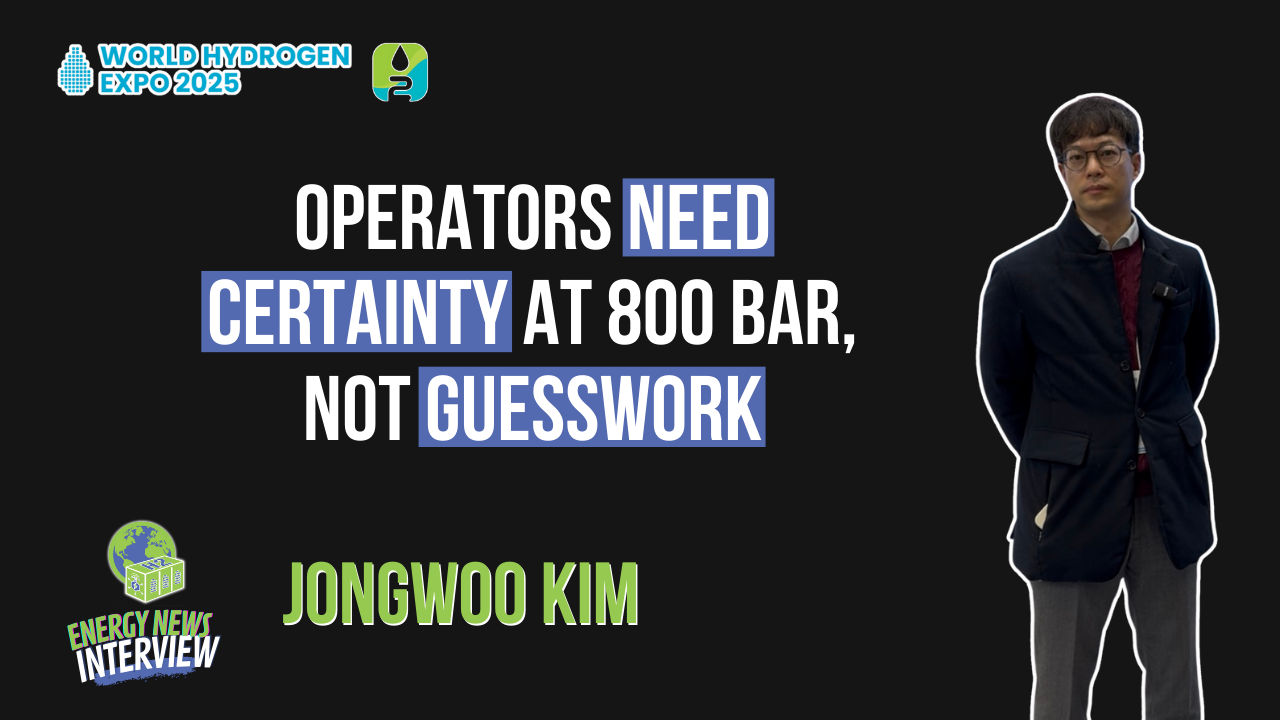
At H2MEET, where compressors and storage tanks dominate the conversation, Rheonik Korea took a different angle: the point where hydrogen actually meets the vehicle.
Jongwoo Kim presented a set of components, the mass flowmeter, hydrogen hoses, and a high-pressure nozzle, designed for refueling systems operating at more than 800 bar. In an industry obsessed with megaprojects, Rheonik focused on the small but critical hardware that determines whether hydrogen actually flows safely into a car, ship, or trailer.
WATCH THE INTERVIEW HERE

Kim demonstrated a nozzle–receptacle system built for ease of use and operator assurance. The push-and-pull connection mechanism allows the dispenser operator to lock and unlock the nozzle with minimal effort, an issue that continues to slow down refueling operations across regions. But the key differentiator, according to Kim, is the built-in green visual safety ring, which gives an immediate confirmation that the nozzle is properly seated. Unlike systems that rely solely on sound or handle resistance, Rheonik’s visual cue lowers the risk of improper engagement, a nontrivial concern at 800-bar pressures.
While Rheonik Korea is the local provider, the technology originates from a German manufacturer. That positioning reflects a trend seen across Asia: domestic companies adopting highly specialized European components to support rapidly growing fueling infrastructure. Rheonik’s role, importing and servicing these systems, fills a technical gap in the Korean market, particularly for hydrogen dispenser manufacturers who depend on highly reliable flow and safety devices.
The equipment is not limited to passenger vehicles. Kim emphasized applications for ships and trailers, where hydrogen transfer volumes and operational pressures are higher and the consequence of mechanical failure is even more severe. As heavy-duty hydrogen adoption accelerates, the industry is shifting its attention toward connection systems that are both robust and intuitive.
Although Rheonik Korea is currently focused on the domestic market, the broader challenge remains the same globally: designing components that simplify high-pressure hydrogen handling without compromising safety margins.