




Singapore energy storage ambitions have been raised fivefold in a single planning document. The Energy Infrastructure Plan announced on 26 October sets a target of just over 1 GWh of storage by 2030, against a previous goal of 200 MWh that the city state reached in 2023, two years ahead of schedule. About 350 MWh is operational today, so the new target implies adding roughly 650 MWh in under four years.
Singapore energy storage in context: what the plan changes
The earlier 200 MWh target was met by one project, the 200 MW and 285 MWh battery on Jurong Island. The country now has about 350 MWh in service, so the 2030 figure is about 2.9 times today’s fleet. The Energy Market Authority has opened an industry consultation on the vision, titled Industry Consultation: Singapore’s Vision for Energy Storage, and the EMA energy storage page sets out how to respond. The consultation closes in late January 2027.
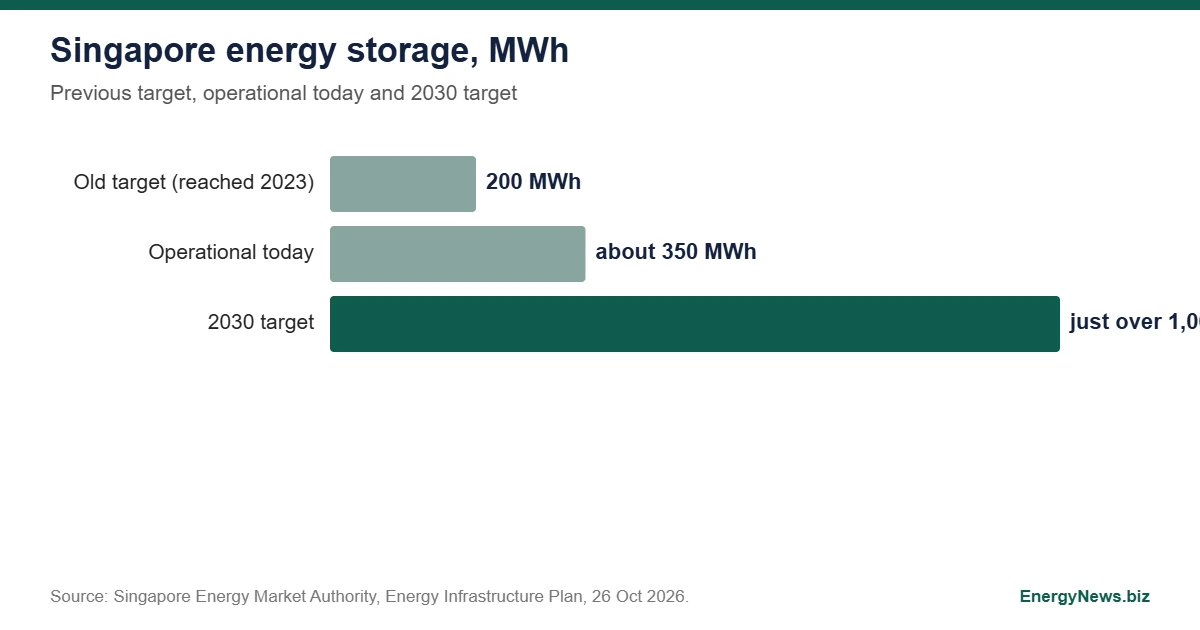
The increment alone, about 650 MWh, is more than three times the whole of the previous target. For Singapore energy storage developers that changes the market from a single flagship project to a pipeline, and it is the reason the consultation matters: the terms set there will determine how that pipeline is financed and who carries the merchant risk.
Demand is the problem the storage target answers
Peak demand reached 8.6 GW in August 2026, and the EMA forecasts 9.9 GW to 13 GW within five years. Against that range, 1 GWh of storage is a modest buffer. Spread over the 8.6 GW peak it equals about seven minutes of supply, and about four and a half minutes at 13 GW. These are calculations from the published figures and assume full discharge at peak.
The value of batteries on a system like this lies less in energy volume than in speed. Frequency response, reserve provision and smoothing of solar output are jobs measured in seconds and minutes. Singapore energy storage at the 1 GWh scale is therefore sized for stability services rather than for shifting generation across the day.
Gas remains the backbone of the plan
The same plan expands the gas fleet by about 26 percent from 12 GW, which arithmetic puts near 15 GW, and lifts LNG regasification capacity from 10 to 15 million tonnes per year by 2030. Gas supplies about 95 percent of Singapore’s electricity today. Solar is lifted from a 3 GWp target for 2030 to 4 GWp by 2035, with about 2.3 GWp installed.
That mix explains the storage logic. Land is scarce and the solar ceiling is low, so storage cannot be justified by large renewable surpluses. Its case is reliability: adding firm gas capacity while using batteries to cover short disturbances and reduce how often peaking plant must start.
Grid spending and a second link to Malaysia
Network investment sits beside the generation plans. The plan earmarks S$5.3 billion for transmission and distribution from 2025 to 2029, and a second interconnector with Peninsular Malaysia of up to 2 GW is being studied for the end of the decade. A 2 GW import link would be about twice the energy storage target in power terms, though not in energy terms, so the two options do different work: one adds capacity from outside, the other adds flexibility inside.
Nuclear is not yet decided, and the plan does not commit to it. For storage developers the consultation is the near term opportunity: ownership structures, the revenue model and technical requirements are all open until the response deadline. The scale of need elsewhere gives a yardstick: in Europe, Germany is described as needing about 100 GWh of stationary storage by 2030 against about 25 GWh installed, a far larger gap for a far larger system.
Add EnergyNews.biz as a preferred source on Google


