





Smoltek Hydrogen and Heraeus Precious Metals are preparing a 3,000 hour durability test of a porous transport electrode designed to operate with less than 0.1 mg of iridium per square centimeter.
The test, scheduled to begin in autumn, will examine the long term stability of Smoltek’s nanostructured iridium catalyst layer under operating conditions. The outcome will be important because reducing precious metal use is only commercially meaningful if electrolyzer performance and lifetime can be maintained over thousands of operating hours.
PEM electrolysis offers several operational advantages for renewable hydrogen production, including rapid response to changes in electricity supply and relatively compact system designs. However, its dependence on iridium based oxygen evolution reaction catalysts creates a material supply challenge as electrolyzer deployment expands.
Iridium is among the rarest naturally occurring elements, and its limited availability has prompted research into substantially lower catalyst loadings and alternative catalyst architectures. The issue is particularly relevant to scenarios involving very large electrolyzer fleets, where even small reductions in precious metal intensity can materially affect total resource requirements.
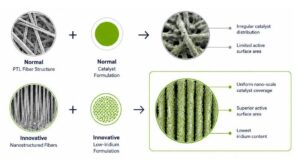
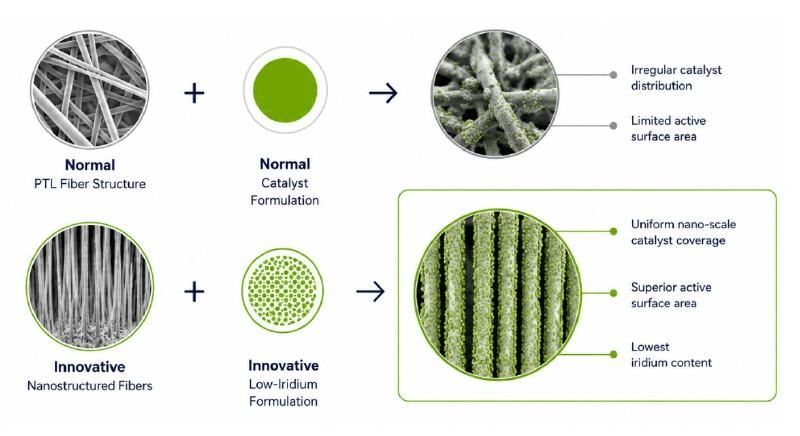
Smoltek Hydrogen is developing a porous transport electrode in which the iridium catalyst is structured at the nanoscale. According to the company, the architecture is intended to improve charge and mass transport while concentrating the catalyst into a layer only a few microns thick.
The company reports that the design can achieve an iridium loading below 0.1 mg/cm². That figure, however, needs to be evaluated alongside durability and performance data before its significance for commercial electrolyzer systems can be established.
The planned 3,000 hour campaign is therefore more consequential than a demonstration of low iridium loading alone.
Electrolyzer developers face a tradeoff between minimizing catalyst use and maintaining stable operation. Catalyst layers that initially perform well can experience degradation through changes in structure, catalyst dissolution, corrosion and other mechanisms during prolonged operation.
Heraeus Precious Metals will lead the testing and material analysis under the collaboration. The company brings experience in precious metal catalysts and analytical characterization, providing an external testing capability for assessing how the nanostructured electrode behaves during extended operation.
The test will examine whether the low catalyst loading remains compatible with stable electrochemical performance over thousands of hours. For industrial deployment, the relevant question is not simply how much iridium can be removed from an electrode, but how that reduction affects efficiency, degradation rates, replacement requirements and ultimately the cost of hydrogen produced over the asset’s operating life.
The technical challenge becomes increasingly important as hydrogen developers plan larger electrolyzer installations.
A lower iridium requirement could reduce exposure to a constrained raw material market and potentially lower stack costs. It could also reduce the amount of precious metal that must be recovered and recycled at the end of an electrolyzer’s operating life.
But catalyst loading is only one component of electrolyzer economics. Electricity remains the dominant operating cost in most green hydrogen production scenarios, while electrolyzer efficiency, utilization rate, balance of plant costs, stack replacement intervals and financing conditions also determine the final cost of hydrogen.
Consequently, an ultra low iridium electrode would need to demonstrate competitive performance across the entire operating envelope rather than only under controlled laboratory conditions.
The 3,000 hour test is intended to provide some of that evidence. It will also help establish whether the electrode architecture can withstand the combination of electrical, chemical and thermal stresses associated with continuous operation.
Smoltek’s approach focuses on changing the physical architecture of the catalyst layer rather than simply substituting iridium with another material.
The company’s stated objective is to use nanostructuring to maximize the active surface area available for electrochemical reactions while maintaining efficient transport of charge and reactants. In principle, this could allow substantially less iridium to deliver the required catalytic activity.
The difficulty is translating nanoscale performance into large area electrodes manufactured consistently at industrial volumes. Uniformity, production yield, mechanical stability and integration with existing PEM stack architectures become increasingly important as electrode dimensions increase.
This is where the collaboration with Heraeus becomes strategically relevant. Moving from laboratory validation toward commercial production requires both electrochemical testing and detailed analysis of how materials change during operation.