





Sodium-ion batteries have been marketed across the storage industry as a safer, lower-cost alternative to lithium chemistries for stationary and grid-support applications. A new experimental study pairing a sodium-ion cell with a supercapacitor for exactly this kind of use, voltage regulation on remote rural grid feeders, found the combination delivered no net energy benefit to the battery at three of four tested switching frequencies, the opposite of what the same pairing achieved with a lithium iron phosphate cell under identical conditions.
The study tested two passive battery-supercapacitor hybrids, lithium iron phosphate paired with a commercial 400 farad supercapacitor and a proprietary sodium-ion cell paired with the same supercapacitor, under pulse-width-modulated current excitation between 1.11 and 11.11 kilohertz, replicating the high-frequency switching stress batteries experience when connected to single-phase inverters on weak, remote grid sections. That specific application is not hypothetical. Ergon Energy’s Grid Utility Support System, deployed on Single Wire Earth Return feeders in rural Queensland, already uses battery-inverter systems as an alternative to costly transmission upgrades in radial grid sections prone to voltage instability, exactly the kind of installation exposed to the sustained high-frequency current ripple the study set out to characterize. The context is a rapidly scaling one: Australia’s utility-scale battery capacity expanded from roughly 1.4 gigawatts in 2022 to more than 8.7 gigawatts under construction by the end of 2024, according to the Clean Energy Council, part of a broader renewable integration push that lifted peak renewable penetration on the grid from 30% in 2018 to 76% in 2024.
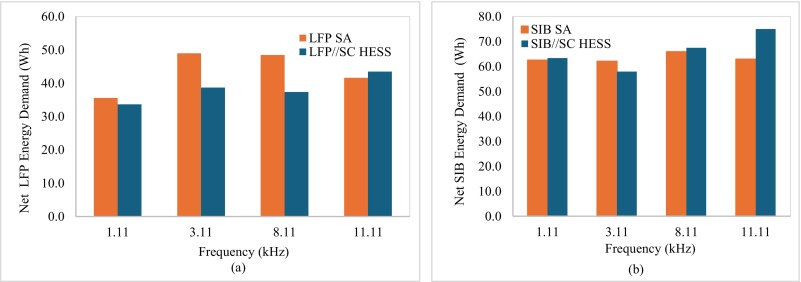
The two hybrid configurations produced sharply different results. Lithium iron phosphate paired with the supercapacitor reduced peak battery current by approximately 43% relative to the battery operating alone, and reduced the battery’s net energy demand at every tested frequency except the highest, 11.11 kilohertz, where the supercapacitor’s own parasitic inductance began to dominate its impedance and erode its buffering capability. Sodium-ion paired with the same supercapacitor reduced peak current by about 21%, roughly half the lithium iron phosphate figure, and produced a net energy benefit at only one of the four tested frequencies, 3.11 kilohertz. At the other three frequencies, the hybrid configuration required more total energy from the sodium-ion cell than running it standalone would have, the opposite of the outcome a supercapacitor pairing is meant to deliver.
The study attributes that divergence to a specific, mechanistic difference in how the two chemistries behave electrically rather than a general shortcoming of sodium-ion as a technology. Lithium iron phosphate’s comparatively flat discharge voltage plateau corresponds to stable interfacial kinetics and low, weakly frequency-dependent internal impedance, allowing the battery and supercapacitor to share high-frequency current in a predictable, complementary way across most of the tested range. The sodium-ion cell’s steadily sloping discharge voltage, linked to continuous phase transitions in its layered cathode structure, produces higher and more frequency-sensitive impedance, which does push a larger share of high-frequency ripple current onto the supercapacitor across a broader span of harmonics than the lithium iron phosphate pairing achieves. But the energy the supercapacitor draws back from the sodium-ion branch to recharge during each pulse-off interval outweighs the energy it saved the battery during the pulse-on interval at nearly every frequency tested, turning what looked like more effective current redistribution into a net energy penalty rather than a benefit.
That finding comes with meaningful caveats about how far it can be generalized. The sodium-ion cell tested is a single proprietary chemistry under development from one manufacturer, with its cathode composition undisclosed, not a representative sample of sodium-ion technology broadly, and commercially available sodium-ion cells use materially different cathode chemistries, including Prussian blue analogues, layered transition metal oxides and polyanionic compounds, each with its own frequency-dependent impedance behavior.
The test cells themselves were also small laboratory units, 7 amp-hours for the lithium iron phosphate cell and 10 amp-hours for the sodium-ion cell, evaluated at a single fixed 1C discharge rate and room temperature, a controlled setup well suited to isolating the impedance mechanisms the study targeted but several steps removed from the larger packs and variable field conditions an actual deployed grid-support installation would encounter.
The authors are explicit on this point themselves, describing the results as demonstrating chemistry-dependent behavior under the tested conditions rather than universal characteristics of all lithium iron phosphate or sodium-ion systems, and noting the study did not evaluate long-term degradation, leaving open whether the short-term current and energy differences observed translate proportionally into battery lifespan differences over sustained field operation.
For engineers evaluating sodium-ion cells for passive hybrid pairings in applications like GUSS, the practical implication is narrower than a blanket verdict on the chemistry: the specific cell being considered needs its own frequency-dependent impedance characterized directly, since the assumption that a supercapacitor will automatically buffer high-frequency stress regardless of which battery chemistry it is paired with, an assumption much of the existing hybrid storage literature the study reviewed had carried forward untested, did not hold for the sodium-ion cell examined here.