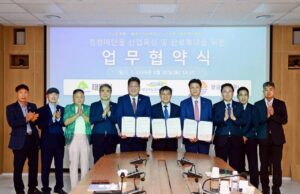




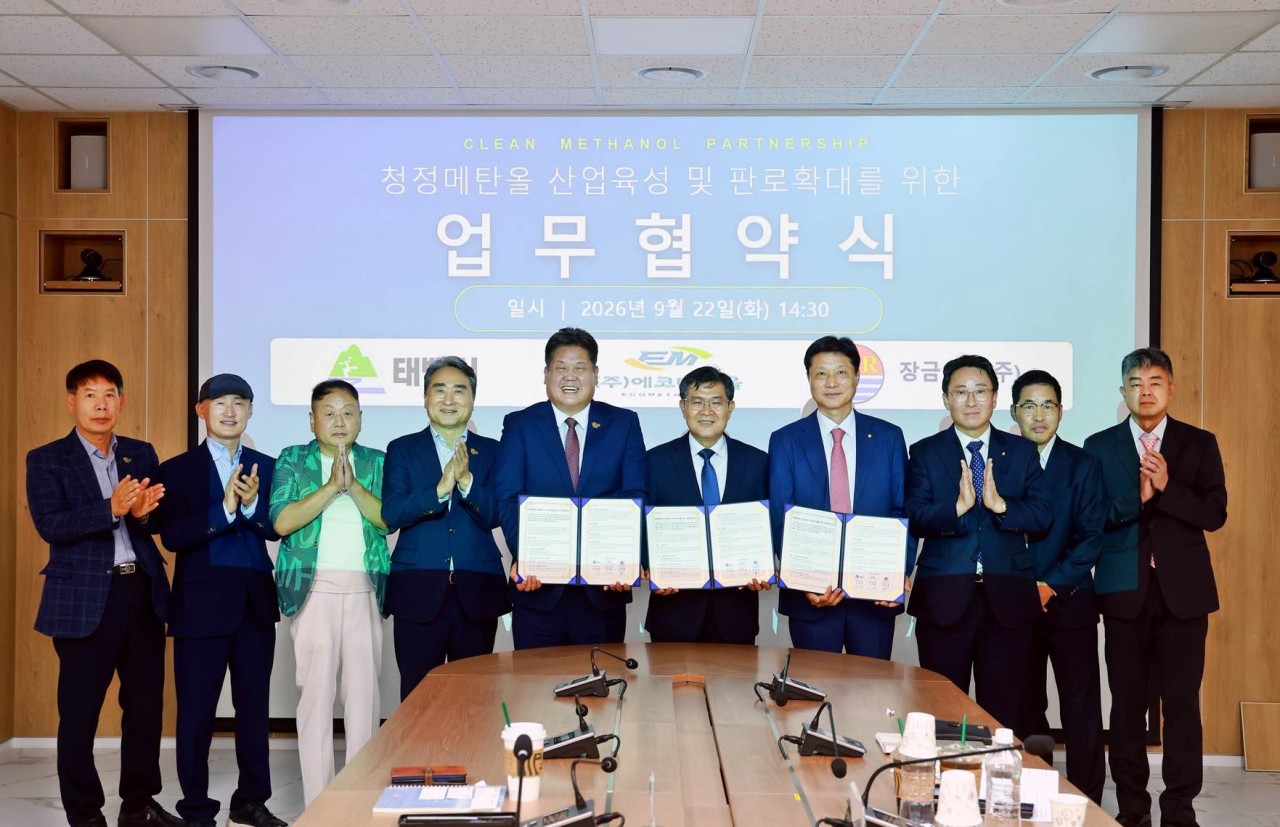
EcoMethanol, Taebaek City and Sinokor Merchant Marine signed a tripartite memorandum of understanding to develop a green methanol production and supply hub at the Dongjeom Industrial Complex in Taebaek, Gangwon Province.
The project involves a planned investment of KRW 120 billion, according to Yonhap, with EcoMethanol expected to develop the production facility and Sinokor positioned as an initial demand source for the fuel. Taebaek City will provide administrative and permitting support.
The agreement comes as South Korea builds a broader regulatory framework for green shipping corridors. The country enacted its Green Shipping Corridors Support Special Act in March 2026, with the legislation scheduled to enter into force on April 1, 2027. The law establishes a framework for designating green shipping corridors and requires government and local authorities to develop measures covering low and zero carbon fuels, green vessels and supporting port infrastructure.
For methanol producers, the policy direction addresses one of the central problems facing alternative marine fuels: production capacity alone does not create a viable market. Fuel suppliers need predictable demand, while shipowners need confidence that sufficient volumes will be available at commercially relevant ports.
Under the MOU, EcoMethanol plans to invest in and operate a green methanol production facility at Dongjeom Industrial Complex. The company said the project will focus on producing high purity green fuel while prioritizing local employment in Taebaek.
Sinokor is expected to provide an initial offtake channel by procuring methanol produced at the site for use as marine fuel. The structure gives the proposed facility a direct connection to maritime demand rather than relying exclusively on future spot market development.
That distinction is important as alternative fuel markets move from pilot projects toward commercial procurement. The International Maritime Organization’s regulatory framework is designed to progressively reduce the greenhouse gas intensity of marine fuels and introduce an economic mechanism for shipping emissions. The framework approved in 2025 remains under negotiation, with adoption discussions deferred until 2026.
The regulatory direction is nevertheless clear. The IMO framework covers ocean going ships above 5,000 gross tonnage, representing more than 85% of global shipping emissions, and combines fuel intensity requirements with an emissions pricing mechanism.
This creates a stronger commercial rationale for securing alternative fuel supply, but it does not remove the underlying cost challenge. Green methanol generally requires more expensive production pathways than conventional fossil based methanol, meaning projects depend on a combination of fuel demand, carbon accounting, renewable energy availability and policy support.
The Taebaek project is also being developed within a larger Korean strategy to establish green shipping corridors and expand alternative fuel infrastructure.
South Korea’s Ministry of Oceans and Fisheries has been preparing the regulatory framework for its Green Shipping Corridors Support Special Act, including requirements for qualifying green ship fuels, environmentally friendly ports, corridor designation and national planning. The ministry says the legislation will support decarbonization across the maritime transport chain rather than focusing solely on individual vessels.
The government is also targeting 889 vessel conversions or deployments involving private and public ships by 2035 under its second basic plan for the development and supply of eco friendly ships.
Methanol is already part of the regulatory architecture being developed for alternative marine fuels. The IMO’s updated regulatory mapping covers methanol alongside ammonia, hydrogen, LNG and other fuels, reflecting progress in the safety and environmental rules governing alternative fuel deployment.
South Korea has separately targeted a green shipping corridor linking Busan and Ulsan with Seattle and Tacoma. The government has said the corridor is intended to begin operations in 2027, with green methanol and green ammonia among the potential zero carbon fuels.
The Taebaek initiative therefore fits into a policy structure that is increasingly connecting fuel production, vessel deployment and port infrastructure. Its commercial significance will depend on whether those three elements can develop at a sufficiently similar pace.
The Cost Gap Remains the Critical Constraint
EcoMethanol and its partners also plan to pursue policy measures aimed at narrowing the cost difference between conventional marine fuels and zero emission alternatives. Among the proposals is a Carbon Contracts for Difference mechanism, which would compensate producers or users for part of the additional cost associated with lower carbon fuels.
Such support could become important during the early commercialization period. IMO itself has emphasized that regulatory requirements need to be accompanied by investment in alternative fuel production and port infrastructure. The organization estimates that shipping currently consumes around 350 million tonnes of fuel oil annually, illustrating the scale of the supply challenge facing any alternative fuel pathway.
For Taebaek, the economics also have a regional dimension. The city intends to use the Dongjeom investment as an early industrial base before expanding the broader clean methanol industrial complex associated with the redevelopment of the former Jangseong Coal Mine site. Yonhap reported that the 120 billion won investment is intended to establish production capacity ahead of that larger development.
The model effectively links three separate risks. EcoMethanol must demonstrate that production can be financed and operated at commercial scale. Sinokor must establish sufficient demand for the fuel within its fleet and maritime operations. Taebaek must ensure that permitting and infrastructure can keep pace with the industrial development.
The success of the hub will consequently depend less on the MOU itself than on whether it progresses into a financed production project, firm offtake arrangements and compatible bunkering infrastructure.