



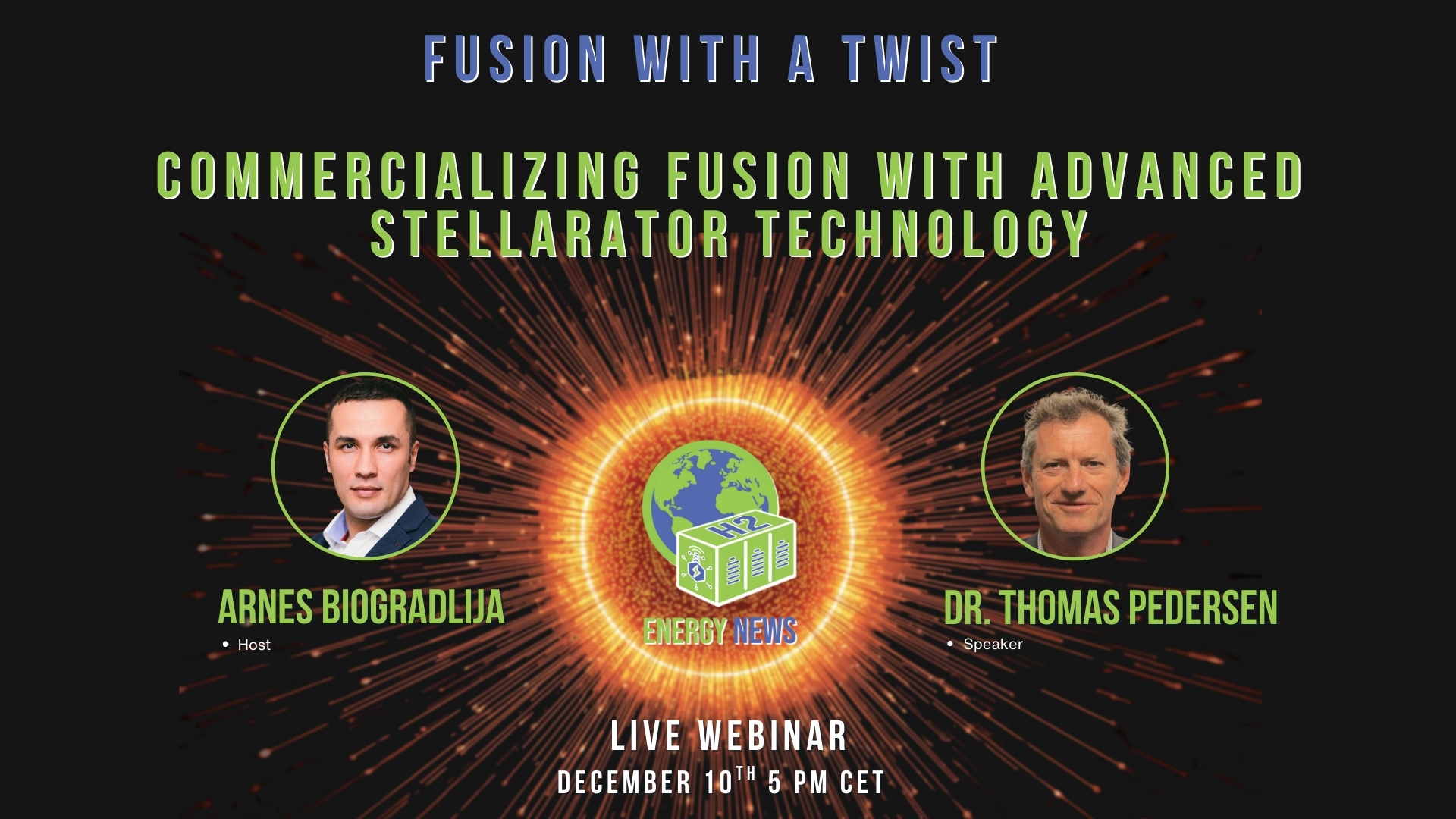
Type One Energy aims to achieve first plasma from its Infinity-1 validation device by decade’s end, positioning construction of the commercial-scale Infinity-2 stellarator for the early 2030s with mid-2030s grid connection at Tennessee Valley Authority’s Bull Run site. The timeline depends on resolving tritium breeding and handling challenges that remain at low technology readiness levels across the fusion sector, according to chief technology officer Thomas Sunn Pedersen, as well as demonstrating that high-temperature superconductor magnets can achieve the required field strengths and tolerances.
WATCH THE WEBINAR HERE

The stellarator approach eliminates the plasma current requirements inherent to tokamaks, avoiding the 10 million ampere toroidal currents that pose instability risks and either limit operation to pulsed mode or require over 100 MW of continuous current drive. Stellarators achieve the necessary twisted magnetic field geometry entirely through external coil configurations, enabling steady-state operation without current-driven disruptions. This architectural difference positions stellarators for continuous power generation and reduced thermal cycling stress on first-wall materials, though at the cost of substantially more complex three-dimensional magnet geometries.
Germany’s Wendelstein 7-X stellarator, which achieved first plasma exactly 10 years ago and where Pedersen spent a decade on development, demonstrated magnetic field accuracy better than one part in 100,000 and validated optimization approaches for particle orbit confinement. The device confirmed that advanced computational methods developed since the 1980s can predict stellarator performance with high fidelity, providing an empirical foundation for Type One’s design methodology. However, W7-X operates at magnetic field strengths limited by low-temperature superconductors, reaching approximately 3 Tesla compared to the higher fields enabled by high-temperature superconductor technology.
Type One’s approach leverages high-temperature superconductors to achieve magnetic fields substantially exceeding W7-X capabilities, enabling more compact fusion geometry through the favorable scaling of plasma confinement with field strength. The relationship between the magnetic field and fusion performance proves particularly strong in stellarators, where the external magnetic field provides all confinement. Plasma pressure scales with the square of magnetic field strength, while energy confinement time increases with field magnitude, allowing smaller device dimensions to achieve ignition conditions compared to low-field alternatives.
The company currently tests high-temperature superconductor magnet technology at MIT’s Plasma Science and Fusion Center, evaluating three conductor configurations simultaneously in a cryogenic environment at approximately 20 Kelvin. This development addresses the requirement for cables capable of multi-directional bending to accommodate stellarator coil geometry, contrasting with planar conductor layouts suitable for simpler magnet shapes. The testing program aims to validate technology readiness for the three-dimensional coil forms required by optimized stellarator configurations.
Infinity-2’s physics basis underwent peer review and publication in March, with the design achieving characterization as “setting the gold standard” for fusion power plant physics foundations according to the Journal of Plasma Physics. External reviewers, including Dr. Hutch Neilson from Princeton Plasma Physics Lab, described the work as “the first serious fusion power plant design.” However, such assessments reflect design quality rather than guaranteed technical success. The design targets deuterium-tritium fusion producing 17.6 MeV per reaction, with the 3.5 MeV alpha particle providing one-fifth of the released energy for plasma self-heating while the 14.1 MeV neutron enables tritium breeding from lithium-6.
Achieving ignition requires satisfying the Lawson criterion, approximately 10^22 keV per cubic meter seconds for the product of density, temperature, and energy confinement time. This threshold represents the point at which alpha-particle heating alone sustains a plasma temperature above 10 keV, roughly 100 million degrees Celsius, without external power input. ITER, the international tokamak under construction in France, targets this regime, though stellarators pursuing similar goals face different confinement scaling relationships and optimization opportunities.
The modular construction approach divides Infinity-2 into six identical half-modules in a three-period configuration, enabling maintenance strategies where individual sections undergo servicing while replacement modules maintain plant operation. This philosophy addresses a persistent fusion challenge: accessing internal components for repair or replacement without extended plant outages that undermine economic competitiveness. W7-X demonstrated this architecture with 10 half-modules, proving fabrication feasibility for complex three-dimensional geometries at a large scale.
Type One’s optimization algorithms incorporate manufacturing constraints directly into magnetic configuration design, relaxing geometric tolerances to levels consistent with high-technology manufacturing rather than requiring unprecedented precision. This represents a departure from earlier stellarator concepts, where tight tolerance requirements created fabrication challenges. The optimization also addresses particle orbit characteristics, ensuring that particles reflecting along field lines rather than circulating remain well confined, a subtle confinement mechanism that requires sophisticated computational treatment.
Tritium breeding presents sector-wide challenges independent of the confinement concept. The fusion neutron must split lithium-6 into tritium and helium-4, with tritium then extracted, purified, and reinjected into the burning plasma. This closed fuel cycle operates continuously in steady-state devices, requiring tritium handling systems that have never operated at fusion-relevant scales. The technology readiness level designation acknowledges that while laboratory demonstrations exist, integrated systems processing kilograms of tritium daily remain unproven. ITER will provide crucial data, though its pulsed operation differs from stellarator steady-state requirements.
Bull Run’s selection as a site location leverages existing infrastructure from the recently retired 800 MW coal plant, including grid connection capacity, water cooling systems, and land area. This brownfield approach reduces balance-of-plant costs and permitting complexity compared to greenfield sites, though fusion-specific requirements, including tritium handling and neutron shielding, necessitate substantial new construction. TVA’s partnership provides a utility perspective on grid integration, maintenance philosophies, and operational requirements that academic fusion programs historically lacked.
The parallel development of Infinity-1 as a validation platform allows empirical verification of specific technical claims before committing to full-scale construction. The scaled device will test divertor efficiency for helium ash extraction, confirm confinement improvements from optimization relative to W7-X, and validate high-temperature superconductor magnet performance. This staged approach mirrors practices in other high-capital industries where subscale testing reduces technical risk, though it extends timelines and requires additional capital compared to direct commercial construction.
Divertor performance determines whether steady-state operation can maintain fuel purity by extracting helium at production rates. The fusion process generates helium-4 nuclei that must exit the plasma to prevent fuel dilution, requiring edge plasma and divertor solutions that efficiently channel particles to pumping systems. Type One proposes improvements over W7-X concepts based on a decade of edge physics research, with Infinity-1 providing experimental validation. Insufficient divertor performance would cause helium accumulation, reducing fusion reactivity and eventually extinguishing the burn.
The mid-2030s commercialization timeline assumes three to five years for Infinity-2 construction following design completion and Infinity-1 validation results by decade’s end. This schedule proves notably more conservative than some fusion ventures projecting grid power by the early 2030s, reflecting recognition of construction duration for complex facilities and regulatory approval processes for first-of-kind nuclear installations. TVA’s role as an experienced nuclear operator with Browns Ferry and Sequoyah plants provides regulatory familiarity, though fusion-specific licensing frameworks remain under development.
Uncertainty in energy confinement time constitutes a primary technical risk despite sophisticated simulation capabilities. While fusion reaction rates are precisely known from decades of plasma physics research, energy transport in turbulent fusion plasmas involves complex phenomena where predictions carry uncertainty margins. Infinity-1 will provide empirical confinement data at parameters approaching Infinity-2 conditions, though extrapolation to full-scale commercial operation involves remaining uncertainties. Lower-than-predicted confinement would require design modifications, potentially including increased device size or magnetic field strength.
High-temperature superconductors maintain superconducting properties at substantially higher magnetic fields than conventional niobium-titanium or niobium-tin superconductors used in existing fusion experiments. This enables magnet operation at field strengths where low-temperature superconductors would transition to a normal conducting state, losing zero-resistance properties. The technology initially developed for applications including particle accelerators and MRI systems now finds fusion application, with multiple companies pursuing high-temperature superconductor magnet development for both tokamaks and stellarators.
Type One’s growth from five employees three years ago to over 150 currently reflects both investor confidence and the workforce requirements for developing complex engineering systems. The scale-up parallels patterns in other fusion ventures that transitioned from research programs to commercial development, requiring expertise spanning plasma physics, superconducting magnets, tritium systems, structural engineering, and power plant integration. Whether this workforce expansion proves sustainable depends on maintaining investor support through technical milestone achievement and eventual revenue generation.
The company’s “Fusion Direct” strategy emphasizes power plant development from inception rather than pursuing incremental scientific experiments, though the Infinity-1 validation step introduces staged development more characteristic of conventional technology progression. This reflects tension between venture capital expectations for rapid commercialization and engineering reality that first-of-kind nuclear systems require extensive validation. The approach contrasts with government-funded programs like ITER, designed primarily for scientific demonstration rather than immediate commercial viability.
Stellarator optimization involves multi-objective design problems balancing confinement quality, stability margins, divertor performance, coil complexity, and manufacturing feasibility. Modern computational capabilities enable exploration of configuration space impossible during earlier stellarator development, identifying solutions that satisfy multiple constraints simultaneously. However, optimization quality depends on physics models’ accuracy, and actual plasma behavior may deviate from predictions in ways that require operational adjustments or design iterations.
The partnership structure with MIT’s Plasma Science and Fusion Center provides access to research infrastructure and expertise without requiring Type One to develop all capabilities internally. Similar partnerships with academic institutions characterize multiple fusion ventures, leveraging decades of government-funded research while pursuing commercial objectives. This model creates questions about intellectual property allocation, publication rights, and whether academic collaborations can maintain pace with commercial development timelines that typically exceed academic project schedules.
Modular maintenance philosophy assumes that half-module replacement represents feasible operations, requiring remote handling capabilities, precise realignment after module installation, and sufficient spare module inventory to maintain high capacity factors. These assumptions remain unproven at fusion-relevant scales where neutron activation complicates hands-on maintenance and geometric tolerances affect magnetic field quality. Successful implementation would differentiate stellarators from tokamaks, where current-driven instabilities and pulsed operation already create maintenance challenges.
The three-to-five-year construction estimate for Infinity-2 following design completion appears optimistic, given typical timelines for first-of-kind nuclear facilities. ITER’s construction timeline has extended substantially beyond initial projections, though that project’s unique international governance structure and scientific mission differ from commercial ventures with streamlined decision-making. Nonetheless, fusion facility construction involves manufacturing complex components, assembling systems with tight tolerances, and conducting extensive commissioning activities that historically consume more time than initially estimated.
Type One’s focus on stellarators represents a minority position in the fusion sector, where tokamak designs dominate both government programs and commercial ventures. This concentration partly reflects tokamak maturity and extensive operational experience, while stellarator optimization capabilities only emerged with modern computational tools. Whether stellarator advantages in steady-state operation and stability outweigh magnet complexity and relative development immaturity remains an empirical question that Infinity-1 and eventually Infinity-2 will help answer.