
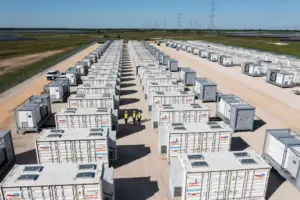





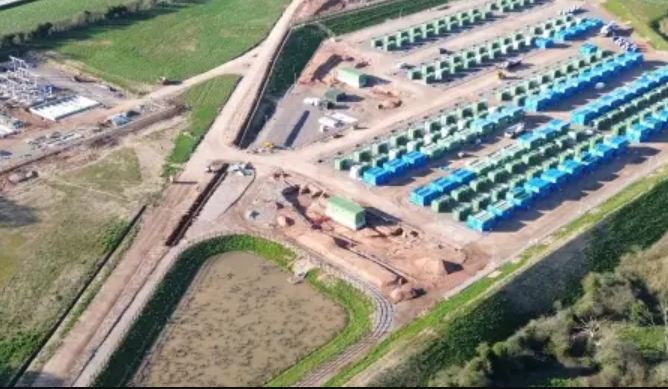
A 350 MW / 1,243 MWh battery energy storage project at Hams Hall in North Warwickshire, developed by BW ESS in partnership with EDF, will ultimately expand to 400 MW / 1,424 MWh following a second phase of development.
Once operational in Q4 2026, it will become BW ESS’s largest global asset, surpassing earlier UK projects such as the 100 MW Bramley installation, which was itself the country’s largest at the time of commissioning in early 2025.
The scale of Hams Hall reflects a broader trend in European battery deployment, where project sizing is rapidly increasing in response to higher renewable penetration and grid congestion challenges. Unlike earlier generations of shorter-duration storage assets, Hams Hall is designed to deliver up to 3.5 hours of discharge capability, positioning it in the mid-duration segment that is increasingly seen as critical for daily load shifting and peak demand management.
Under a 10-year floor agreement, EDF will optimize the asset through its PowerShift platform, enabling participation in wholesale markets, balancing services, and arbitrage opportunities. This structure reflects a growing convergence between physical storage assets and algorithm-driven optimization platforms, where revenue performance is increasingly tied to real-time market participation rather than fixed tariff arrangements.
The project’s location near Birmingham provides direct access to one of the UK’s highest demand zones and connects to the Hams Hall 400 kV substation, reducing transmission constraints that can limit storage asset efficiency. Grid proximity is becoming a critical factor in storage economics, as congestion costs and curtailment risks directly affect dispatch potential and revenue stability.
Once fully operational, the facility is expected to supply energy equivalent to the consumption of approximately 1.3 million homes for up to 3.5 hours. While such equivalency figures provide a simplified representation of capacity, the operational value of the asset lies in its ability to provide frequency regulation, peak shaving, and short-term reserve services, all of which are increasingly important as wind and solar generation expand across the UK system.
The development also highlights the growing role of institutional capital in large-scale storage deployment. BW ESS’s co-ownership structure includes participation from infrastructure investors such as AIP Management, reflecting the shift toward long-term yield-based investment models in energy storage infrastructure. These structures are designed to align construction risk, operational optimization, and long-term revenue generation across multiple stakeholders.
From a system perspective, the expansion of grid-scale storage is directly linked to the UK’s increasing reliance on variable renewable generation. As wind and solar capacity continues to grow, the electricity system faces greater short-term imbalances between supply and demand, particularly during periods of low wind output or rapid demand spikes. Storage assets like Hams Hall provide a mechanism to smooth these fluctuations, reducing reliance on fossil-based peaking plants and improving overall system stability.