





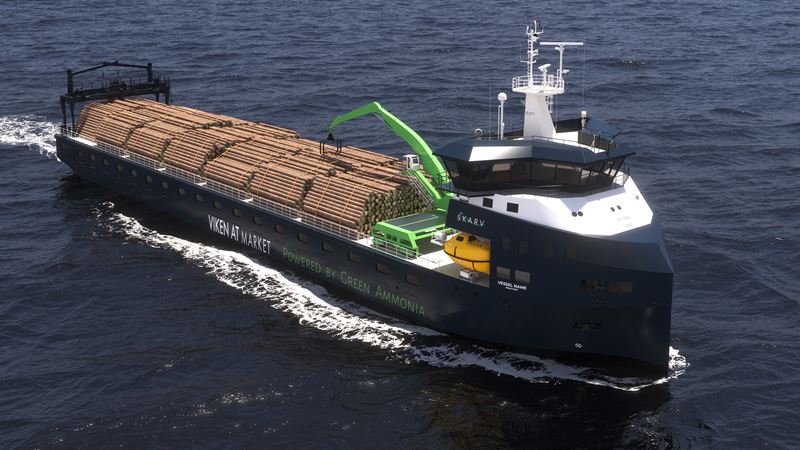
Wärtsilä’s new contract to supply its Wärtsilä 25 Ammonia solution to a cargo vessel for Norway-based Skarv Shipping Solutions represents one of the first commercial-scale steps toward ammonia-powered short-sea shipping in Europe, offering a concrete test of the fuel’s viability in operational conditions.
The vessel, to be built at Huanghai shipyard in China, will be the first newbuild equipped with the Wärtsilä 25 Ammonia engine, alongside the full ammonia fuel gas supply system and exhaust after treatment. The order was booked in the fourth quarter of 2025, with equipment deliveries scheduled to begin in the fourth quarter of 2026. For an industry where alternative fuel projects often remain limited to pilot retrofits or dual fuel readiness, the move signals a shift toward early commercial deployment, albeit at a limited scale.
Ammonia’s appeal lies in its carbon free combustion profile at the point of use and its potential to address the emissions gap left after efficiency measures are exhausted. Wärtsilä’s own analysis, published in its report on sustainable fuels for shipping by 2050, frames ammonia as a necessary complement rather than a standalone solution. Fuel efficiency technologies and operational measures can reduce emissions materially, but sustainable fuels are required to eliminate the majority share. This framing aligns with broader industry assessments that see ammonia as one of several fuels competing for long term adoption, alongside methanol, hydrogen derivatives, and advanced biofuels.
The Wärtsilä 25 Ammonia solution combines a four stroke ammonia engine with the AmmoniaPac Fuel Gas Supply System, the Wärtsilä Ammonia Release Mitigation System, and a selective catalytic reduction system tailored for ammonia combustion. Wärtsilä states that total greenhouse gas emissions can be reduced by at least 90 percent when operating on sustainable ammonia compared with equivalent diesel engines. While this figure reflects well to wake emissions under ideal fuel sourcing assumptions, lifecycle emissions remain highly sensitive to how the ammonia is produced, transported, and stored. Green ammonia supply at scale remains constrained, and price volatility is expected to persist through the 2030s.
Skarv Shipping Solutions positions the project as part of a broader effort to renew the European short sea fleet while reducing its climate impact. Short sea shipping is often cited as a favorable early market for alternative fuels due to predictable routes, centralized bunkering, and regional regulatory pressure from the European Union. However, the commercial case depends on balancing higher capital expenditure and fuel costs against tightening emissions regulations and potential carbon pricing under the EU Emissions Trading System.
From a technical perspective, Wärtsilä’s approach leverages experience from low pressure dual fuel engines running on LNG. This legacy reduces development risk but does not eliminate operational challenges unique to ammonia, including toxicity, combustion stability, and nitrogen oxide control. The inclusion of dedicated release mitigation and after treatment systems underscores that safety and emissions compliance remain core hurdles for ammonia propulsion. These systems add complexity and cost, raising questions about scalability beyond early adopters with strong decarbonization mandates.
The project also illustrates how engine makers are positioning themselves amid regulatory uncertainty. Wärtsilä emphasizes that the solution allows operators to meet current EU emissions targets for 2050 and exceed the IMO’s 2040 ambition. While compliance alignment is critical for shipowners planning assets with multi decade lifetimes, regulatory frameworks for ammonia bunkering, crew training, and port infrastructure are still evolving. Deployment on a single newbuild does not resolve these systemic constraints but provides operational data that regulators and classification societies increasingly demand.