




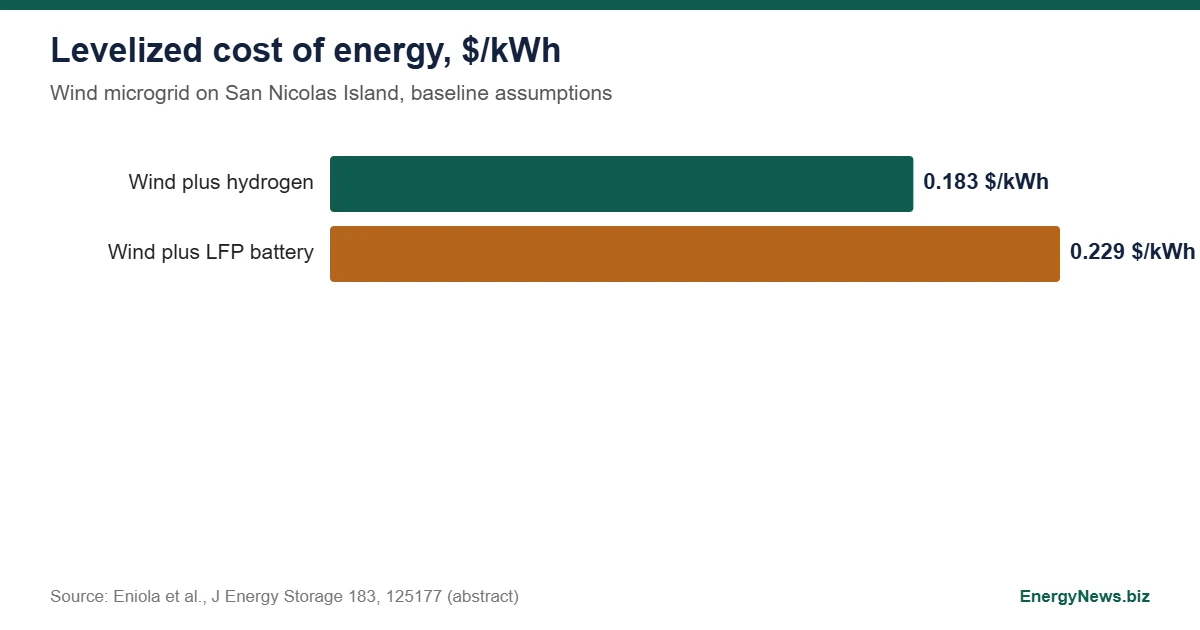
A paper in the Journal of Energy Storage (volume 183, part A, article 125177) compares lithium iron phosphate battery storage and hydrogen storage for a wind microgrid using wind and load data from San Nicolas Island, California. Under baseline assumptions the wind and hydrogen system reaches a levelized cost of energy of $0.183/kWh and the wind and battery system $0.229/kWh. This report rests on the abstract and highlights.
Two systems, one energy management rule
Victor Eniola, Jack Cimorelli, Christopher Niezrecki, Xinfang Jin and David Willis built a physics-based wind and battery model in MATLAB/Simscape and compared it with a previously published wind and hydrogen model under one rule-based energy management scheme. A multi-objective genetic algorithm co-optimises cost and wind curtailment with wind overbuilding, and battery life is estimated by a first-to-failure calendar and cycle criterion.
| Metric | Wind plus hydrogen | Wind plus LFP battery |
|---|---|---|
| Wind curtailment | about 18% | about 28% |
| Capital cost | $9.1 M | $9.6 M |
| Levelized cost of energy | $0.183/kWh | $0.229/kWh |
A cost gap that the abstract qualifies
On these figures the battery system’s levelized cost is about 25% higher and its capital cost about 5.5% higher (ENB calculation from the abstract values). The authors still describe battery storage as attractive when moderate upfront investment is the priority, and as having higher operational efficiency, while hydrogen gives greater economic benefit when high renewable use and low curtailment are required. The abstract does not say where on the cost and curtailment trade-off the battery’s lower upfront cost appears, and the single quoted baseline has hydrogen cheaper on capital as well. That point needs the full text.
The work is funded through a US Department of the Navy award and uses demand data supplied by NAVFAC. The paper: doi 10.1016/j.est.2026.125177. Related microgrid coverage on ENB: microgrid battery optimisation and cost.
Add EnergyNews.biz as a preferred source on Google


