




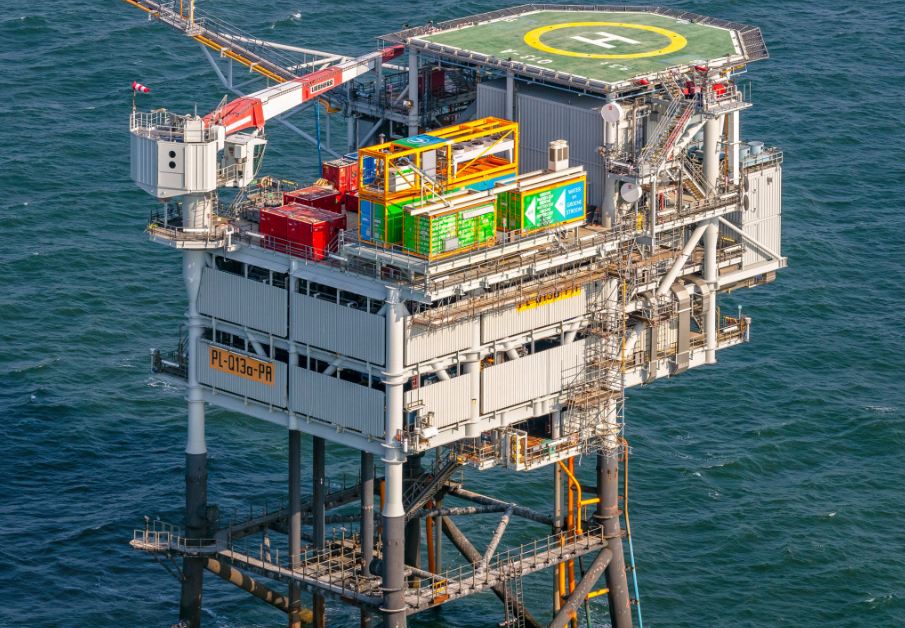
The PosHYdon pilot project has successfully produced green hydrogen on the operational Q13a-A platform off the Dutch coast, marking the first demonstration of hydrogen production integrated with offshore wind power and active natural gas production on a working offshore installation.
The milestone reflects growing interest in using existing offshore infrastructure to support Europe’s hydrogen ambitions while reducing the costs and technical risks associated with entirely new developments. Rather than constructing dedicated offshore hydrogen facilities, PosHYdon explores whether mature oil and gas assets can be repurposed to produce renewable hydrogen using electricity generated by offshore wind farms.
The Q13a-A platform, operated by Eni Energy Netherlands, is located approximately 13 kilometers off the coast of Scheveningen and is the first fully electrified production platform in the Dutch sector of the North Sea. The system converts seawater into demineralized water before feeding it into an electrolyzer powered by offshore wind electricity to produce hydrogen.
While offshore electrolysis has attracted significant attention as a potential solution for transporting renewable energy without requiring additional high voltage transmission cables, few projects have moved beyond conceptual studies. PosHYdon is therefore less significant for the amount of hydrogen it produces than for the operational data it is expected to generate under real offshore conditions.
One of the central questions the project seeks to answer is whether electrolyzers can operate efficiently while responding to the highly variable output of offshore wind generation. Unlike conventional industrial hydrogen production, offshore renewable electricity fluctuates continuously with weather conditions, creating technical challenges for equipment designed to operate efficiently under changing power inputs.
The pilot will initially focus on achieving stable system operation before progressing to tests that evaluate how effectively hydrogen production can respond to variations in offshore wind generation. The project will also generate operational data on maintenance requirements, system reliability, safety procedures, and production costs in a marine environment.
These factors could prove as important as hydrogen output itself. Offshore hydrogen production remains significantly more expensive than conventional hydrogen manufacturing, and uncertainty surrounding installation, maintenance, and equipment durability continues to constrain investment decisions. Demonstrating reliable long term operation could reduce technical risks for larger commercial projects planned later this decade.
The project also reflects the Netherlands’ broader strategy of integrating offshore energy infrastructure rather than developing separate systems for electricity, hydrogen, and natural gas. Existing offshore platforms already possess valuable assets including foundations, pipelines, operational expertise, and established logistics networks. Reusing this infrastructure could reduce development costs while extending the economic value of offshore energy assets as hydrocarbon production gradually declines.
PosHYdon brings together a broad consortium including DEME, EBN, Eneco, Emerson, Gasunie, Hatenboerwater, Investa Expertise Centrum, Iv, Nel, Eni, Nexstep, NGT, Nogat, TAQA, and TNO, with support from the Dutch Ministry of Economic Affairs and Climate Policy. The participation of transmission operators, technology providers, research institutions, and energy companies highlights the cross sector collaboration required to evaluate integrated offshore energy systems.
According to TNO, one of the project’s primary objectives is to reduce uncertainty surrounding future offshore hydrogen deployment. The organization expects practical operational experience to improve understanding of system performance while helping developers better estimate costs and maintenance requirements for commercial scale projects.
The Netherlands has identified offshore hydrogen production as one possible pathway for managing the country’s rapidly expanding offshore wind capacity. As additional wind farms come online, transmitting all generated electricity to shore could require significant investment in new transmission infrastructure. Producing hydrogen offshore offers an alternative by converting renewable electricity into an energy carrier that can potentially be transported through existing gas pipeline networks.
Whether offshore electrolysis ultimately proves commercially competitive remains uncertain. The approach introduces additional complexity compared with conventional onshore hydrogen production, including offshore water treatment, marine equipment maintenance, and more demanding operating conditions. Developers must also demonstrate that the potential savings from reduced electricity transmission infrastructure outweigh the higher costs of offshore installations.