




If you listen to most conference panels, natural hydrogen sounds like a miracle waiting to be monetized. A geological cheat code that will let us skip expensive electrolysers and political headaches. Then the hype cooled, investors left, and the sector was treated like an interesting geological rumour again.
WATCH THE FULL INTERVIEW HERE
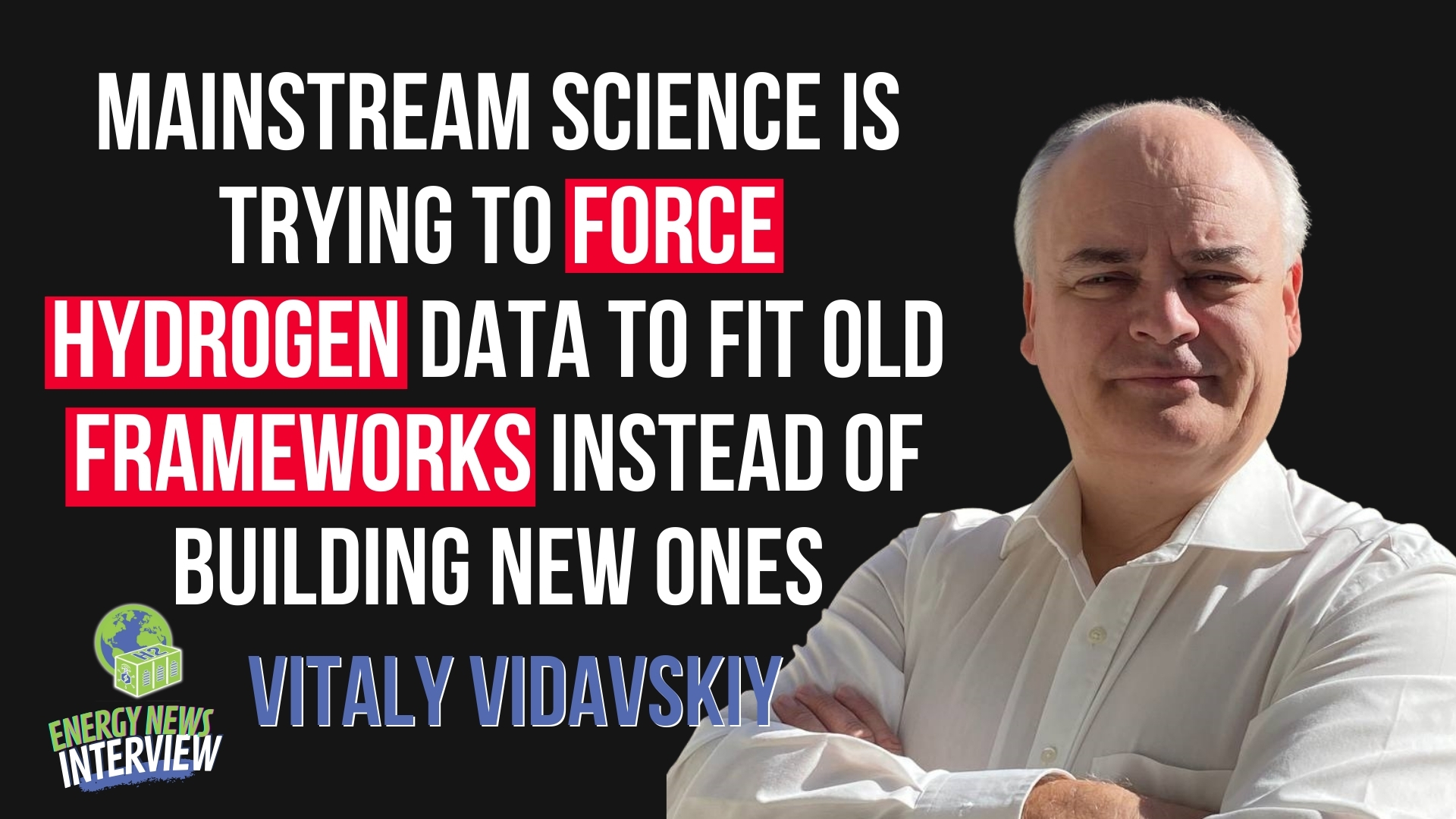
But Vitaly Vidavskiy does not work on rumours. For him, natural hydrogen is neither miracle nor myth. It is a hard confrontation with scientific dogma, outdated exploration models, and investors who want certainty in a world that cannot offer it yet.
Vitaly has lived inside this story for almost four decades. Originally from Moscow, trained in geology and geochemistry, he first learned about natural hydrogen in 1985 when a classmate introduced him to the work of Dr Vladimir Larin. While most researchers were still debating classical crustal processes, Larin was building an entirely different picture of the Earth. One where hydrogen continuously rises from the planet’s deep interior and vents through faults like a planetary heartbeat.
The idea was ignored or mocked for years. Vitaly describes the pattern clearly. A scientist finds data that does not fit the textbook model, approaches senior academics, and is told the same thing in polite language. Stop looking there. There is no answer.
Larin kept looking. He compared the elemental composition of Earth, Moon, Sun, and meteorites. He showed that chemical elements across the solar system are not arranged by solar wind sorting but by first ionisation potential, filtered by magnetic fields. Out of that work came the foundation for today’s hydritic Earth model.
The practical proof arrived decades later. Six years ago, Larin’s team drilled what Vitaly calls the first true designated natural hydrogen well. The HORTE N3 well in Nebraska was drilled with no offset wells, no prior hydrocarbon history, and no inherited datasets. It hit hydrogen at 44 percent, helium at almost 13 percent, and, more importantly, demonstrated a repeatable geological behaviour that mainstream models still cannot fully explain.
Despite this, the industry today sits in an uncomfortable middle zone. Around 110 startups claim to work on natural hydrogen. Roughly 40 wells have been drilled worldwide, mostly in the United States. Some hit high concentrations, some hit nothing, and none have yet demonstrated a commercial flow from open sources.
And that is Vitaly’s point. Not commercial discovery. Commercial flow. A stable, reproducible flux that proves hydrogen is not a one-off curiosity but a long-lived resource.
Vitaly draws a firm line between deposit thinking and dynamic thinking. Most companies treat hydrogen as if it behaves like gas or oil trapped in reservoirs. Land grabbing in Nova Scotia and elsewhere reflects that mindset. But hydrogen is too mobile, too reactive, too small, too volatile. Reservoirs cannot hold it for geologic time. It chews through cap rocks and escapes. Accumulations exist, but only as slowed-down points along conduits. The Mali well proves this. The operators must stop production several times a day to let the tiny reservoir repressurize because the source is a flux coming from below.
Events in Paris and elsewhere show the industry is beginning to admit this. The deposit model is losing credibility. The dynamic model is gaining ground.
Vitaly points to QIMC as one of the few companies pursuing the right target. They openly search for streams instead of deposits. They treat natural hydrogen as a moving system. Their Nova Scotia corridor mapping aligns closely with the hydridic Earth concept. He is careful with confidential data, but he makes no secret of his view that QIMC is among the closest to a possible breakthrough.
Why does the breakthrough matter so much? Because investors are running out of patience. The hype cycle brought attention, but not the commercial validation needed to anchor long-term capital. Meanwhile, AI, real estate, and mining are pulling investment away. From a VC perspective, natural hydrogen is competing with everything, not just other energy forms.
Vitaly is brutally honest about predatory investors or takeover scenarios. A company like Avalio cannot be bought for its physical assets because the value is the model, the interpretation skills, and the decades of cross-disciplinary work. You cannot acquire a concept by buying a shell company. The only future is a genuine collaboration between technical insight and smart capital.
If 2025 to 2027 pass with no clear commercial flow, Vitaly believes the sector must confront reality. If a concept does not work, science moves on. The stationary deposit model is already on life support. The industry will either adopt the dynamic model or fade into a cycle of dry wells and excuses.
Natural hydrogen challenges regulators who cannot decide if it is a mineral or petroleum. It exposes the weaknesses of grant-driven science. It reveals how fragile exploration strategies become when copied from oil and gas without understanding the physics.
It is not a new shale play. It is a stress test of our ability to rethink geology, energy, and risk itself. And that is why Vitaly Vidavskiy’s voice matters more now than at any time in the past fifty years.
Add EnergyNews.biz as a preferred source on Google


