




At this year’s H2MEET, amid the usual claims of “next-gen solutions,” one booth drew a surprising amount of curiosity, not because of bold branding or flashy displays, but because the company behind it insisted they had built something essential that no one else in the market has: a helium purifier designed for cryogenic condensing, paired with a hydrogen compressor capable of reaching 1,000 bar.
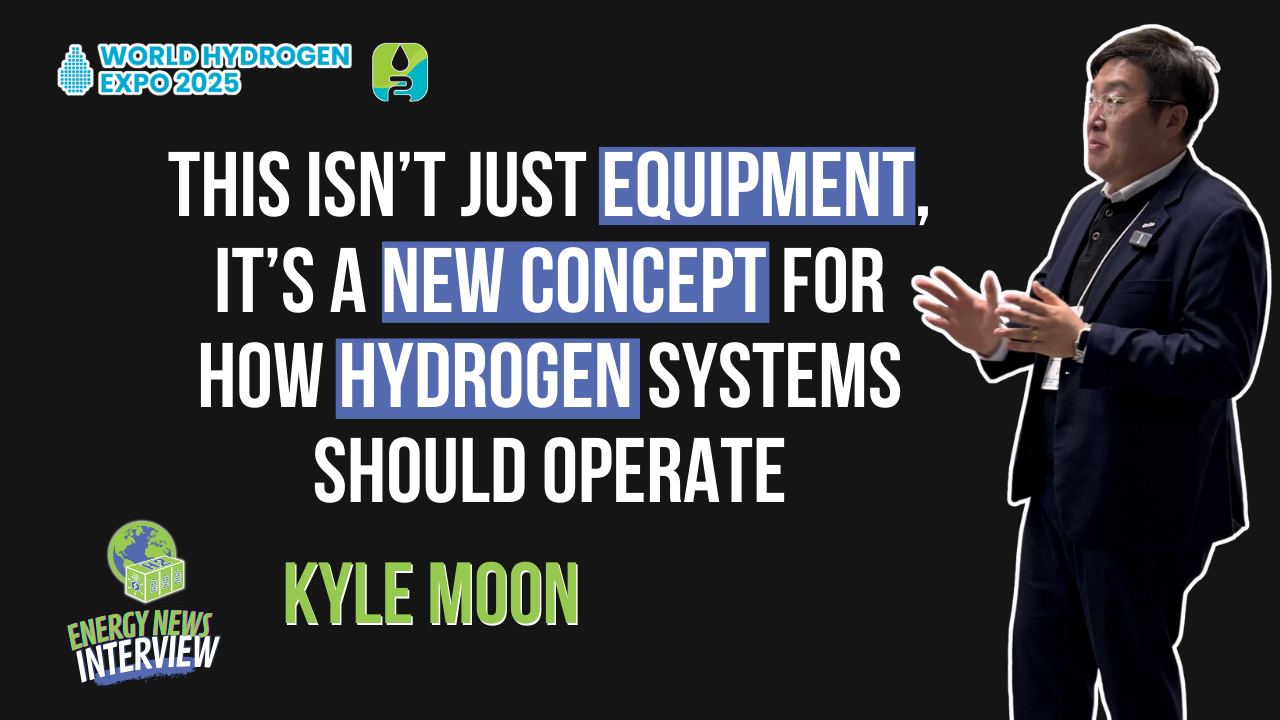
Daeha’s Kyle Moon explained that the company arrived in Korea with a “new concept of equipment,” positioning their helium purifier as a first of its kind. According to Moon, no other player has launched a comparable system on the market. Designed to operate at 30 bar with a 1403 RPM flow rate and 99% purity, the purifier sits at the edge of a new technical niche, one built on rising helium demand and the growing overlap between helium purification and hydrogen infrastructure.
WATCH THE INTERVIEW HERE
But the larger attention-grabber was Daeha’s hydrogen compressor, a 100-horsepower unit that pushes hydrogen to 1,000 bar. For reference, hydrogen refueling stations typically require 700 bar, meaning Daeha’s system targets both charging applications and the higher pressures needed for testing Type IV hydrogen storage vessels. In a market where capacity ceilings have been conservative, the company is trying to position itself as a performance outlier.
Moon was quick to differentiate Daeha’s compressor from competitors, not by invention, compressors are not new tech, but by verification. The system has already undergone testing by a Korean government agency, meeting national hydrogen regulation standards. For buyers, this signals two things: the compressor fits regulatory expectations, and its performance claims have external validation, a rarity in a market where reliability often remains a question mark.
Reliability, in fact, was Moon’s recurring point. Hydrogen compressors require strict maintenance cycles and predictable service intervals. Moon highlighted that Daeha designs the units specifically for easier maintenance, emphasizing that “we cannot operate many, many years” without seal replacement and scheduled servicing, a reminder often glossed over by OEMs eager to emphasize design over operational realities.
When asked about price, Moon declined to give a fixed number, noting that the cost depends heavily on customer specifications. He pointed customers instead toward a customized proposal process. While this is common in the sector, it also signals a market where standardization is still limited, and manufacturers rely on bespoke configurations rather than catalog pricing.


