


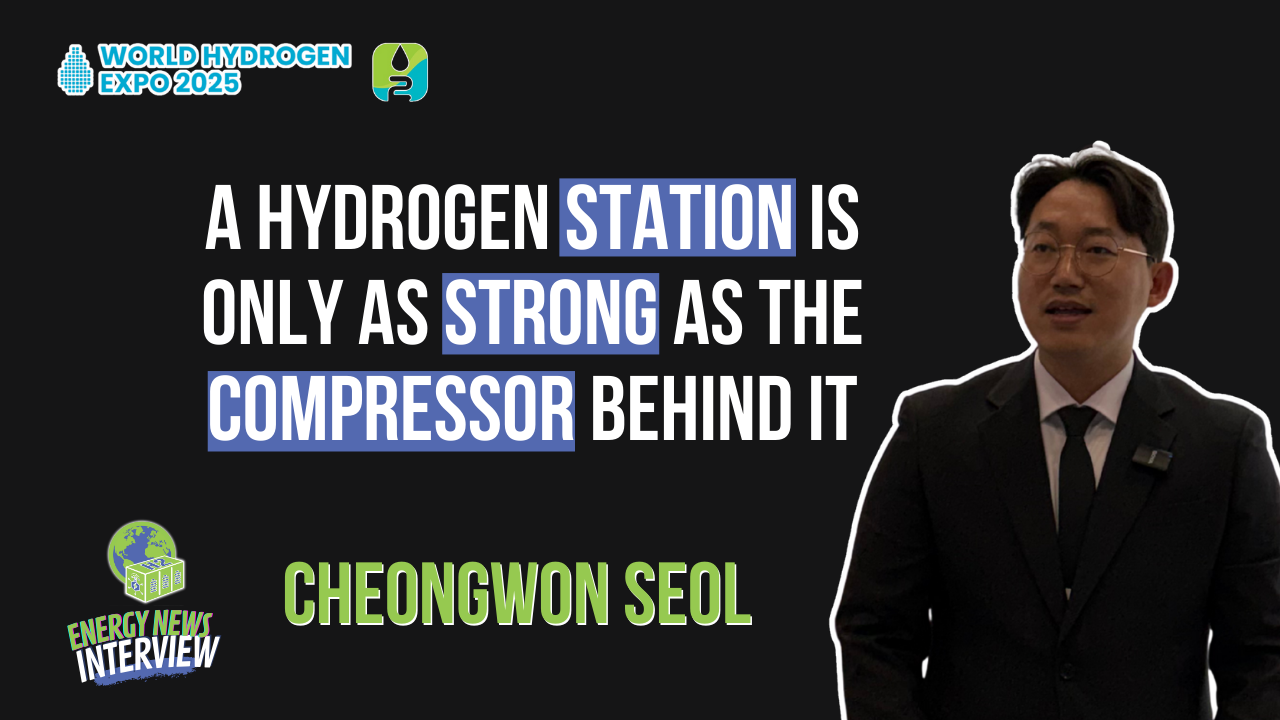


At H2MEET, where innovation claims often outpace proof, Korea GASGEN did not hesitate to position itself as a contender in the hydrogen compression race.
Cheongwon Seol, Korea GASGEN CEO, presented the company’s hydrogen compressor package with confidence that reflects Korea’s broader ambition: dominate domestic infrastructure first, then scale outward.
WATCH THE INTERVIEW HERE
What Korea GASGEN is offering is a piston-type hydrogen compressor, an approach the company argues is both safer and easier to maintain than competing systems. At a time when station downtime remains one of the costliest pain points in the hydrogen ecosystem, “easy maintenance” is not a marketing phrase; it’s an existential requirement.
But Korea GASGEN’s main differentiator, according to Seol, sits in what he calls their “booster technology.” The company claims improved piston balance, upgraded cooling lines, and a more stable package designed for prolonged runtime. In other words, fewer service stops and fewer operational surprises. Considering many compressors globally still struggle with reliability under continuous heavy load, longevity is becoming one of the loudest market demands.
The company is, for now, betting heavily on domestic deployment. Korea’s hydrogen vehicle network is growing, but it remains under pressure to improve resilience and throughput. Korea GASGEN is positioning its solution specifically for hydrogen vehicle refueling, boosting low-pressure hydrogen to the high pressures needed for fueling, directly addressing station bottlenecks.
While the company remains Korea-focused, Korea GASGEN acknowledges rising interest from outside the country. Yet international expansion comes with expectations: traceable performance metrics, third-party certifications, and compatibility with varied regulatory environments. Seol highlighted that the company has obtained the necessary certifications for its technology, though specifics remain to be detailed publicly.


