


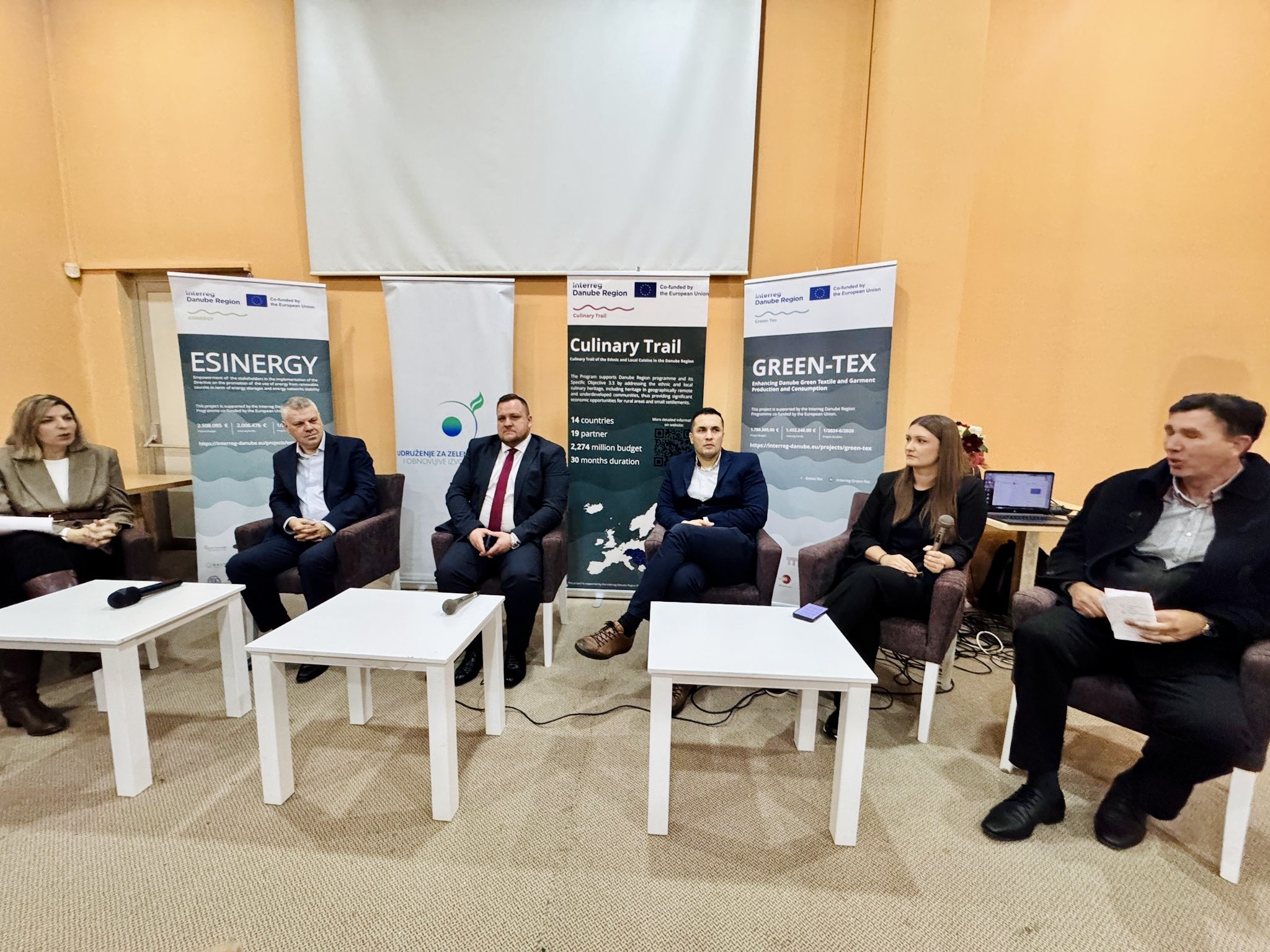


At the Altindag Cultural Center in Visoko, on December 18, a panel discussion titled “Green and Digital Transition of Bosnia and Herzegovina” brought together experts in energy, digitalization, sustainable development, and media.
The event aimed to foster a professional discussion on the challenges and opportunities presented by the green and digital transition in Bosnia and Herzegovina, with a particular focus on local communities.
The panel featured Mustafa Bešić, Director of Mikrografija d.o.o.; Izet Jagodić, engineer at Smart Solar Energy d.o.o. Živinice; Arnes Biogradlija, founder of BASE; Faruk Cerić, Senior Project Manager at SERDA; and Anela Dokso, journalist at EnergyNews.biz. The discussion was moderated by Mersiha Babić, President of the H2OIE Assembly.
The program opened with two expert presentations. Azra Džigal, a sustainable development consultant, spoke on “Economic Effects of the Green and Digital Transition – Challenges and Opportunities,” emphasizing:
“Green and digital transformation represents a key developmental framework for the country, directly impacting economic growth, employment, and the long-term stability of public finances. Investments in digital infrastructure, renewable energy, and education strengthen the competitiveness of the economy, reduce energy dependence, and increase resilience to crises. For companies, green and digital transformation involves shifting business logic from short-term cost reduction to long-term efficiency, innovation, and sustainability. Digitalization of processes, energy efficiency, and investment in employee skills enable higher productivity, easier access to markets and capital, and stronger resilience to market changes. Companies that adapt early to these trends gain a clear competitive advantage,” Džigal highlighted.
Zerina Kukić, a chemistry graduate, presented on “Green Chemistry as the Foundation of the Transition,” stressing that the green transition does not begin only with renewable energy or electrification but much earlier—in the very foundations of production processes.
“Green chemistry entails smarter, cleaner, and more efficient production: reducing waste and harmful chemicals, rational energy and material use, and utilizing renewable resources. It does not mean less industry but rather a modern, competitive, and sustainable industry aligned with European Union market requirements. The key to success lies in the willingness to leave the comfort zone and embrace new technologies promptly, rather than reacting only when changes become obligatory,” Kukić emphasized.
During the panel discussion, the energy system of Bosnia and Herzegovina was highlighted as facing significant challenges due to outdated infrastructure and heavy dependence on fossil fuels. Faruk Cerić stated:
“The energy system of Bosnia and Herzegovina faces major challenges due to outdated infrastructure and high dependence on fossil fuels. Modernization and the application of new technologies are crucial to reducing pollution and ensuring safe and efficient energy supply.”
Speaking on digitalization, Mustafa Bešić noted that Bosnia and Herzegovina has realistic potential to accelerate the transition to a sustainable and technologically advanced economic model.
“It is crucial to link renewable energy projects with digital solutions that increase efficiency and transparency of the system. Green transition is not only an ecological issue but also a developmental opportunity for new jobs and investment. Digitalization of energy systems further enables better resource management and long-term stability, especially in the context of contemporary global political challenges. Panels like this are important as they create space for concrete solutions and cooperation across sectors in Bosnia and Herzegovina,” Bešić added.
Arnes Biogradlija emphasized the importance of holding such events in local communities, stating that their primary goal is to raise public awareness of the green transition and the critical importance of renewable energy.
“We are aware that smaller communities rarely have access to such professional events, even though green energy is of enormous importance for local communities and businesses,” Biogradlija added.
From an engineering perspective, Izet Jagodić stated that the energy transition is not a trend but a necessity. If implemented without a clear technical basis and realistic analysis, it could seriously compromise supply security and lead to rising costs for citizens and businesses. He stressed that engineers must play an active role in planning and decision-making to ensure a stable and affordable transition.
As a conclusion to the panel, Anela Dokso, journalist at EnergyNews.biz, noted that the discussion on “Green and Digital Transition of BiH” in Visoko was substantive and valuable, providing numerous concrete insights into the real state and challenges of energy transition in Bosnia and Herzegovina.
“The discussion openly addressed the strong dependence on fossil fuels, as well as the clear opportunities Bosnia and Herzegovina has through renewable energy, grid modernization, and digitalization of the energy system. It was clear that the green transition in BiH will not be possible without parallel digital transformation, a stable regulatory framework, significant investments, and a just transition for communities dependent on coal. If BiH wants to keep pace with European energy and climate goals, it must act more decisively and quickly, integrating energy policy, industrial development, and digital technologies into a unified, long-term sustainable approach,” Dokso emphasized.
The panel discussion in Visoko confirmed that the green and digital transition represents not only an ecological imperative but also a development opportunity for Bosnia and Herzegovina, requiring a coordinated, expert, and long-term sustainable approach.
Partners of the panel included SmartPR, Mikrografija d.o.o., SMART SOLAR Smart Energy – Solar d.o.o. Živinice, BASE, Vareški Minerali d.o.o., Green Sustainable Solutions d.o.o., ENERGY NEWS, ITII, MultiLAB, 1, 2, 3 CHANGE Digital Path, and the Association for Green Hydrogen and Renewable Energy.
Add EnergyNews.biz as a preferred source on Google


