


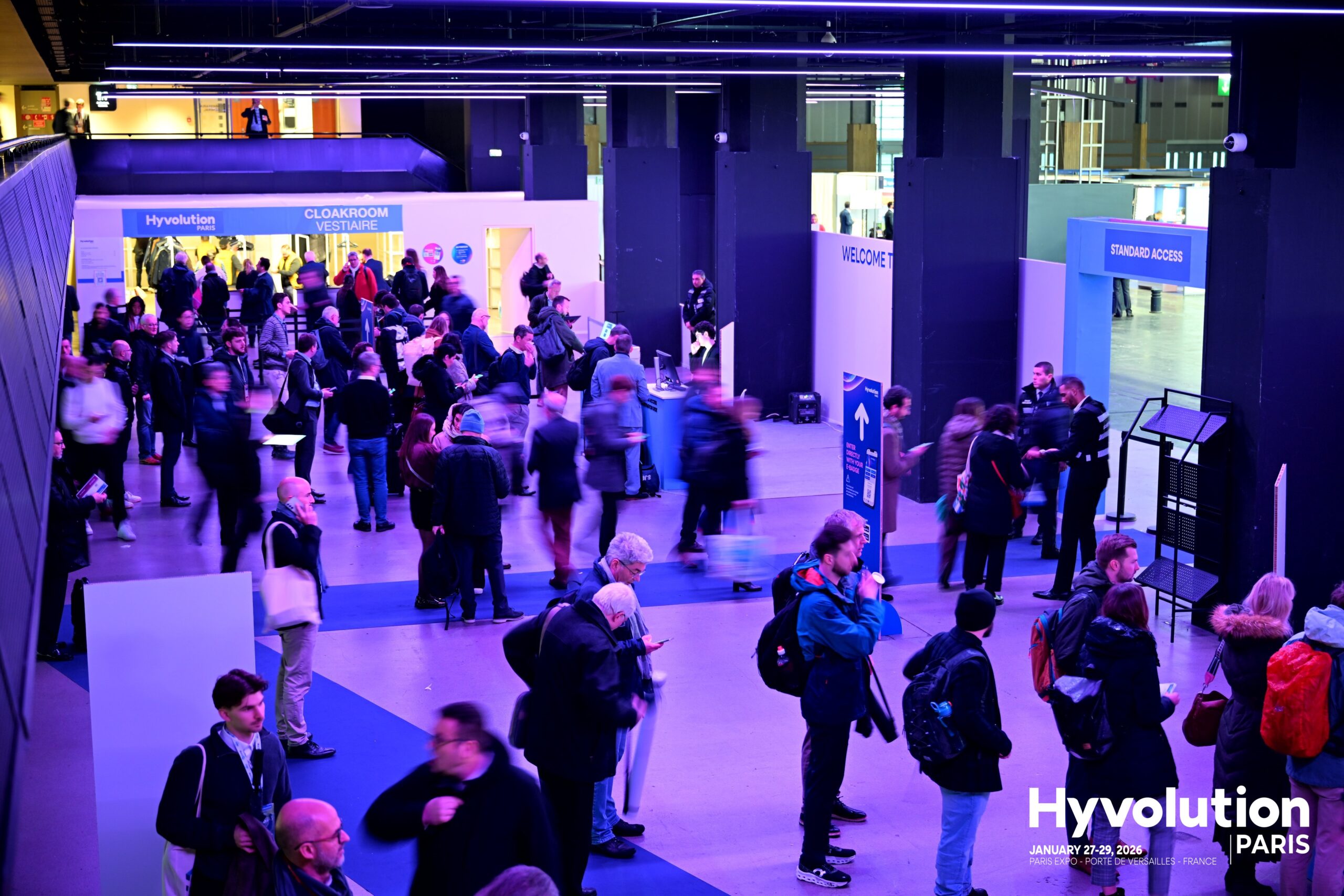


By early 2026, Europe’s hydrogen sector had reached an inflection point. Project pipelines remained large on paper, but financing constraints, demand uncertainty, and delayed offtake agreements were forcing a reckoning across the value chain. Hyvolution 2026 in Paris offered a clearer signal of where the market is actually heading.
Attendance data and agenda design pointed less toward hype and more toward implementation, with nearly 12,100 professionals gathering at Paris Expo Porte de Versailles from January 27 to 29, primarily to discuss projects already in deployment rather than aspirational concepts.
The composition of participants underscored this transition. With 400 exhibitors and brands from 65 countries, and 40 percent of exhibitors coming from outside France, the event reflected a hydrogen market undergoing consolidation rather than rapid expansion. Industrial players, energy companies, infrastructure providers, and financial institutions dominated discussions, suggesting that speculative entrants are giving way to actors capable of executing under tighter capital conditions. Roughly 30 percent of visitors were international, reinforcing Hyvolution’s positioning as a business forum rather than a national policy showcase.
This maturity shift was evident in how hydrogen was framed. Rather than positioning hydrogen as a universal decarbonization solution, the program focused narrowly on use cases where electrification remains impractical. Heavy industry, heavy mobility, and e fuels emerged as priority sectors, reflecting both technical constraints and evolving policy incentives. French policymakers echoed this pragmatism. Jean Luc Fugit, President of France’s Higher Energy Council, emphasized hydrogen’s role in industrial decarbonization and heavy transport, implicitly acknowledging that broader applications remain economically challenging without sustained public support.
Financing dominated the underlying narrative. Multiple sessions addressed capital structuring, risk allocation, and bankability, an implicit response to stalled final investment decisions across Europe. The presence of major financial institutions and development banks signaled that capital is still available, but increasingly conditional on credible offtake, integrated infrastructure planning, and realistic cost assumptions. Hydrogen projects are now being evaluated alongside competing decarbonization options, rather than treated as standalone transition imperatives.
Storage infrastructure surfaced as a critical bottleneck and opportunity. Industry feedback highlighted that hydrogen production capacity alone is insufficient without parallel investment in storage and logistics. This was reflected both on the exhibition floor and in conference programming, where discussions increasingly linked storage economics to grid flexibility, industrial resilience, and seasonal balancing. Vallourec’s Delphy division noted that storage has become central to commercial discussions, indicating that project developers are moving beyond electrolyzer capacity targets toward system level optimization.
International participation further illustrated diverging regional strategies. Delegations from Brazil, Canada, and Germany used the event to benchmark policy frameworks and industrial readiness, while interest from emerging hydrogen exporters highlighted growing competition for future demand centers. This internationalization aligns with Hyvolution’s broader expansion strategy, with editions planned in Brazil, Chile, and Canada in 2026, and an Asian edition under evaluation. The Paris event remains the anchor, but the brand’s geographic diversification mirrors a hydrogen market that is fragmenting into regional supply demand clusters rather than converging into a single global market.
Operational depth also differentiated the 2026 edition. More than 240 speakers across main stages, workshops, and masterclasses focused on deployment challenges, regulatory alignment, and industrial scaling. The emphasis on feedback from existing projects suggested a recognition that early hydrogen rollouts have been slower and more expensive than initially forecast. This realism, rather than dampening interest, appeared to recalibrate expectations toward achievable timelines and narrower but more defensible business cases.
Hyvolution’s evolution reflects broader structural changes in the hydrogen economy. As public subsidies face greater scrutiny and private capital demands clearer returns, platforms that prioritize execution over advocacy are becoming more relevant. The collaboration with France Hydrogène reinforced this role, aligning industry representation with policy dialogue and regional deployment efforts across France’s 15 regional hydrogen delegations.
By centering financing, infrastructure readiness, and prioritized use cases, Hyvolution 2026 illustrated how the hydrogen sector is adjusting to a less forgiving market environment. The shift was not away from hydrogen itself, but toward a more disciplined industrial strategy where viability, rather than volume, defines progress.
Add EnergyNews.biz as a preferred source on Google


