


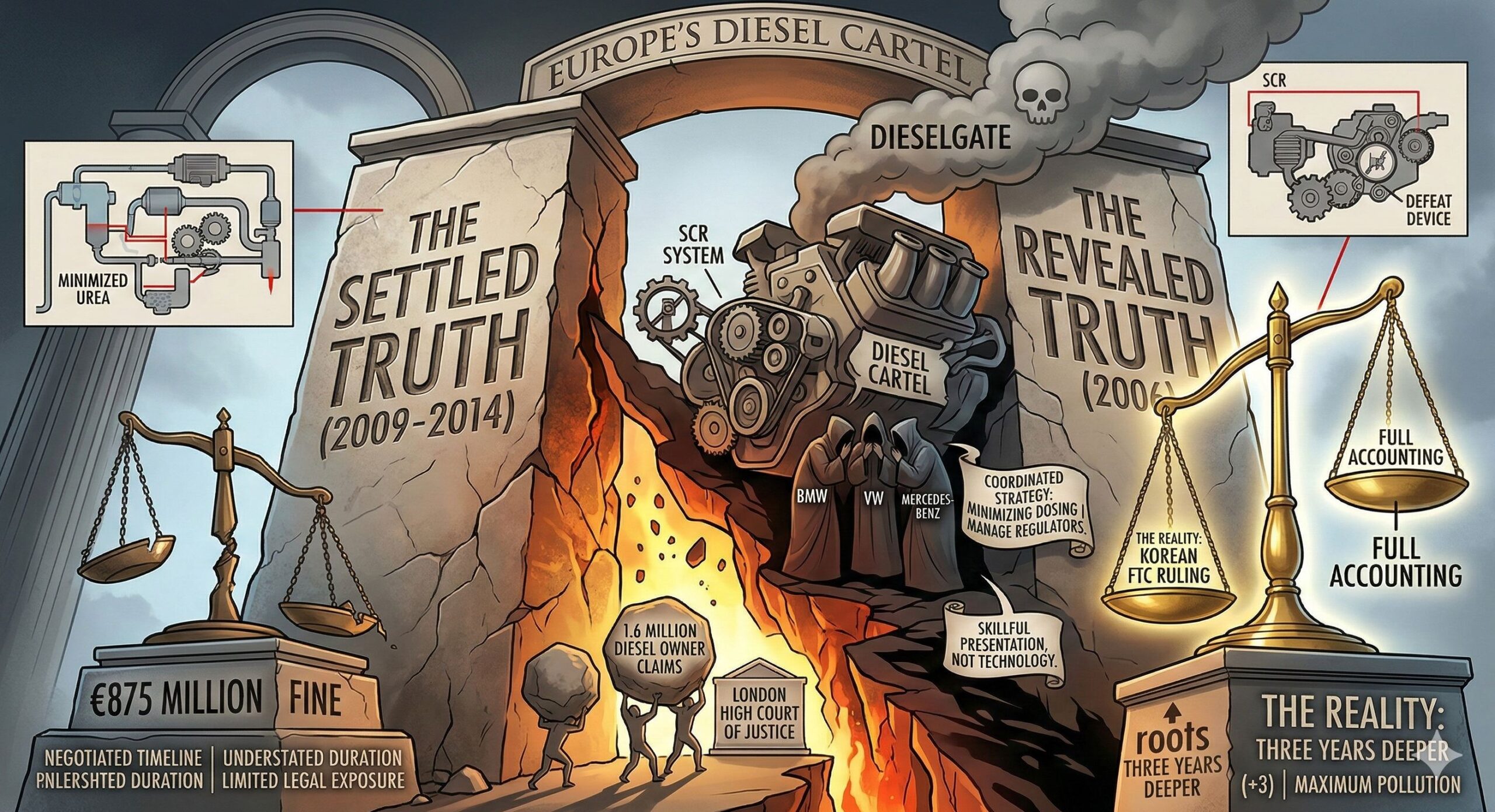


When the European Commission settled its emissions cartel case against BMW, Volkswagen, and DaimlerChrysler in 2021, the €875 million fine was calibrated against a defined window of illegal coordination: 2009 to 2014. That timeline, it now appears, may have been a negotiated convenience rather than an accurate historical record.
Internal emails filed as evidence in ongoing litigation at London’s High Court of Justice, and reviewed by Follow the Money, show the same carmakers exchanging strikingly coordinated communications about diesel emissions technology as early as October 2006, the precise starting point the Commission originally suspected but ultimately said it could not prove. The gap between what regulators suspected and what they settled for is not merely a procedural footnote. It shaped the scale of the fines, the legal exposure of the companies, and the public accounting of how long European consumers drove vehicles designed to emit more toxic nitrogen oxides than the technology permitted.
The central technology under discussion was Selective Catalytic Reduction, a system that injects urea into exhaust gases to neutralize nitrogen oxide emissions. The engineering tension was real: fitting an adequately sized urea tank into compact vehicles popular in European urban markets posed genuine design challenges, and smaller tanks demanded more frequent refilling, which manufacturers believed would depress consumer demand. What the emails reveal, however, is that the response to this tension was not independent engineering judgment by competing firms. It was a coordinated strategy aimed at minimizing dosing levels while managing how that decision would be communicated to American and European regulators.
One email is particularly direct. It states that while all parties wanted a limitation on urea dosing because of tank size constraints, “no one wants to report the true motivation of this limitation of HWL dosing to the authorities.” The authorities named were the California Air Resources Board and the Environmental Protection Agency, the same agencies that nine years later exposed Volkswagen’s defeat device fraud in what became known as Dieselgate. A separate Volkswagen message from the same month noted that “everyone has reaffirmed that a solo effort at this point is to everyone’s disadvantage,” the language of market collusion rather than technical collaboration.
The framing across multiple emails is notable for how explicitly it treats regulatory communication as a strategic rather than a compliance exercise. One message described the challenge as “ultimately not a question of technology, but about the most skilful presentation possible to the authorities.” A BMW engineer acknowledged in November 2006 that he was mentally preparing for close regulatory scrutiny of the new system. An internal DaimlerChrysler summary noted that despite disagreements on specifics, there was consensus that “a uniform solution must be found, especially because of the communication with the authorities.”
The Commission’s decision to settle in 2021, rather than litigate the question of when the cartel began, reflects the structural pressures of EU competition enforcement. Settlements conserve institutional resources and guarantee a fine, but they transfer significant negotiating leverage to the defendants. Jan Blockx, assistant professor of European economic law at the University of Antwerp and a former competition lawyer, noted that the companies had strong incentives to resist any admission of pre-2009 coordination, and that the Commission faced real risk if it pursued an appeal before the Court of Justice. The outcome was an agreed timeline that may have understated the cartel’s duration by three years.
The Korean Fair Trade Commission, adjudicating the same conduct involving the same parties, reached a different conclusion two years after the EU settlement, ruling that the infringement began in 2006. That divergence illustrates how settlement-based enforcement, increasingly standard in EU competition law, can produce different historical records than adversarial proceedings, with direct consequences for fine calculations, civil litigation exposure, and the broader public record.
The London High Court case that surfaced these documents is itself substantial. Five carmakers face claims brought on behalf of approximately 1.6 million diesel vehicle owners alleging that their cars contained illegal defeat device software. The case does not re-litigate the existence of the cartel, which the EU decision established, but the evidentiary record being assembled around it is producing disclosures that regulators either did not access or chose not to pursue. Bosch, whose correspondence with the carmakers about SCR technology is also included in the document release, was not fined or accused of cartel participation in the Commission’s proceedings.
Mercedes-Benz, the successor to DaimlerChrysler, stated it cooperated extensively with the Commission investigation but declined to address the specific time period or the emails. Volkswagen declined to comment. BMW characterized the 2021 Commission decision as the matter’s conclusion. None of the three responses engaged with the substance of the 2006 correspondence.
The broader pattern here extends beyond a dispute over dates. The defeat device scandal that erupted in 2015 was, in regulatory terms, a discovery failure spanning more than a decade. The same manufacturers who were coordinating their approach to emissions regulators in 2006 were still operating defeat devices when U.S. authorities finally detected them in 2015. The internal candor visible in these emails, including explicit acknowledgment that true motivations could not be disclosed to regulators, suggests that the gap between what these companies reported and what they did was structural, not incidental.
Add EnergyNews.biz as a preferred source on Google


